EPF subscribers withdrawing savings before completing five years of continuous service must now use Form 121 instead of Forms 15G and 15H to claim TDS exemption from tax year 2026-27 onwards, according to the Employees' Provident Fund Organisation (EPFO). The change follows the introduction of the Income-tax Act, 2025, and Income-tax Rules, 2026. Form 121 allows eligible taxpayers to declare that their estimated tax liability for the relevant tax year is nil, but submitting the form does not automatically make every EPF withdrawal tax-free. TDS applies when withdrawal exceeds ₹50,000 at a rate of 10% where the employee furnishes a valid Permanent Account Number (PAN). Subscribers must meet applicable eligibility conditions and check their total estimated income, withdrawal amount, service period, and estimated annual income before filing the new declaration to avoid unexpected tax deductions.
The Cabinet has increased the EPF wage ceiling to ₹25,000, expanding coverage for 51 lakh employees. According to reports from Mint, this change, the first in 12 years, raises employer contributions and enhances pension benefits for long-term subscribers, impacting total accumulated corpus. Union Information and Broadcasting Minister Ashwini Vaishnaw stated that the hike seeks to "reflect sustained wage growth, rising incomes and continued expansion of formal employment over the intervening years." The wage ceiling eligibility for Employees Provident Fund (EPF) coverage was raised by ₹10,000, increasing from the ₹15,000 set in 2014. As per Economic Times, the hike represents a 66.67% increase in the EPFO wage ceiling. EPFO currently has about 30 crore subscribers, including around 7.5 crore contributing members, with its total fund close to ₹26 lakh crore, according to Moneycontrol sources.
For employees earning ₹20,000 monthly, the wage ceiling change significantly impacts retirement savings. Under the revised framework, the employee contribution increases to ₹2,400 (12% × ₹20,000) from the previous ₹1,800 (12% × ₹15,000), resulting in an additional deduction of ₹600 monthly. The employer's matching contribution also increases to ₹2,400, but ₹1,666 goes to the Employees' Pension Scheme (EPS) while ₹734 goes to EPF. This compares to the old system where only ₹2,350 total went to retirement savings. The total monthly social security contribution now reaches ₹4,800, with the higher wage ceiling bringing more workers under mandatory coverage.
The UPI withdrawal facility testing comes as 55.49 crore registered UPI users increasingly rely on digital payments, according to government data. Integrating UPI with EPFO withdrawals would facilitate a smoother process for many subscribers who are already active UPI users. However, the new UPI feature does not change existing withdrawal conditions. Members may still withdraw up to 75% of total corpus subject to applicable conditions, with the remaining 25% required to stay in the account to ensure long-term investment continuity. The EPFO has specified categories of needs for which withdrawals can be made, including marriage, education, and house-related expenses. The latest development coincides with select UPI transactions including Merchant Discount Rates (MDR) from October 15, 2026, as introduced by the National Payments Corporation of India (NPCI), though person-to-person payments remain free.
For employees whose EPF contribution was earlier restricted to the ₹15,000 ceiling, the employee contribution can increase significantly. As reported by Mint, the earlier employee contribution was ₹1,800/month (12% × ₹15,000), while the new contribution will be ₹3,000/month (12% × ₹25,000), resulting in an additional deduction of ₹1,200/month from salary. The potential annual reduction in take-home pay could be ₹14,400, though the actual impact depends on employer salary structures and PF contribution calculations. The employer's statutory contribution in such cases would also increase from ₹1,800 to ₹3,000. However, take-home pay depends on the salary structure and how employers calculate contributions.
The EPFO issued a comprehensive security advisory on October 7, 2026, urging members to protect personal and financial information from cyber threats. According to Mint, the retirement fund body advised members to "strictly follow guidelines" to safeguard against common cybersecurity frauds. Key recommendations include always visiting only official EPFO websites (epfindia.gov.in, epfo.gov.in, unifiedportal-mem.epfindia.gov.in), never clicking on unverified web links, and never sharing sensitive data including UAN, passwords, OTP, Aadhaar, PAN, or bank details with anyone. The EPFO emphasized that it does not ask for personal details or login credentials through phone calls, WhatsApp, SMS, social media, or email. Members are advised to verify URLs carefully, report suspicious websites or phishing attempts to official helpdesk channels, and follow the organization's official social media handles across X, YouTube, Instagram, Facebook, and LinkedIn.
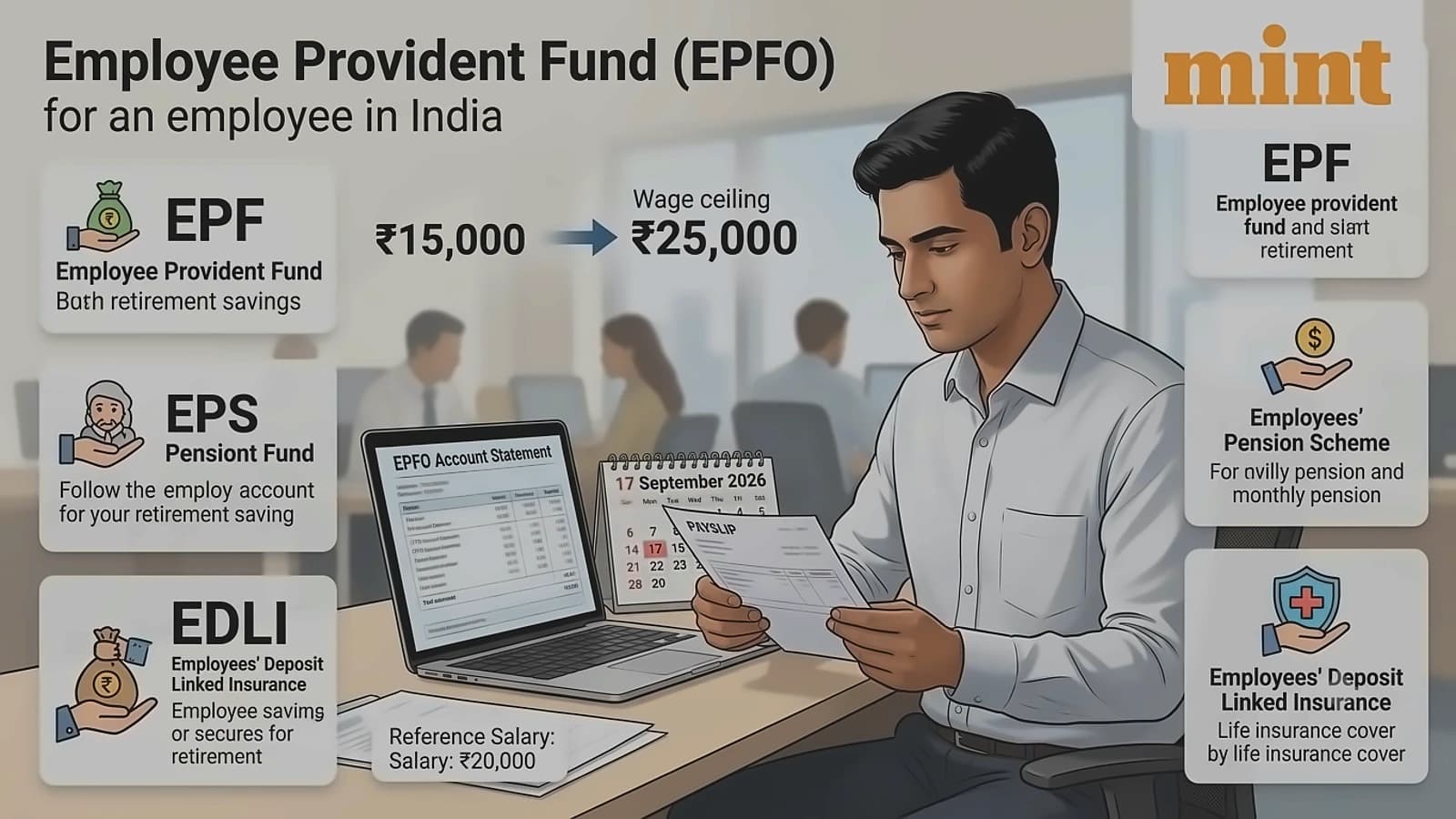
The wage ceiling hike brings an additional 51 lakh employees under mandatory provident fund cover, widening social security coverage for workers. According to Mint, the EPFO currently has around 7.98 crore contributing members across about 7.68 lakh contributing establishments, while the EPS provides pension benefits to around 82 lakh pensioners. The EPFO also administers pension under the Employees' Pension Scheme (EPS) and insurance protection under the Employees' Deposit Linked Insurance Scheme (EDLI), with benefits under these heads also likely to be enhanced. As per Economic Times, the wage ceiling hike is expected to enhance retirement savings and social security coverage for employees.