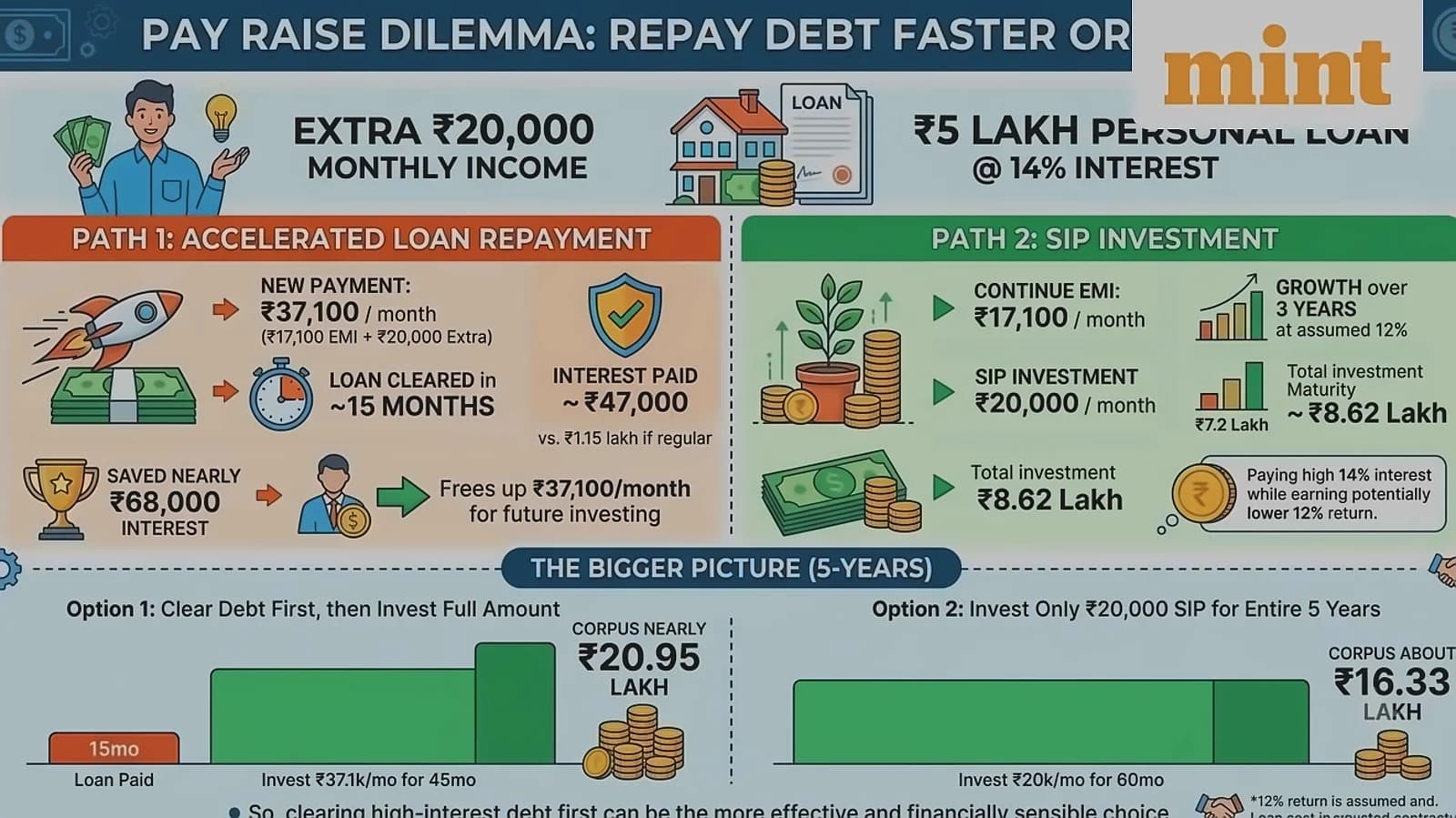
Financial experts recommend comparing loan costs against potential investment returns before making windfall decisions. According to reports from The Economic Times, if a home loan charges 9% annual interest and a mutual fund is expected to deliver 10% post-tax returns, the math favors investing over prepayment. However, the scenario changes dramatically when loan rates exceed expected returns. A personal loan at 14% is typically very difficult for most fixed-income investments to beat, making prepayment the preferred option. For practical applications, lump-sum prepayments using annual bonuses can be highly effective. As per Mint, on a ₹30 lakh loan at ~8.75%, a ₹2 lakh annual prepayment can cut 4-6 years off a 20-year tenure and save ₹8-12 lakh in interest. The Rule of 78 method adds complexity to these calculations, as it front-loads interest payments to favor lenders, making early prepayment potentially more costly than simple interest loans for shorter-term loans.
A critical factor often overlooked is that home loans on self-occupied properties do more than just charge interest. As reported by The Economic Times, every EMI payment builds ownership in an asset, making prepayment not a simple comparison with investment returns. This asset-building component creates a different financial dynamic that must be considered alongside traditional interest cost calculations. Additionally, if this loan is towards your self-occupied house, you are building equity in the property as you repay your loan, in addition to investing the unexpected cash flow. Some risk-takers may even choose to invest the cash flow in derivatives to increase returns, though this approach amplifies both gains and losses. The Rule of 78 method particularly impacts asset building, as borrowers pay more interest earlier in the loan cycle, reducing potential savings if prepaid early.
Financial planners acknowledge that emotional considerations play a legitimate role in financial decision-making. According to The Economic Times, many people feel calmer once loans are cleared from their books, even if the numbers suggest otherwise. Financial experts broadly agree that emotional well-being is part of financial health, and decisions that improve sleep quality can still be optimal for individual situations despite being suboptimal on paper. Recent analysis confirms that for most people, the sooner they pay off a loan, the less anxious they feel, making prepayment emotionally optimal in such cases. However, the Rule of 78 method may complicate emotional satisfaction, as borrowers pay more interest earlier in the loan cycle, potentially reducing the immediate gratification of loan clearing.
For most salaried homeowners, bonuses are the single most powerful but under-utilised tool for reducing long-term interest costs. As reported by Mint, unlike monthly income, bonuses arrive as discretionary surplus, creating strategic choices between lump-sum prepayments or permanent EMI increases. In a typical 20-year home loan, more than 55-60% of total interest is paid in the first half of the tenure, making early period principal reduction disproportionately valuable. Lump-sum payments directly reduce outstanding principal with interest savings compounding over remaining tenure, while floating-rate home loans typically allow penalty-free prepayments. Alternatively, converting a ₹2 lakh bonus into EMI enhancement equates to roughly ₹16,500 extra per month, offering steady acceleration but reducing monthly cash flow flexibility. Financial institutions usually reduce tenure, not EMI when prepayments are made, making lump-sum approaches extremely efficient for borrowers seeking to compress long-term liabilities.

Financial experts caution against using windfall money for high-risk speculative investments without proper preparation. According to The Economic Times, while technically possible to earn higher returns through derivatives or high-risk instruments, these approaches amplify both gains and losses. Experts recommend avoiding speculative bets with debt-backed or lump-sum money unless borrowers have a strong risk appetite and adequate financial cushion elsewhere. The Rule of 78 method further complicates risk management, as it front-loads interest payments, making early prepayment more expensive and potentially increasing borrower risk exposure. The decision between prepaying a loan and investing the cash is one of many trade-offs we must make, and unfortunately, we often yield to our emotions which can bias decisions. Therefore, prepaying a loan with unexpected cash may be optimal from an emotional perspective, even if it's not economically meaningful.