A Supreme Court advocate has provided crucial clarification on joint home loan obligations after a co-borrower's death. Amitraj Kaushal, Advocate, Supreme Court of India, explained that in most joint home loans, both borrowers sign on as 'joint and several' obligors, meaning the entire responsibility for remaining EMIs falls on the surviving borrower by default. As reported by Mint, Kaushal noted that it doesn't matter who was actually paying more of the EMI while both were alive - the bank cares about recovering its money, and the loan agreement usually covers this scenario. This clarification addresses a common misconception where families assume that continuing to pay EMIs automatically grants full ownership of the house.
The most critical misunderstanding occurs when families assume paying off the loan automatically makes them the owner of the entire property. As Kaushal explained to Mint, ownership follows the title deed, not the loan repayment. If two siblings jointly took a home loan and one dies, the surviving sibling is liable to repay the outstanding loan, while the deceased sibling's share of the property could pass to their spouse, children, or other legal heirs depending on applicable succession law or will. For example, if a couple takes a ₹60 lakh joint home loan and ₹42 lakh remains outstanding when one borrower dies, the surviving co-borrower does not become liable for only ₹21 lakh - they remain responsible for the full ₹42 lakh while the deceased borrower's legal heirs inherit their share of the property. This creates a genuinely tricky situation where the surviving borrower could end up paying the entire loan for a house where someone else legally owns a chunk of it.
Credit-linked life insurance or home-loan protection policies can substantially reduce financial pressure on surviving borrowers, according to Mint reports. Rohan Shah, national credit head of Easy Home Finance Limited, provided an example of a couple borrowing ₹50 lakh under a reducing-cover plan, where an eligible insurance payout could be used to clear the outstanding amount, leaving the surviving borrower with the house free of that debt. However, experts caution against assuming that every joint home loan is fully insured. Shah gave an example of a ₹50 lakh joint loan where each borrower has 50% cover, if the outstanding balance reaches ₹42 lakh but the deceased borrower's cover has reduced to ₹20 lakh, the insurer could pay only ₹20 lakh towards the loan, leaving ₹22 lakh for the surviving borrower to deal with. Shah advised that anyone taking a joint loan should ask specifically whether the policy is joint-life or single-life, and whether coverage is proportionate or full value on either borrower's death. Coverage can also be lower than the outstanding loan if only one borrower is insured and the uninsured borrower dies, or if the cover is inadequate or has expired before the loan ends.
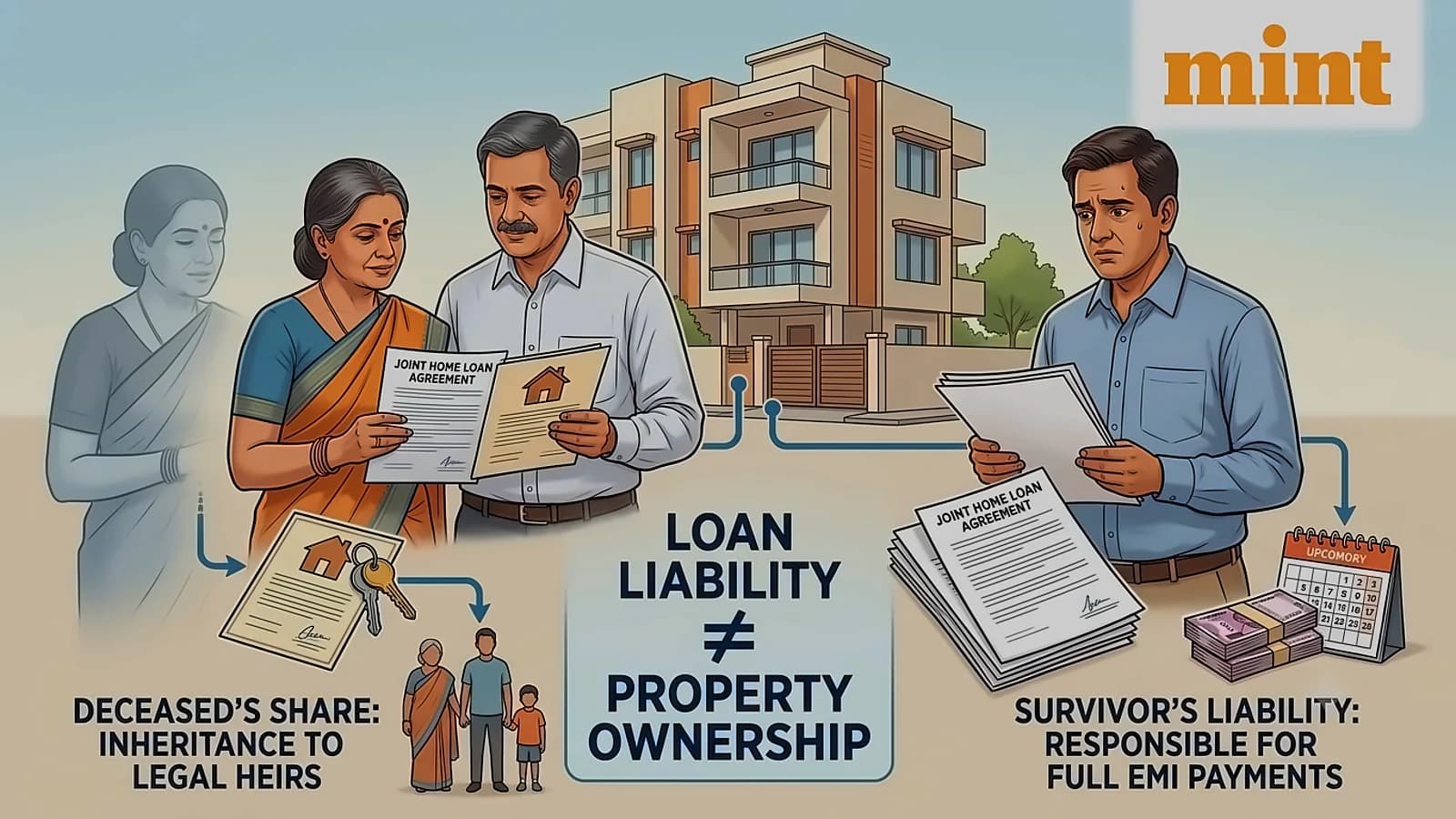
Families should not stop paying EMIs simply because an insurance claim is being processed, as reported by Mint. Kaushal recommends that borrowers get a clear co-ownership agreement in writing at the time of taking the loan, including what happens to each person's share if one dies. The family should simultaneously check for any loan-protection policy and initiate the claim. Monga recommended that families should promptly notify the lender and insurer and submit the death certificate and required claim documents. Shah also suggested shifting auto-debit arrangements to an account that the surviving borrower can actively fund to avoid missed EMI payments during the transition. If the surviving borrower defaults, the bank doesn't just walk away - the bank can recover dues from the deceased borrower's estate as well, since the estate typically remains liable for outstanding debts unless it's been fully distributed. The central point remains that a co-borrower's death changes the people involved in a home loan, but it does not automatically erase the debt.
The immediate priority should be to establish four key factors, according to Mint recommendations. Families must identify who is the borrower, check the loan agreement and repayment obligations. They must determine who owns the property by reviewing the title deed and ownership records. The insurance coverage must be verified by checking the insurance certificate, sum assured and coverage structure. Finally, families should review the Will and applicable succession documents to understand who inherits the deceased borrower's share. Kaushal recommends that borrowers consider making a will to clearly specify who should inherit the property and ideally take a joint home loan with someone they are comfortable eventually passing the property to. Once the loan is fully settled, families should obtain the no-dues confirmation, release of the mortgage and original title documents. As Kaushal suggests, families should separately ask: who owes the lender, who owns the property and what security does the lender hold? Those three answers can be different, and the distinction becomes particularly important when the person repaying the loan does not own the property.