The Income Tax department has notified all income tax return (ITR) forms for assessment year 2026-27 (FY 2025-26) and enabled excel utility for the ITR-1 and ITR-4 forms, allowing taxpayers to prepare their tax returns offline and later upload them digitally. According to reports from Mint, each ITR form is designed for specific categories of taxpayers, with the ITR-1 (Sahaj) applicable for individuals with income up to ₹50 lakh covering income from salary, one house property, and other sources. The ITR-2 is for individuals/HUFs not having income from business or profession with income from capital gains, multiple house properties, etc. The ITR-3 covers individuals/HUFs having income from a proprietary business or profession from business, profession, and other sources. The ITR-4 (Sugam) applies to individuals, HUFs, and firms with presumptive income under Section 44AD/44ADA/44AE. ITR-5 is for partnership firms, LLPs, applicable for firms, AOPs, BOIs, while ITR-6 covers companies other than those claiming exemption, and ITR-7 applies to trusts, political parties, and other organizations required to file returns under various sections.

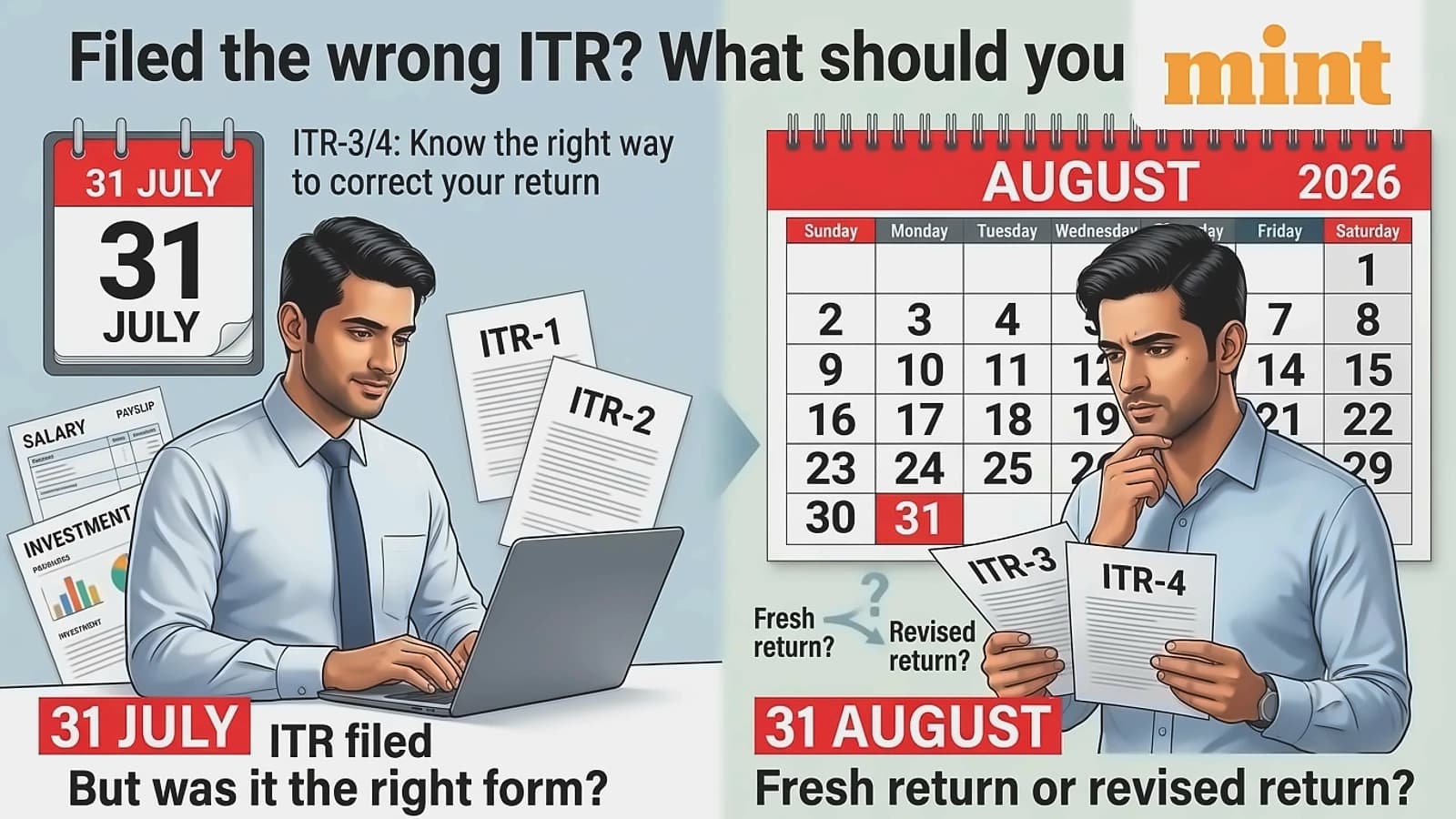
In case of incorrect ITR form filing, the Income Tax Department may treat the return as defective under Section 139(9) and issue a notice requiring correction within a specified timeframe. As reported by Mint, taxpayers are generally given 15 days to correct defects after receiving a notice from the department. If the highlighted defect is not rectified within the prescribed time, the return may be treated as invalid, as if no return was filed at all. In cases involving under-reporting or misreporting of income, matters may later be picked up in scrutiny proceedings, which may lead to additional tax, interest, and penalties. Filing the wrong ITR form can lead to serious consequences, as exemplified by scenarios where taxpayers with business income filed simpler forms meant for salaried taxpayers, or those with multiple properties used ITR-1 instead of ITR-2.
According to Gaurav Makhijani, Managing Partner at MGA, taxpayers can correct genuine mistakes by filing a revised return up to 31 March 2027 or before completion of assessment, whichever is earlier. As reported by Mint, taxpayers can correct the mistake by filing a revised return online through the income tax portal by selecting the option to revise the earlier return and updating the correct ITR form and details. Ritika Nayyar, Partner at Singhania & Co., noted that the revised return can be filed only if the original return was filed within the due date. Even if the timeline is missed, taxpayers may still regularise omissions by filing an Updated Return (ITR-U) with additional tax and interest. From AY 2026-27 onwards, the due date for filing revised return has been extended up to the end of AY i.e., 31st March of the relevant AY, with fees of ₹5,000 (₹1,000 for income up to ₹5 lakhs).
According to Gautam Thacker, an Advocate at the Bombay High Court, common mistakes include taxpayers selecting ITR forms without checking whether they match their income type and taxpayer category, incorrect filing of capital gains, foreign income, or business income using simpler forms meant for salaried taxpayers, errors in residential status or tax regime selection, and missing mandatory disclosures relating to bank accounts, exempt income, and foreign assets. As reported by Mint, many taxpayers rely only on pre-filled data without reconciling it with Form 26AS, AIS, and personal financial records. To avoid common mistakes, taxpayers must understand their income profile, consult resources, and seek professional advice when needed.
Tax experts recommend waiting until mid-June 2026 before filing ITR forms to avoid common filing mistakes. According to recent guidance, filing too early before Form 26AS, AIS, and TIS are fully updated can lead to mismatches, notices, and penalties. The Income Tax Department pre-fills returns using data from employers, banks, brokers, and mutual funds, which takes weeks to fully populate after April 1. Taxpayers should log into the IT portal and cross-check all income and TDS data before filing. For employees, downloading Form 16 (mandatory by June 15) and matching every figure against pre-filled ITR is essential. Those with income from multiple sources should verify each entry in AIS and raise correction requests for any wrong entries before filing.