The Income Tax Department announced a record 78 million Income Tax Returns (ITRs) filed for Assessment Year 2026-27 by August 31, 2026, surpassing the previous year's figures. As per Income Tax India, the department expressed sincere gratitude to taxpayers and professionals for their timely compliance, stating that "We sincerely thank the taxpayers and professionals for their timely compliance." This figure exceeds the 7.3 crore ITRs filed by the extended deadline of September 16, 2025, for AY 2025-26. Over 5.9 crore ITR-1 and ITR-2 forms were filed by the initial due date of July 31, 2026, demonstrating strong taxpayer compliance across different categories.
The August 31, 2026 deadline for non-audit taxpayers marked the end of a revised filing window, with changes introduced through the Finance Act 2026 amending the return-filing timetable under the Income-tax Act, 1961. The amendment gave non-audit businesses and professionals one additional month to file returns, while the original due date remained 31 July for other taxpayers. Companies and taxpayers whose accounts must be audited have a filing deadline of 31 October, and taxpayers covered by transfer-pricing requirements under Section 92E must file by 30 November. AY 2026-27 applies to income earned during the 2025-26 financial year from 1 April 2025 to 31 March 2026.
As reported by Mint, an individual or business is considered a tax-audit taxpayer if conditions under Section 44AB of the Income Tax Act, 1961 are met. Siddharth Maurya, Managing Director of Vibhavangal Anukulkara, explained that such taxpayers are required to get their books of account audited by a Chartered Accountant, verifying financial information such as turnover, receipts and expenses. For businesses, the threshold is ₹1 crore in profits, but rises to ₹10 crore where cash receipts and payments are less than 5% of total receipts and payments respectively. For professionals, the general threshold is ₹50 lakh in gross receipts.
Various ITR forms cater to different taxpayer categories, including individuals, HUFs, firms, companies, and trusts. ITR-3 is filed by individuals and Hindu Undivided Families (HUFs) with income from a proprietary business or profession, while ITR-4 is a simpler form that caters to small and medium taxpayers. ITR-5 is filed by firms and Limited Liability Partnership and Cooperative Societies, ITR-6 by companies registered under Companies Act, and ITR-7 by trusts and charitable institutions. Taxpayers are required to file tax audit reports (Form 3CA/3CD/3CB/3CD), along with the application for tax audit, with the tax-audit report due by 30 September 2026.
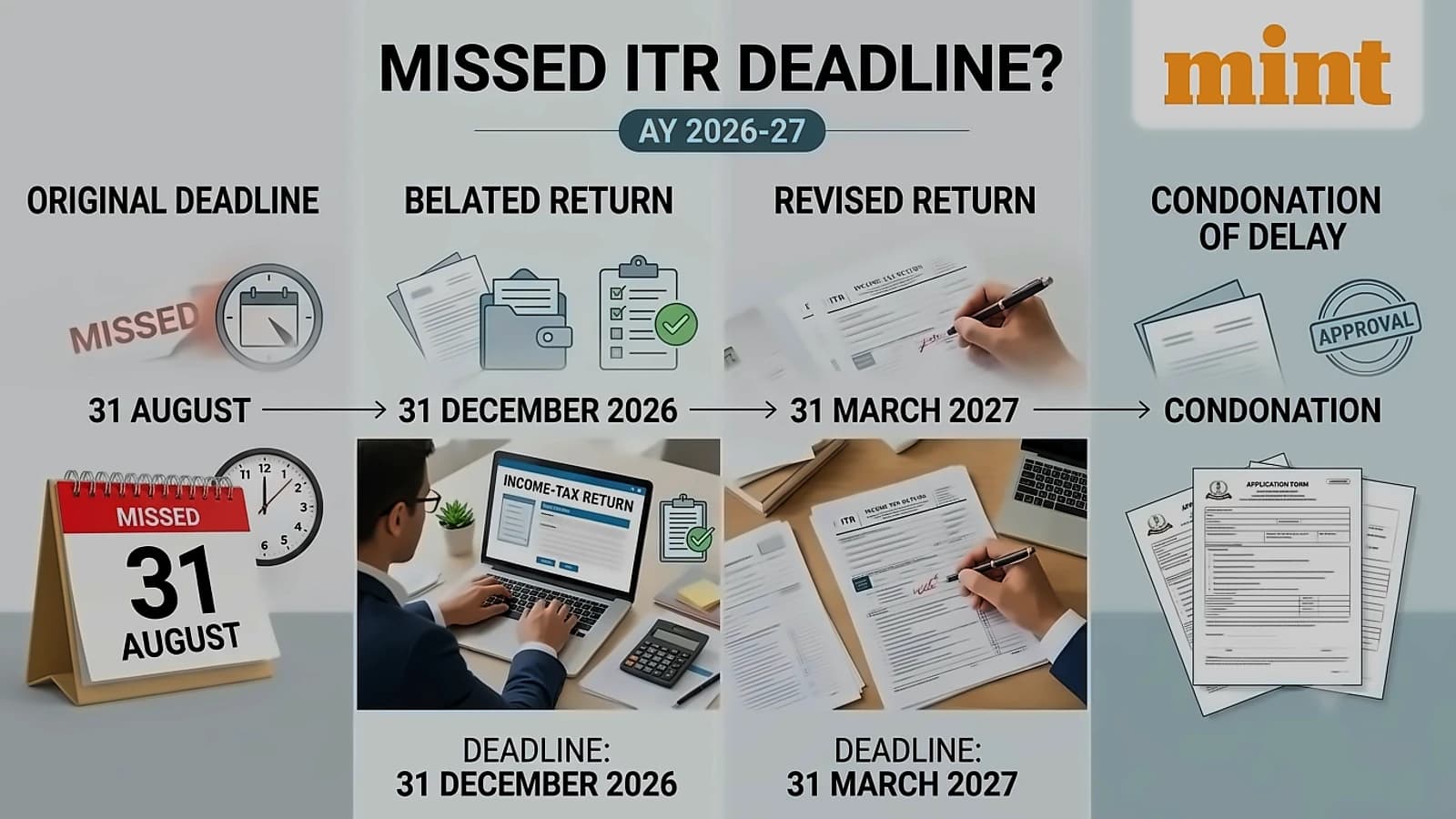
Missing the August 31, 2026 deadline does not eliminate filing opportunities, as taxpayers can still file a belated ITR for AY 2026-27 up to December 31, 2026, or before completion of assessment, whichever is earlier. However, filing after the original due date attracts penalties - ₹1,000 for taxpayers with total income not exceeding ₹5 lakh, and ₹5,000 for others. Additionally, interest at 1% per month is charged on outstanding tax liability. The Income Tax Department stated that returns for this assessment year remain regulated by the Income-tax Act, 1961, despite the Income Tax Act, 2025 taking effect from 1 April 2026. The new act is said to have removed obsolete provisions and simplified the language in a more coherent format, with earlier predictions suggesting it may lead to higher voluntary compliance.