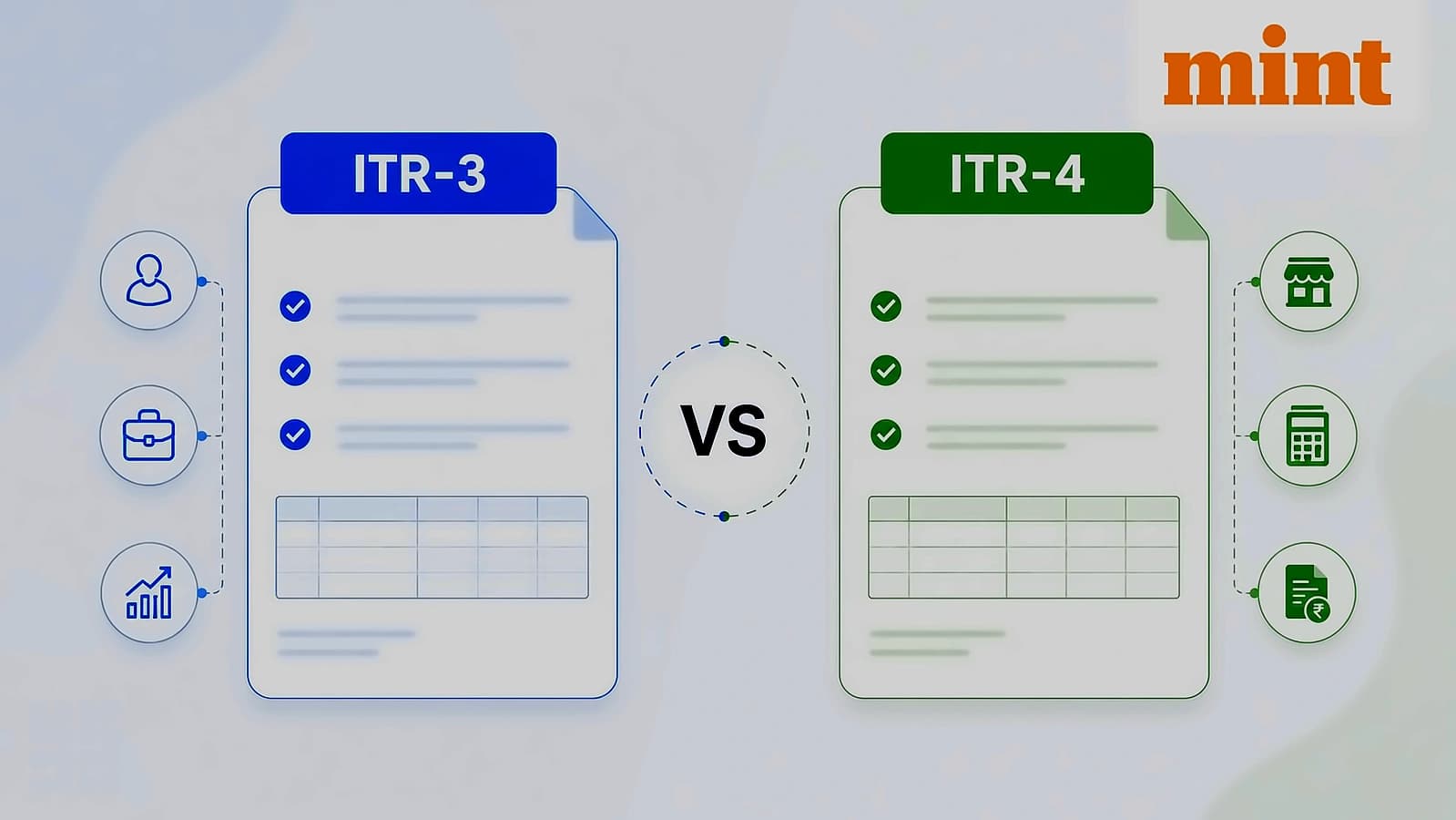
The Income-Tax Department has notified all I-T return forms for financial year 2025-26 (assessment year 2026-27) and enabled Excel Utility for ITR-1, ITR-2, ITR-3 and ITR-4 forms on its e-filing portal. According to reports from Mint, the deadline for individual taxpayers filing ITR is 31 July 2026, while those using ITR forms 3 and 4 have until 31 August 2026. Taxpayers who miss the July deadline can still file a delayed return by 31 December 2026. As per Moneycontrol, the deadline for non-audit business cases and trusts has been extended to 31 August 2026, with individuals earning income from Futures and Options (F&O) trading having until August 31 to file their ITR. This extension is primarily because income from F&O trading is treated as business income under the Income Tax Act. The Excel Utility feature allows taxpayers to prepare returns offline by downloading the required ITR form, filling it out, generating a JSON file, and uploading it online after proper verification and cross-checking of details.
ITR-4 can be filed by a Resident Individual/HUF/Firm (other than LLP) who meets specific income thresholds and conditions. As reported by Mint, eligible taxpayers must have income not exceeding ₹50 lakh during the financial year, income from Business and Profession computed on presumptive basis under sections 44AD, 44ADA or 44AE, and long-term capital gains under section 112A not exceeding ₹1.25 lakh. The form is also suitable for income from salary/pension, two house properties, agricultural income up to ₹5,000, and other sources including interest from savings accounts and bank deposits. According to Moneycontrol, the revised ITR forms seek to capture more detailed information from taxpayers, particularly in areas such as capital gains, trading income, bank accounts and tax deduction claims. The form is applicable for Individual or Hindu Undivided Family (HUF), who is resident other than not ordinarily Resident or a Resident Firm (other than LLP) having total income up to ₹50 lakh and having income from business or profession which is computed on a presumptive basis (under sections 44AD / 44ADA / 44AE of Income Tax Act, 1961).
The Income-Tax Department has introduced significant changes in how taxpayers report income from house properties using the ITR-4 form. Taxpayers can now report income from up to two house properties in ITR-1, rather than just one house property, with a new specific field for 'rent which cannot be realised' added to aid taxpayers with rented properties. According to the official income-tax website, house property may consist of two or more independent units, one of which is self-occupied, and the remaining is used for any other purpose (i.e., let-out or used for own business). Income from such property will be computed by treating the self-occupied part as an independent property and income from the let-out part as an independent property, following the respective ITR-4 user manual guidelines. For unrealised rent that is subsequently realised, any recovery will be deemed as income under the head 'Income from House Property' in the year of realisation, charged to tax after deducting 30% of the unrealised rent.
To claim deductions under Section 80C, taxpayers must provide additional information regarding the amount eligible for deduction and the policy number or document identification number. According to Mint, this section covers various investment options including life insurance, PPF, and tax-saving fixed deposits. The documentation requirements ensure proper validation and verification of eligible investments for tax deduction purposes. As per Moneycontrol, taxpayers filing returns for FY 2025-26 will encounter several changes across the Income Tax Return forms, with more detailed disclosures on capital gains and trading activities to align more closely with the tax department's data-driven scrutiny framework.
For specific sections, detailed documentation is mandatory for claiming deductions. As reported by Mint, taxpayers claiming deductions under Section 80CCD(1) or 80CCD(1B) must provide PRAN information, while those under Section 80DD or 80U need details about disability nature, dependent type, deduction amount, PAN of dependent, Aadhaar of dependent, and Form 10 IA acknowledgement number. For health insurance deductions under Section 80D, documentation includes insurer name, policy number, and health insurance amount details. According to Moneycontrol, experts say one of the biggest mistakes taxpayers make is assuming that if an income item is not manually entered in the return, it will go undetected. Today, the tax department receives information from banks, mutual funds, brokers, employers and various other reporting entities, making careful review of returns before submission crucial to prevent unnecessary scrutiny.