ITR-4, also known as Sugam, is designed for resident individuals, HUFs and firms (excluding LLPs) that opt for presumptive taxation under Sections 44AD, 44ADA or 44AE of the Income-tax Act, 1961. According to the latest guidance, the form is available only if the taxpayer's total income does not exceed ₹50 lakh during the financial year. In addition to presumptive business or professional income, taxpayers filing ITR-4 can report income from salary or pension, one house property, interest income, dividend income, family pension, agricultural income up to ₹5,000 and long-term capital gains under Section 112A up to ₹1.25 lakh. The form is the simplest way for shop owners, freelancers, consultants, and small transport operators to file, as presumptive taxation lets eligible taxpayers declare income at a prescribed percentage of turnover or receipts without maintaining detailed books of accounts.
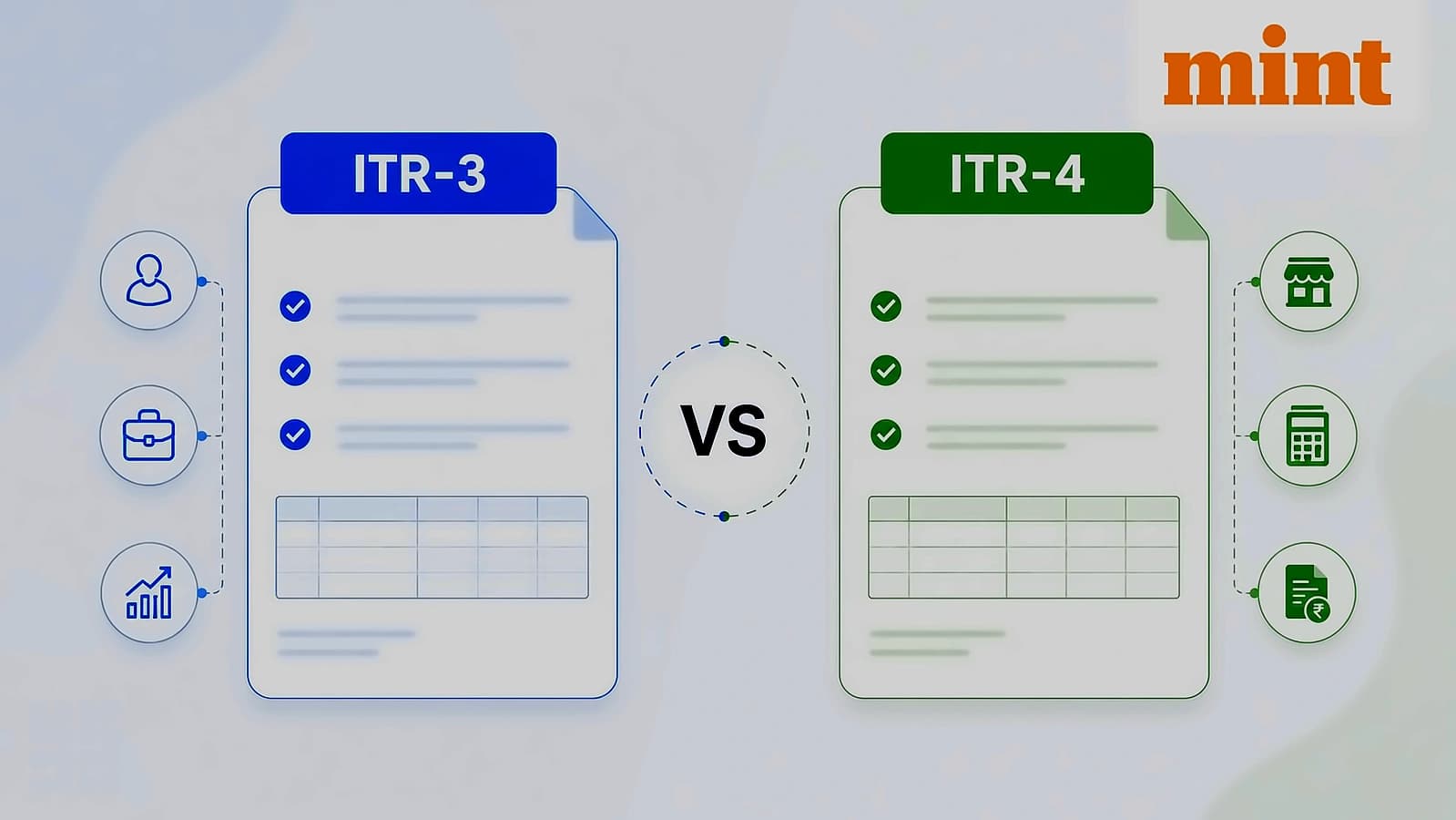
Section 44AD applies to small businesses with income presumed at 8% of turnover for cash receipts and 6% for digital receipts. This scheme is available to eligible businesses with annual turnover of up to ₹2 crore, with the threshold increasing to ₹3 crore if cash receipts do not exceed 5% of total receipts. Section 44ADA covers specified professionals such as doctors, lawyers, architects, engineers, and consultants, with income presumed at 50% of gross receipts. This scheme can be availed if gross receipts are up to ₹50 lakh, with the limit increasing to ₹75 lakh where cash receipts do not exceed 5% of total receipts. Section 44AE applies to taxpayers engaged in goods transport business, with income computed on a prescribed fixed amount per vehicle per month for operators owning up to 10 goods vehicles, irrespective of actual earnings.
Taxpayers cannot use ITR-4 if they are directors of a company, hold unlisted equity shares, earn income from foreign assets or foreign sources or have signing authority in overseas bank accounts. As reported by the latest guidance, the form is also unavailable to taxpayers with short-term capital gains, long-term capital gains under Section 112A exceeding ₹1.25 lakh, income taxed at special rates, deferred tax liability on ESOPs, or losses that need to be carried forward. Similarly, taxpayers with total income exceeding ₹50 lakh or income from certain foreign retirement benefit accounts covered under Section 89A cannot file ITR-4. F&O and intraday traders cannot use ITR-4 either, because that income is treated as a regular business and is reported in ITR-3. The form is also unavailable to non-residents (NRIs) and RNORs, companies, LLPs, charitable or religious trusts, local authorities, associations of persons (AOPs), and bodies of individuals (BOIs).
The revised ITR-4 now contains additional reporting fields aimed at ensuring that taxpayers claiming presumptive taxation satisfy all eligibility conditions. According to the latest guidance, the Income Tax Department now expects more comprehensive reporting of derivatives transactions for taxpayers engaged in Futures & Options trading. Active traders are expected to maintain detailed transaction records, calculate turnover correctly, and ensure accurate disclosure of profits, losses, and expenses to comply with the revised reporting requirements. The form also introduces better reporting of capital gains, updated deduction schedules, more detailed reporting for business income, enhanced verification of tax credits, and better reporting of exempt income. These modifications are intended to reduce mismatches between taxpayer declarations and information already available with the department, with the objective to capture financial information more accurately and improve tax reporting.
The non-audit due date for ITR-4 and ITR-3 has been permanently set to August 31, 2026, separate from the July 31 deadline for ITR-1 and ITR-2. Small long-term capital gains under Section 112A are now allowed in ITR-4 up to ₹1.25 lakh, unlike earlier when any capital gain forced taxpayers to ITR-2 or ITR-3. A new 'investments' field has been added to the financial particulars of the business section, with a separate field for investments on the assets side. Bank balance reporting is now mandatory, requiring taxpayers to report their bank account balance as at the end of the financial year. The old regime is now the default, with taxpayers choosing the new regime needing to file Form 10-IEA before the due date. Late filing attracts a fee of ₹1,000 if total income is up to ₹5 lakh, and ₹5,000 above that, plus 1% monthly interest under Section 234A on unpaid tax. Belated returns can be filed up to December 31, 2026.