The Employees' Provident Fund Organisation (EPFO) is developing a comprehensive framework to extend provident fund benefits to self-employed individuals, gig workers, workers in the unorganised sector and employees of exempted establishments, according to latest reports. The proposal aims to create a universal provident fund (PF) scheme that would allow individuals currently outside the EPFO network to voluntarily contribute towards retirement savings. This represents a significant expansion from the current system where only companies with 20 or more employees are eligible for EPF benefits, leaving most gig workers and self-employed individuals without formal retirement savings options. The Code on Social Security, 2020 empowers the Centre to frame social security schemes for gig workers, platform workers, unorganised workers and other eligible categories, though no universal EPF scheme has been notified so far. The initiative forms part of the EPFO 3.0 reform programme, designed to bring in workers currently left out of the Employees' Pension Scheme (EPS). The government is working on an ambitious overhaul of the EPFO that could significantly expand India's retirement savings framework, potentially marking one of the biggest changes to India's social security architecture.
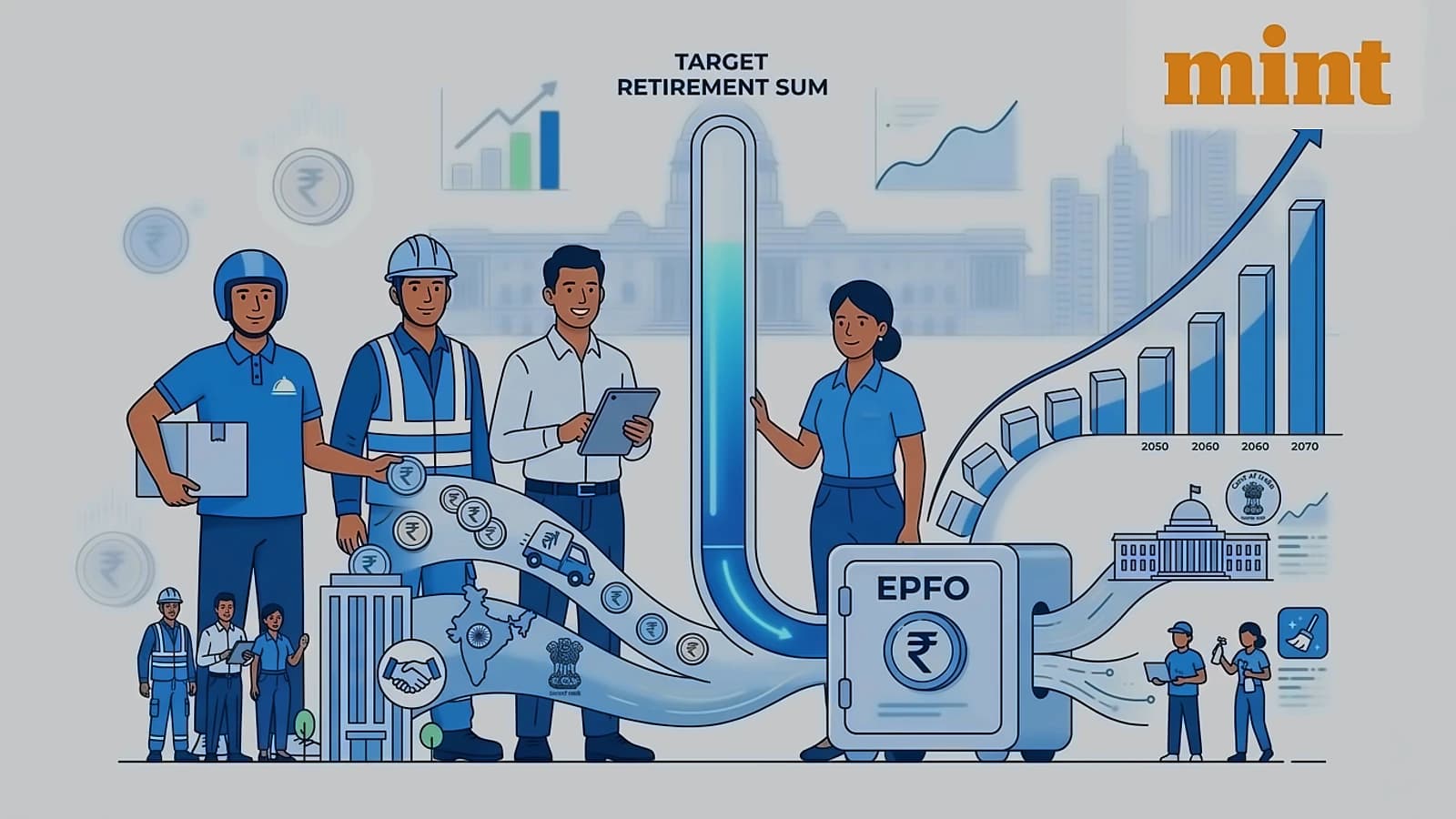
The proposed scheme would operate on a defined contribution model, drawing funding from workers themselves, employers, government co-contributions for lower-wage workers, aggregators for gig and platform workers, and CSR or third-party funds. Each member would receive an individual pension account on EPFO's digital platform, with contributions accumulating over time in long-term, government-backed securities and other approved instruments, earning annual interest. At age 55, workers can decide the purpose for retirement savings, with the scheme operating like PF until retirement. According to The Indian Express, the system will compute the proposed Target Retirement Sum (TRS) dynamically based on the member's chosen pension goal and expected retirement age. Members will have personalised dashboards showing total contributions, real-time corpus status, and progress towards the TRS for applicable schemes. Once a member turns 60, the accumulated savings, referred to as the "Target Retirement Sum" (TRS), will be converted into a pension calculated using annuity and interest rates prevailing at the time. The system would calculate contribution requirements dynamically based on declared savings targets, with members able to revise their goals and have contribution requirements recalculated accordingly. If a rate of 8 per cent is declared on a retirement corpus of ₹1 crore, the interest would amount to ₹8 lakh a year, which could be distributed as monthly payouts.
EPFO is considering changes to the withdrawal phase, as reported by multiple sources. Instead of requiring subscribers to withdraw their corpus at retirement, members may be allowed to retain their savings with EPFO and withdraw them gradually through a systematic withdrawal plan (SWP)-like mechanism. Under such a model, retirees could decide the amount and timing of periodic withdrawals based on their financial needs. According to The Indian Express, members from the age of 55 can decide how they want to use their accumulated retirement corpus, with the scheme operating like PF until that stage. The official explained that "Till that time, it will operate like PF, you keep on accumulating. At that stage when you are retiring, it converts into an annuity or a systematic withdrawal plan." The proposed system would allow members to increase withdrawals during the early years of retirement by drawing from their principal or reduce withdrawals so that more interest remains invested, potentially increasing future payouts. Members may be able to choose their monthly pension payout after retirement, with the flexibility to adjust withdrawals over time. The system would provide inflation-adjusted projections, enabling members to compare different retirement scenarios before deciding on their withdrawal strategy.
The proposal includes family and survivor pension benefits for spouses, children and orphans through a pooled "Family Benefit Fund" managed on actuarial principles, according to The Indian Express. Members of EPF, GPF, and other provident funds could also be allowed to transfer balances into the new pension initiative to enhance retirement savings. The EPFO is planning a "one-to-many" mapping system under which a single Universal Account Number (UAN) can be linked with multiple employers or digital platforms, allowing gig workers with multiple income sources to track all provident fund and pension contributions through a single account. The proposed scheme would be entirely self-funded, unlike the Pradhan Mantri Shram Yogi Maandhan Yojana, under which the Centre contributes an equal amount towards the subscriber's pension savings. Unlike existing government welfare plans, the proposed universal PF model will operate as an entirely self-funded structure requiring no direct budgetary support from the state. The Ministry of Labour and Employment has yet to decide which agency will oversee the scheme's implementation, while the EPFO 3.0 system would let members simulate their expected pension using inputs such as age, corpus size, interest rate and retirement age, with inflation-adjusted projections available as optional features.
The proposed reforms are expected to be backed by a core banking solution (CBS)-based technology platform, following EPFO's recent technology upgrades under its 2.0 reforms. According to The Indian Express, the move follows EPFO's recent technology upgrades, including a centralised database that merged 123 regional databases to improve claim processing and account visibility. An official explained that "We have to prepare for such a large volume. It was thought that the core banking solution, which is already validated and regulated by the Reserve Bank of India (RBI), would be a very robust system for us. So, that is the foundation." The EPFO expects nearly 25 million gig workers and building and construction workers to be brought under the proposed framework over the next five years. Contributions may come from workers themselves, employers, government co-contributions for lower-income workers, aggregators in the case of gig and platform workers, corporate social responsibility (CSR) funds, NGOs and donor organisations, and other third-party contributors. For unorganised workers, there is no contribution requirement, but they themselves can make a contribution, or else, a third party can make a contribution, or it could be donation, tip or payment-related diversion.