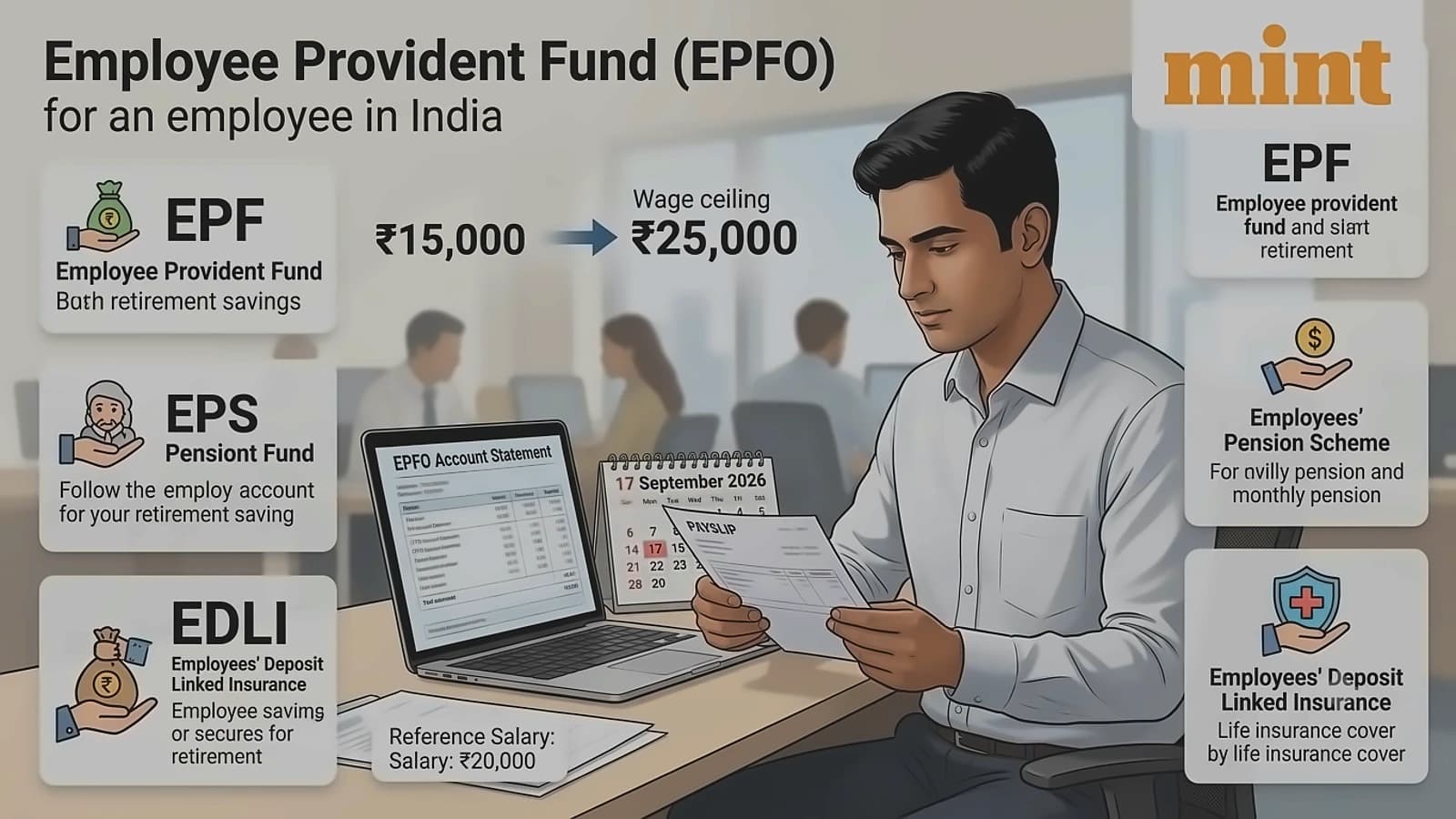
The Employees' Provident Fund Organisation (EPFO) is developing a comprehensive framework to extend social security coverage to millions of workers currently outside the existing EPF system. According to The Times of India, the proposed Universal Provident Fund Scheme will allow unorganised sector workers and self-employed individuals to set aside portions of their income for retirement savings, earning regular interest on par with existing EPFO schemes. The framework aims to provide retirement security to gig workers, freelancers, and other self-employed professionals who lack access to structured long-term retirement savings mechanisms comparable to EPF.
As reported by The Times of India, the proposed scheme will maintain similar contribution mechanisms to existing EPFO systems, allowing workers flexibility to contribute daily or annually based on their preferences. Tax benefits will remain comparable to EPFO, with contributions up to ₹2.5 lakh annually being tax exempt and other EEE (Exempt, Exempt, Exempt) benefits remaining unchanged. The scheme will be entirely financed by subscribers and will earn annual interest rates from EPFO. A significant change from traditional EPFO is the withdrawal mechanism, where subscribers will be allowed to retain the accumulated corpus with EPFO even after retirement, with flexibility for systematic withdrawal plans.
According to The Times of India, experts identify participation and contribution continuity as the biggest implementation challenge, as traditional EPF works effectively due to payroll-linked contributions. Puneet Gupta from EY India notes that a voluntary framework must address irregular income patterns, varying contribution capacities, and changing work arrangements. The solution lies in EPFO 3.0 digital infrastructure and designing simple user experiences for workers across diverse backgrounds. Kuldip Kumar from Mainstay Tax Advisors emphasizes creating clear value perception through tax incentives, portability, ease of access, transparency, and administrative confidence.
As reported by The Times of India, the proposal represents a significant expansion of India's social security framework and could be one of the most inclusive retirement options available. Puneet Gupta from EY India explains that the scheme could become India's most inclusive retirement savings platform because eligibility will be driven by individuals rather than employers. The framework will allow people across different employment forms to participate in a common retirement savings ecosystem, addressing the gap where many employees with monthly pay exceeding ₹15,000 are not eligible for EPS due to changes made in September 2014. This universal approach becomes particularly relevant as the Code on Social Security, 2020 took effect on 21 November 2025, making ESIC coverage nationwide and establishing formal coverage for gig and platform workers through aggregator contributions.
According to The Times of India, experts view this proposal as India's decisive step towards a universal pension scheme and potentially the most attractive retirement planning option. Kuldip Kumar highlights the confidence associated with an EPFO-administered scheme, noting that EPFO has historically declared stable and competitive annual interest rates. Puneet Gupta from EY India believes the scheme could create a pathway for millions of individuals to participate in formal retirement savings systems, reflecting a shift towards more inclusive, portable, and technology-enabled social security models aligned with today's workforce realities. The timing becomes particularly significant as the Labour Codes came into force on 21 November 2025, establishing a unified framework that could streamline the implementation of such universal schemes.