The revision of the wage ceiling to ₹25,000 represents a "win-win situation" that will bring more people under social protection measures, according to Chandra Bhushan Kumar, Secretary, Ministry of Labour & Employment. Speaking to ANI on Monday, Kumar emphasized that "the wage limit has already gone up, minimum wage limit in most of the states and all those things. And more people who are on the margin are going to be covered in this particular social protection measure." The secretary's endorsement comes as the government implements the first wage ceiling revision since September 2014, with the Union Cabinet approving the increase from ₹15,000 to ₹25,000 on September 16, 2026. Union Labour Minister Dr. Mansukh Mandaviya cited a government survey stating that the average salary in private establishments has increased up to ₹23,000 per month, making the updated limit critical to matching economic realities.
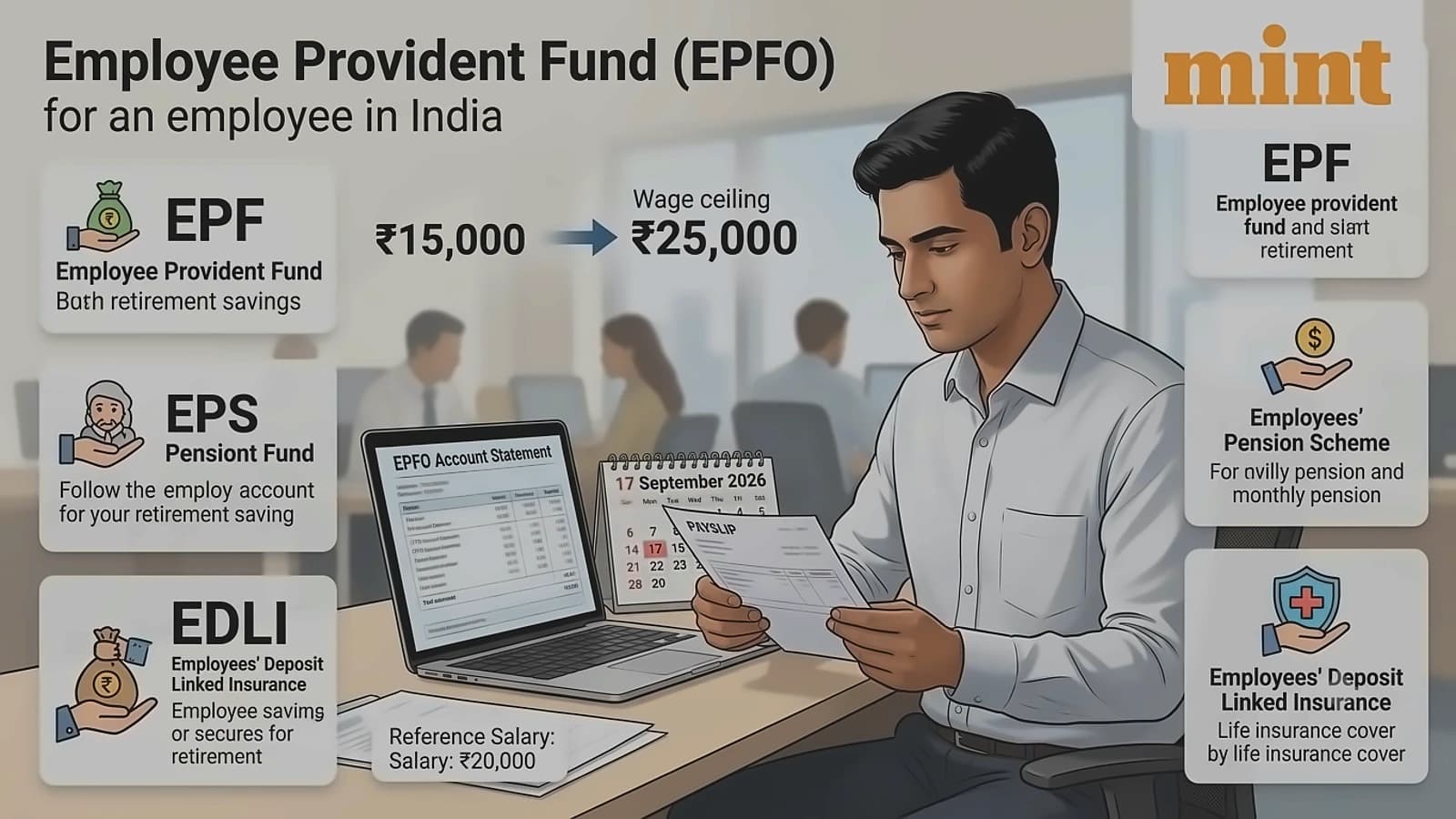
The EPFO wage ceiling has risen to ₹25,000 from September 17, 2026, creating a unique transition month for employees earning ₹20,000 monthly. As per Mint, September 2026 follows a dual calculation framework where the old ₹15,000 ceiling applies for 1-16 September, while the revised ₹25,000 ceiling applies from 17 September. This transition period affects employee and employer contributions differently based on membership status before and after the effective date. The government estimates that more than 51 lakh employees could come under EPFO coverage for the first time under the revised framework, with the 66% increase aimed at bringing workers earning between ₹15,000 and ₹25,000 a month within the statutory social security framework.
EPFO has released comprehensive calculation frameworks showing how EPF, EPS, and EDLI contributions vary across different employee scenarios in September 2026. According to Mint, Scenario A involves new EPF members from September 17 with wages above the old ₹15,000 ceiling, requiring ₹1,120 employee contribution and ₹342.53 employer EPF contribution for the first 16 days, then ₹2,080 employee contribution and ₹636.13 employer contribution for the remaining 14 days. Scenario B covers existing EPF members joining EPS from September 17, requiring ₹2,400 employee contribution and ₹1,622.53 employer contribution throughout the month. Scenario C applies to existing EPF and EPS members whose wages move from ₹15,000 to ₹20,000, resulting in ₹2,080 employee contribution and ₹1,443.87 employer contribution for the full month. The total employee and employer EPF/EPS contribution ranges from ₹2,240 to ₹4,800 depending on the scenario, with EDLI contributions of ₹46.67 to ₹100 providing life insurance coverage.
The revised wage ceiling has significantly impacted Employees' Deposit Linked Insurance (EDLI) calculations, with mathematical calculations reaching ₹10.5 lakh while actual payouts remain capped at ₹7 lakh. According to EPFO's FAQs, the calculation works by multiplying 35 times the average monthly wage of ₹25,000 (₹8.75 lakh) plus 50% of the average PF balance (up to ₹1.75 lakh), resulting in the ₹10.5 lakh total mathematical calculation. However, the maximum assurance benefit currently payable under EDLI Scheme 2026 remains capped at ₹7 lakh, meaning nominees will not receive the full ₹10.5 lakh calculation amount. The EPFO has indicated that an actuarial valuation of the EDLI fund will be undertaken based on which benefits may be decided in the future, though for now the ₹7 lakh maximum assurance benefit continues to apply. Under the earlier wage ceiling of ₹15,000, EDLI provided a maximum insurance benefit of ₹7 lakh, with the calculation being (₹15,000 × 35) + ₹1.75 lakh. The ₹1.75 lakh component is also important in determining the final payout, as if the government raises this amount as part of the EDLI rule changes, the maximum insurance benefit could increase further.
The Union Cabinet approved the proposal to raise the mandatory PF wage ceiling from ₹15,000 to ₹25,000 a month on September 16, 2026. According to reports from NDTV Profit, this decision came on the recommendation of the Ministry of Labour and Employment, making it the first revision to the ceiling since September 2014. The government raised the wage ceiling to bring more than 51 lakh additional workers under mandatory coverage and further drive workforce formalisation. The proposal was recommended by the Expenditure Finance Committee on June 16, 2026, with the decision announced on September 16, 2026. The Ministry of Labour and Employment notified the revised ceiling through Gazette notification S.O. 5109(E) the next day, with the new limit effective from September 17, 2026. A gazette notification formally brought the higher limit into effect, with employers now required to factor in the revised threshold when calculating employee and employer PF contributions.
The expanded coverage will significantly increase the government's financial commitment to social security schemes. As reported by NDTV Profit, the expanded coverage will increase the government's estimated annual expenditure to around ₹11,339 crore, compared with the existing budgetary support of approximately ₹10,250 crore. Over five years, the government's estimated financial commitment is around ₹56,696 crore. EPFO currently has around 7.98 crore contributing members across approximately 7.68 lakh contributing establishments, while around 82 lakh pensioners are covered under the Employees' Pension Scheme. The revised ceiling would also alter the split of the employer's 12% contribution, with a greater share allocated to the pension component and the remainder credited to the EPF account to earn interest.