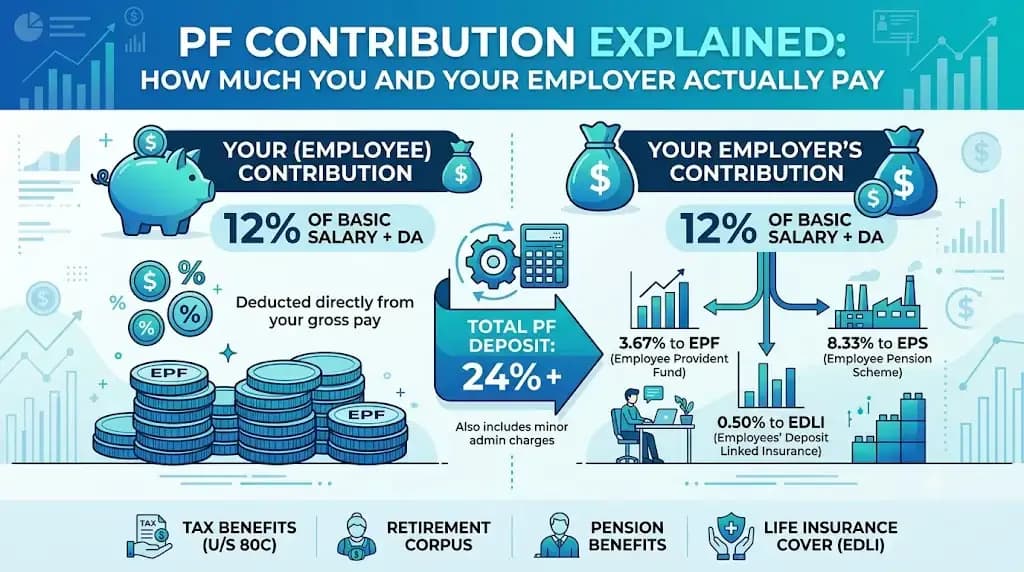
Recent updates to Labour Codes and EPF rules have introduced significant changes to provident fund contributions for salaried employees. According to reports from Mint, under the new Labour Codes, if allowances exceed 50% of wages, the excess is added back to wages for statutory compliance, triggering many employers to redesign salary structures. Meanwhile, the EPF Scheme 2026 clarifies that mandatory PF contribution is linked to the statutory wage ceiling of ₹15,000 per month, with employers mandated to contribute a minimum of ₹1,800 per month towards EPF. Contributions above this amount are voluntary and require mutual agreement between employer and employee. With companies beginning to implement the EPF Scheme 2026 alongside the Code on Wages, 2019 and the Code on Social Security, 2020, many employees are being asked to choose how much they want to contribute towards their Provident Fund. The new framework allows eligible employees to choose between contributing 12% of applicable wages, 9% of applicable wages, or a flat ₹1,800 per month, depending on the employer's policy.
Gibin John, Senior Investment Strategist at Geojit Investments, explained that the statutory EPF contribution is capped at ₹1,800 per month, which is 12% of the statutory wage ceiling of ₹15,000. As reported by Mint, many employers historically calculated EPF contributions on actual basic salary rather than the statutory wage ceiling, resulting in significantly higher contributions for employees. Apurv Gupta, Founder and CEO of Otto Money, noted that based on the new framework, many employers may keep contributions at ₹1,800/month while employee deductions are computed on the new, higher basic pay structure. Rohitaashv Sinha, Partner at King Stubb & Kasiva, explained that employees opting for 12% of applicable wages continue to benefit from higher retirement savings and greater compounding over time, with an employee earning ₹60,000 contributing ₹7,200 per month leading to a significantly larger retirement corpus over a 25-30 year career. According to Business Standard, legal experts emphasize that there is no universally 'best' option - the right choice depends on an employee's age, financial commitments, investment habits and retirement goals.

According to Mint reports, the financial impact varies significantly based on salary levels. For an employee earning ₹30,000 monthly basic pay, contributions restricted to the statutory ceiling result in ₹3,600 total monthly PF contribution, while contributions on actual basic salary can reach ₹7,200. The financial planners generally view the flat ₹1,800 contribution as suitable only for employees who have a clear investment strategy outside EPF, as it maximises immediate cash flow but substantially reduces long-term retirement accumulation. For employees choosing the 9% option, they'll receive a higher monthly salary than under the 12% option while continuing to save regularly for retirement, with an employee earning ₹60,000 contributing ₹5,400 per month resulting in an additional ₹1,800 in monthly disposable income. According to Business Standard, the ₹1,800 option provides the highest monthly take-home salary because PF deductions are significantly lower, making it suitable for employees with immediate financial obligations such as education expenses, medical costs or large EMIs. However, experts warn that this option may substantially reduce the retirement corpus over time.
The EPF Scheme 2026 introduces a mandatory minimum balance of 25% of total accumulated funds, addressing the critical issue of low retirement savings among members. As reported by EPFO, nearly 48.7% of EPF members have PF balances of only between ₹10,000 and ₹20,000 at the time of final settlement. The EPFO explained that an employee earning ₹15,000 per month can accumulate up to ₹14 lakh over a 20-year period, of which the minimum balance of nearly ₹3.5 lakh would remain even if 75% was withdrawn. This measure alone is expected to ensure a retirement corpus that is seven to 35 times higher for nearly 50% of the members. The new scheme replaces multiple purpose-specific withdrawal provisions with a common framework and allows members to access provident fund savings after completing 12 months of service for categories such as illness, education, marriage and housing. Unlike the 1952 scheme, which allowed partial withdrawals for specified purposes but didn't require members to retain any minimum retirement corpus, the EPF Scheme 2026 mandates that a protected balance remain in members' accounts even after withdrawals.
Experts recommend a diversified approach to retirement planning despite EPF changes. As reported by Mint, John advised employees to continue using EPF as a low-risk retirement savings instrument, emphasizing its stability and disciplined long-term wealth creation. Gupta recommended a consistent savings rate of 20% of CTC, with EPF up to tax-advantaged limits (₹7.5 lakh and ₹2.5 lakh per annum) as safe assets. For higher earners, Otto's framework suggests up to ₹20,800 employee contribution in EPF, ₹14% employer NPS contribution for equity exposure, and additional allocation to mutual funds, gold, and international equity for retirement planning. According to Business Standard, Kheyali Singh, Associate Partner at Singhania & Co., noted that 12% PF is best for building a larger retirement corpus as it helps employees build a larger retirement corpus while benefiting from the power of compounding, particularly suitable for early retirees. The 9% option provides a middle-ground offering higher take-home pay than 12% while preserving meaningful retirement savings, making it suitable for employees managing household expenses or repaying home loans. For employees with immediate financial obligations, the ₹1,800 option maximizes cash flow but requires careful consideration of long-term retirement planning.
EPF withdrawal rules have become more streamlined with recent reforms in 2025-26. According to EPFO guidelines, full EPF withdrawal requires 2 months of unemployment for members under 55 years, while those above 55 can withdraw even while employed. Partial withdrawals are available for specific purposes after completing 5 years of service, with medical emergencies (no minimum service), home purchase/construction (5 years), marriage/education (7 years), and home loan repayment (10 years). For withdrawals before 5 years, the employer's contribution becomes taxable at slab rates plus TDS of 10% (with PAN) or 30% (without PAN) under Section 192A. The EPF withdrawal process now takes 3-7 days through the UAN portal, with automatic settlement for claims below ₹1,00,000. Employees should ask their HR department whether choosing a lower PF contribution will add the reduction in employer's PF contribution back to their salary while keeping their CTC unchanged, as the answer could make a significant difference to both their monthly income and long-term wealth. According to Business Standard, when the government temporarily reduced PF contribution from 12% to 10% during Covid-19, the Ministry clarified that under a cost-to-company (CTC) model, savings should flow to employee take-home salary rather than reduce employer outgo, though this may not apply in all cases depending on employment contract structures.