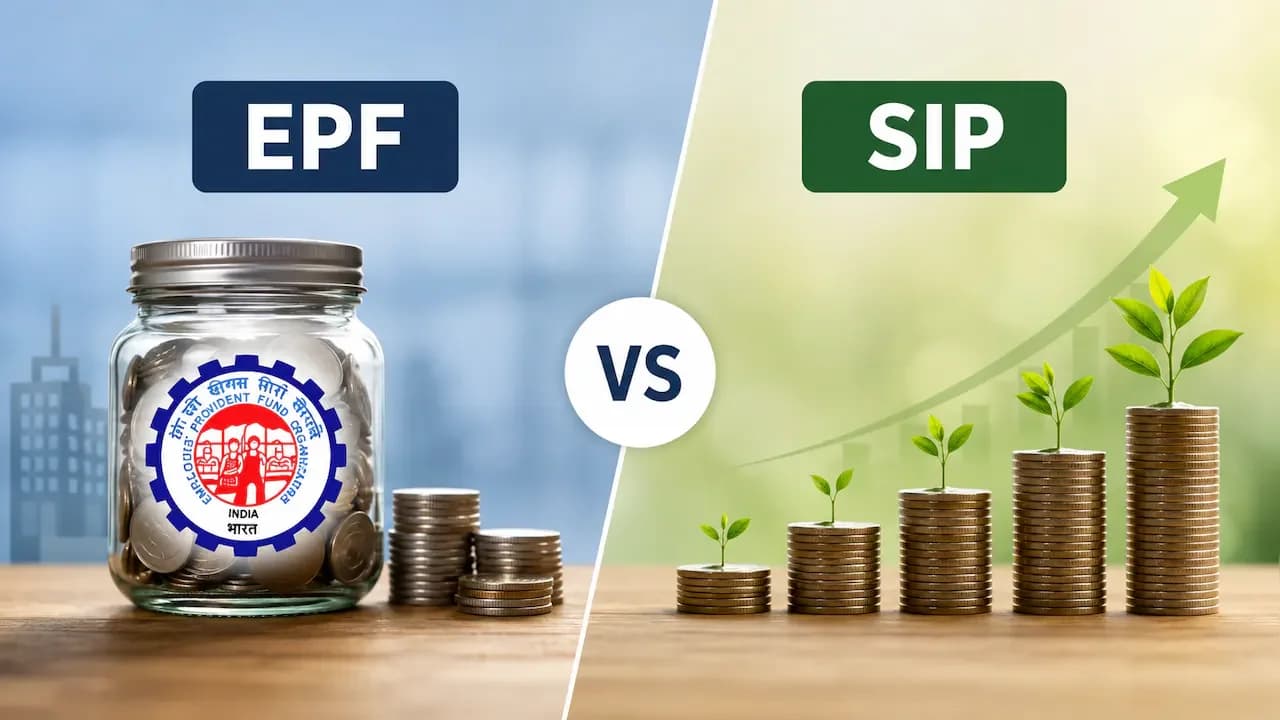
For those facing unemployment, EPF withdrawal rules allow up to 75% of the balance to be withdrawn if the employee has been unemployed for at least one month. However, as financial expert Ramalingam Kalirajan emphasizes, withdrawing this amount means depleting your retirement savings, making it crucial to carefully evaluate long-term implications. The withdrawal process requires careful consideration, as taking out Rs 10 lakh means giving up the interest and compounding that the amount could have accumulated had it remained in the EPF. Rebuilding the balance later may require significantly greater savings, especially after a long gap in investment growth. Importantly, VPF contributions cannot be withdrawn separately - they remain part of the overall EPF account and follow the same withdrawal rules, making the lock-in period mandatory for all EPF savings including voluntary contributions.
For those considering alternative investments, mutual funds can offer potentially higher returns compared to traditional options like FDs, though they come with market risk. As Kalirajan advises, consider investing in a diversified portfolio of mutual funds across different asset classes and fund categories to mitigate risk. Corporate bonds can provide higher returns than FDs but carry credit risk associated with the issuer's ability to repay the debt, with highly-rated corporate bonds or bond funds offering a balance of risk and return. Asset allocation strategies involve dividing the PF withdrawal between mutual funds for growth potential and safer options like FDs or bonds for stability. Financial planning experts strongly recommend consulting with a Certified Financial Planner (CFP) or qualified financial advisor before making investment decisions, as they can assess your financial situation and provide personalized recommendations aligned with your needs and objectives.
The Employees' Provident Fund (EPF) operates as a retirement-focused savings scheme where employees contribute a prescribed share of their basic salary and dearness allowance, while employers make their own contributions. According to reports from NDTV Profit, the EPF balance earns interest based on the rate declared by the government for the relevant financial year, with this interest becoming part of the balance that can generate further interest in subsequent years. This reinvestment effect is what gives compounding its power in EPF investments. The Voluntary Provident Fund (VPF) is an extension of this system, allowing employees to contribute additional amounts above the mandatory 12% EPF deduction, with VPF earning exactly the same 8.25% rate as EPF. As per recent reports, VPF contributions count towards the Section 80C deduction of up to ₹1.5 lakh a year under the old tax regime, though there is no 80C benefit under the new tax regime. The Voluntary Provident Fund (VPF) is one of the simplest ways for a salaried person to build a large, safe retirement corpus, with VPF earning the same 8.25% per year rate as EPF, making it one of the highest fixed returns you can get with a full government-backed guarantee.
For an initial Rs 10 lakh EPF balance, projections show significant growth potential over different time horizons. As reported by NDTV Profit, assuming an average annual return of 8.25%, the estimated corpus would reach Rs 14.86 lakh after 5 years, Rs 22.09 lakh after 10 years, and Rs 48.82 lakh after 20 years. These projections demonstrate how time plays a crucial role in EPF growth, with the compounding effect becoming more pronounced over longer investment periods. However, these numbers are indicative and should not be treated as assured returns, as EPF interest rates may be revised over the years. The Voluntary Provident Fund (VPF) offers the same 8.25% rate with no upper limit on contributions as a share of pay, though there is a ₹2.5 lakh taxable-interest rule that affects high earners. Interest is compounded yearly and credited to your EPF account, so you also earn interest on past interest, making VPF one of the few places you can earn a high, government-guaranteed return on your own salary.

The decision to withdraw or retain EPF savings ultimately depends on individual financial circumstances and investment horizons. As reported by NDTV Profit, for those with a lengthy investment horizon and no immediate requirement for funds, keeping the EPF corpus intact could provide significant benefits from compounding effects. The retirement-focused structure of EPF makes it particularly suitable for long-term wealth accumulation, with regular contributions alongside growth helping build a considerably larger retirement fund over the long term. However, unexpected situations and legitimate financial needs can create compelling reasons to access the savings when necessary. A common, sensible plan for a salaried EPF member is to use VPF for the higher rate and PPF for a guaranteed tax-free corner - the two work well side by side. For high earners, the ₹2.5 lakh taxable-interest rule on VPF contributions may influence strategic planning, as even the taxable portion still earns the 8.25% rate after tax, often beating other safe investment options. A common strategy involves using VPF for higher rates and PPF for guaranteed tax-free returns, with both schemes working well together for comprehensive retirement planning. Financial experts emphasize the importance of prioritizing prudence and long-term financial stability when deciding how to utilize your PF corpus, striking a balance between risk and return based on your financial goals and circumstances.