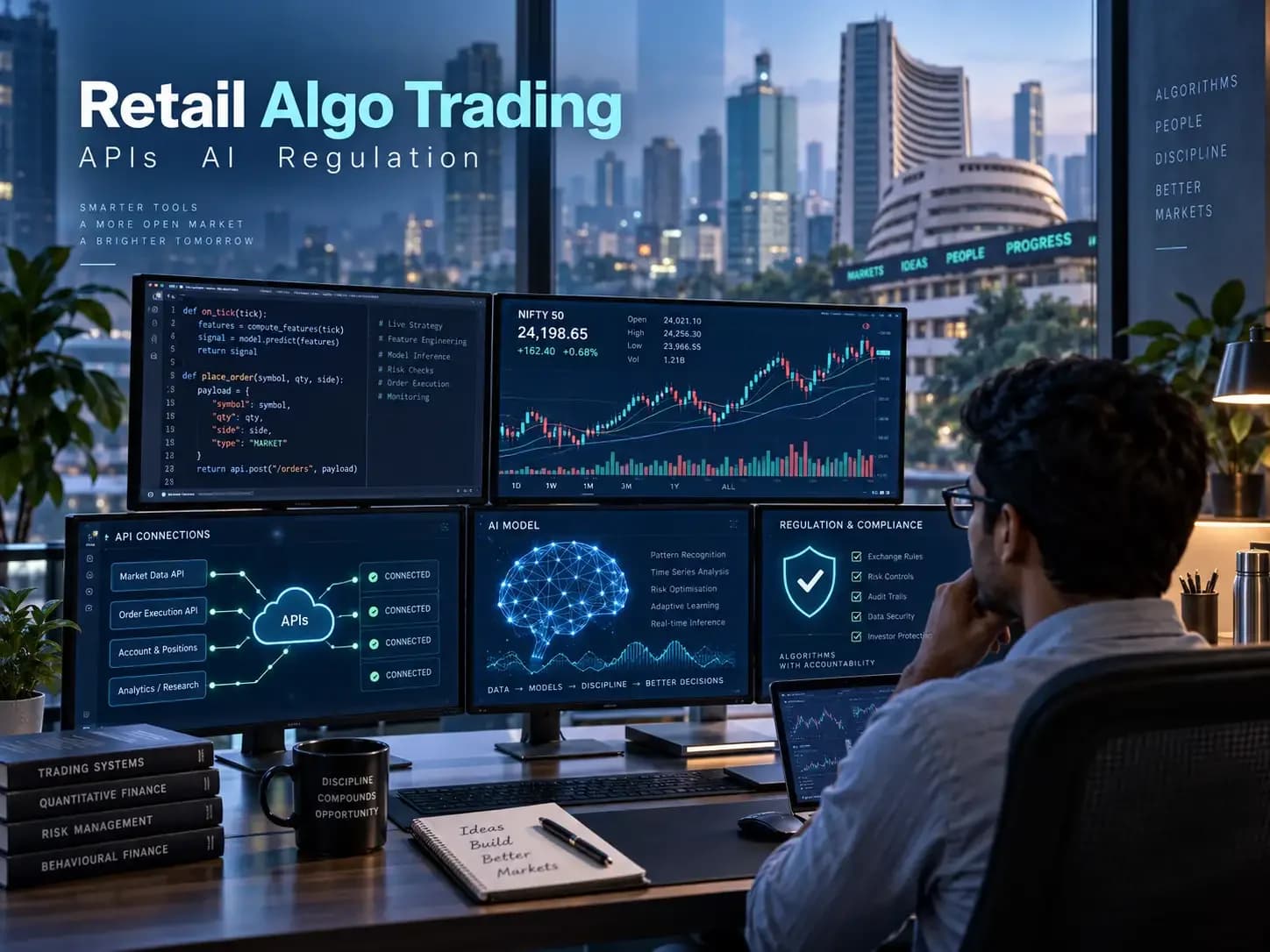
Retail algo trading in India is becoming more accessible as technological infrastructure improves dramatically. According to The Economic Times, the combination of broker APIs, cloud infrastructure, affordable market data, no-code and low-code platforms, AI-assisted coding and a clearer regulatory framework is bringing systematic trading closer to retail investors. What once required an institutional technology stack can increasingly be accessed through a laptop, a broker account and a few thousand rupees a month. As Prashant Shah, CEO & Co-Founder of Definedge Securities, explains, "Sophisticated infrastructure is increasingly being packaged into simpler tools" - the infrastructure that used to sit exclusively with institutions and prop desks is now available over an API from any broker. The result is that traders no longer have to recreate an institutional technology stack from scratch, with market data, APIs, cloud infrastructure, backtesting engines and strategy-building platforms all becoming more accessible.
AI is significantly compressing the learning curve for algorithmic trading by removing the programming barrier that historically required weeks or months of specialist skills. As reported by The Economic Times, AI-assisted strategy builders and low-code platforms have significantly reduced the time required to move from an idea to a working prototype. Vishal Mehta, CMT, Founder of vishalmehtacmt.com, emphasizes that "Drag-and-drop tools" and AI-generated code mean the technical heavy lifting can increasingly be outsourced to software, with the trader's job shifting towards defining the rules: when to enter, when to exit, how much capital to deploy and how to manage risk. This development is particularly attractive to a generation of retail traders already comfortable with technology and accustomed to using app-based investment platforms. However, experts warn that removing the coding barrier does not remove the strategy-development barrier - a poorly designed strategy can still lose money, only now it may do so faster and more consistently.
The economics of algorithmic trading have undergone a dramatic transformation, with infrastructure costs collapsing to make systematic strategies accessible to retail traders. As reported by The Economic Times, Mehta estimates that traders can access much of the required infrastructure for a few thousand rupees a month, representing a significant shift from the meaningful upfront investment once required. Cloud computing and market-data access have brought down the cost of running systematic strategies compared with what traders would have faced a decade ago. This matters because algo trading does not necessarily require the kind of capital that was once associated with institutional trading infrastructure, with the barrier moving from "Can I afford the technology?" to "Do I have a strategy worth automating?". According to Shruti Jain, Chief Strategy Officer at Arihant Capital Markets, "What needed a Bloomberg terminal, a quant team and coding skills until a few years ago now runs on an API and a smartphone."
SEBI's framework for safer participation of retail investors in algorithmic trading, issued in February 2025, has provided crucial regulatory clarity and formalized the ecosystem. As reported by The Economic Times, the framework has been operationalized through the exchange ecosystem, with the new framework providing greater clarity around how retail algo orders are handled, including responsibilities of brokers and the tagging and approval of algorithms. Mehta believes this regulatory clarity is critical, noting "Earlier it was a grey area. Now it's official" - retail algo trading is moving away from an informal ecosystem towards a more structured market infrastructure. The emergence of exchange procedures and empanelled algo providers has increased confidence among traders who were previously hesitant to automate their trades due to uncertainty around technology, brokers or regulatory oversight.
The Indian algorithmic trading market presents substantial growth potential, with IMARC estimating the overall market at approximately ₹615.61 million in 2025 and projecting it to reach about ₹1.35 billion by 2034. As reported by The Economic Times, NSE reported 12.9 crore registered investors as of March 2026, with the active trader base representing a substantial addressable market for trading technology tools. The broader opportunity lies in strategy development, screening, backtesting, analytics, automated execution, portfolio monitoring, and risk controls rather than simply selling AI trading signals. According to SEBI's Investor Survey 2025, among reported challenges after investment, 90% of surveyed investor households cited lack of knowledge and information, while 60% cited lack of timely and accurate market insights, supporting the idea that technology has a role not only in execution but also in filtering, organizing, and interpreting information. AI adds another layer by assisting with research, summarizing information, pattern recognition, signal ranking, portfolio monitoring, and strategy development, expanding the scope of automated trading beyond simple execution.