India's hand and power tools exports could surge more than 25-fold to over $25 billion by 2035 from around $1 billion currently, according to industry experts at the Tools & Equipment Expo 2026. The three-day expo, which began at Bharat Mandapam in New Delhi on September 18, brought together more than 300 exhibitors, over 2,000 products on display, 150+ new product launches and 8,000+ industry professionals. As reported by Moneycontrol, Yogesh Mudras, managing director at Informa Markets in India, highlighted that India's hand and power tools exports are currently around $1 billion and have the potential to cross $25 billion by 2035. Speaking at the event, Mudras emphasized that the opportunity to strengthen India's manufacturing and export capabilities is significant as the sector enters an important phase of growth.
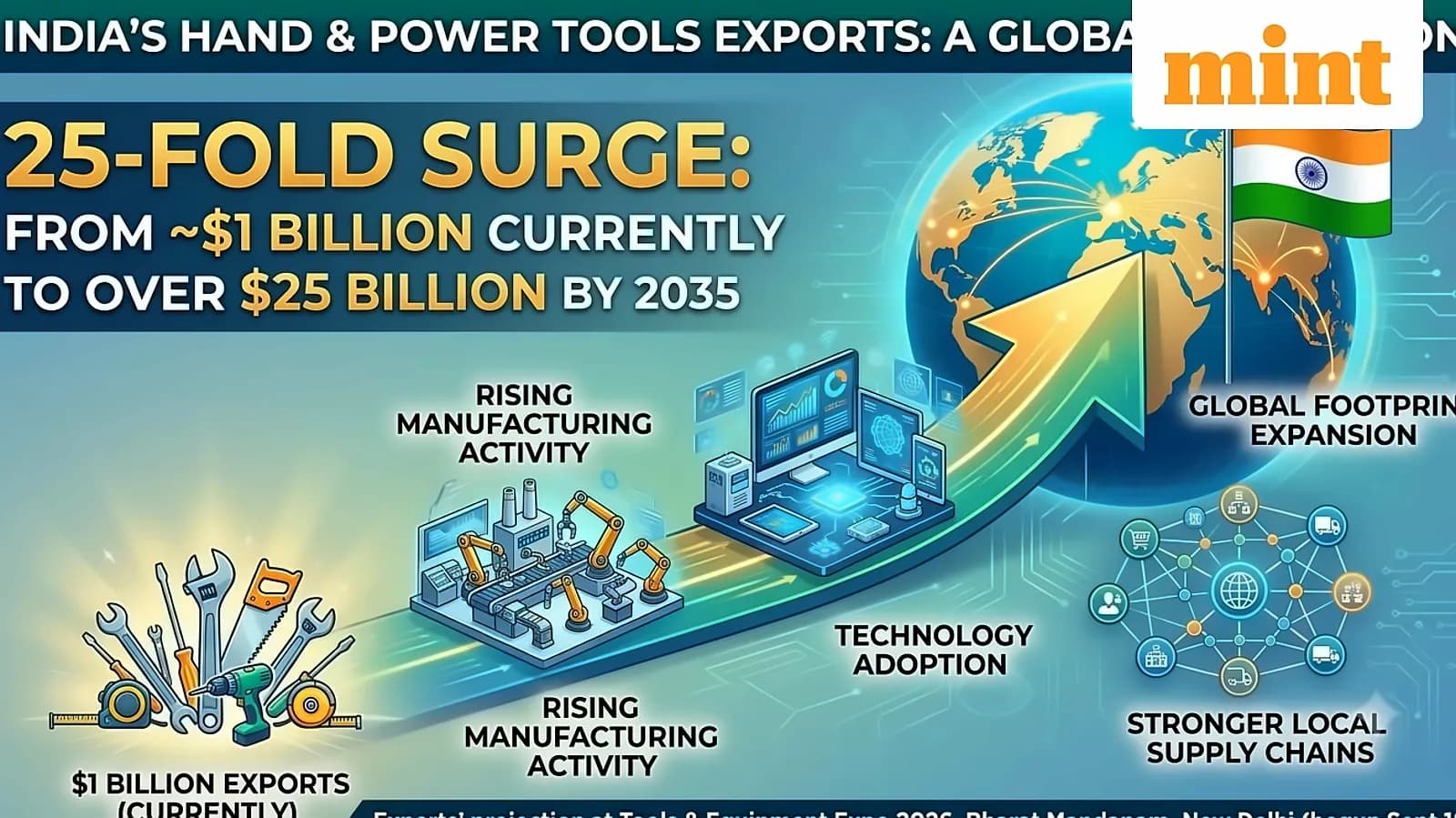
The growth projection is driven by rising manufacturing activity, technology adoption, and stronger local supply chains that are creating opportunities for the sector to expand its global footprint. India already accounts for around 15% of the global cutting tools market, according to industry estimates. The global cutting tools market is currently valued at about $23 billion and is projected to approach $30 billion by 2030, said PG Subramanian, executive secretary of the Indian Cutting Tool Manufacturers' Association. As reported by Mint, the push comes as India's manufacturing sector is looking to deepen domestic supply chains and reduce dependence on imported components. According to Yadu Kumar Yadav, deputy director at NPC-DPIIT under the Ministry of Commerce and Industry, the focus over the past decade had been on integrating MSME products, processes and systems through lean manufacturing, but the next phase would centre on deeper digital integration.
The next phase involves deeper digital integration, with businesses moving towards Industry 4.0 and IoT-enabled systems. According to Yadu Kumar Yadav, deputy director at NPC-DPIIT under the Ministry of Commerce and Industry, MSMEs need to move from lean manufacturing towards Industry 4.0 and IoT-enabled systems. The recently launched BRICS Center for Industrial Competencies is creating an ecosystem for manufacturers and industry associations to connect, facilitate B2B matchmaking and promote innovation. Platforms such as TAEE can support this transition by bringing innovators, MSMEs and technology providers together to exchange knowledge and explore collaborations.
Despite the growth potential, the industry faces significant hurdles including raw-material constraints and limited domestic recycling and reprocessing facilities. Industry representatives have also sought easier access to government schemes and simpler regulatory compliance. They further stressed that technology and machinery will need to be accompanied by skilled manpower and greater localisation of components and supply chains if India is to capture the projected export opportunity. As reported by Mint, the focus for MSMEs over the past decade had been on lean manufacturing, with the next phase involving deeper digital integration and Industry 4.0 adoption. The sector faces challenges related to raw materials and limited availability of domestic recycling and reprocessing facilities, according to industry estimates.