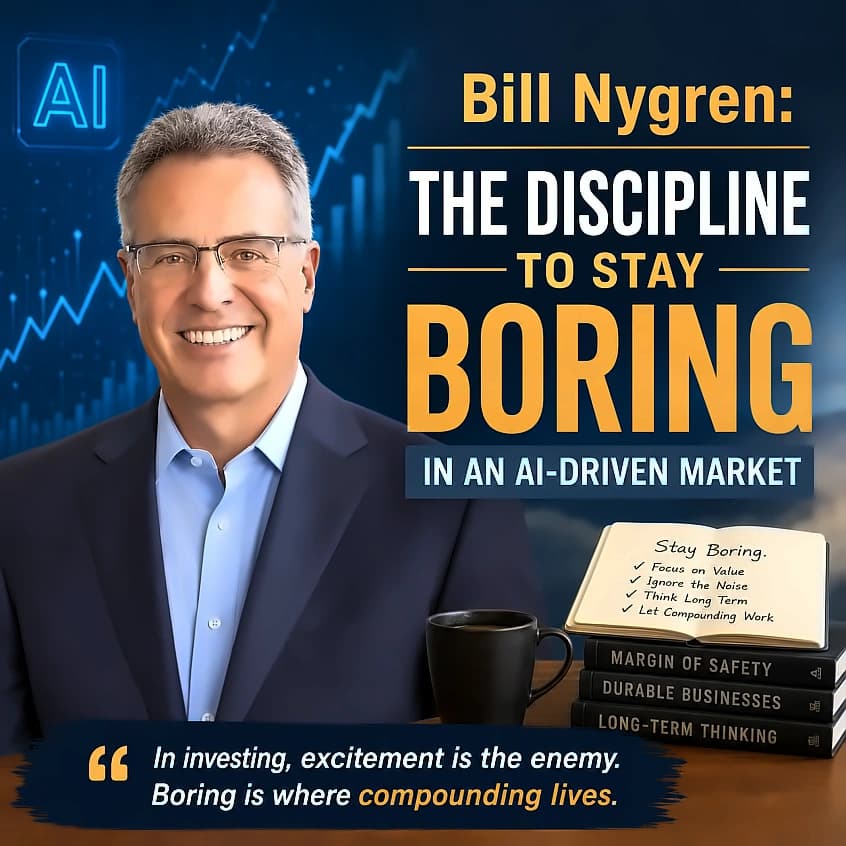
The traditional value investing cycle faces unprecedented challenges as artificial intelligence disrupts the certainty that underpins today's equity valuation multiples. According to Seeking Alpha, the S&P 500 currently trades at 28x trailing PE ratio, which reflects a premium that prices in decades of growing free cash flow. However, AI technology is eroding this foundation by disrupting the certainty that equity valuation depends on, making it impossible to price decades of cash flows that cannot be predicted. This fundamental shift threatens the multiples that currently support the market, creating uncertainty about future returns and challenging the traditional value investing approach.
According to Safal Niveshak, value investing operates through a predictable four-stage cycle that explains why the approach works over decades but fails in short-term periods. The cycle begins with Stage 1: Value investing works over the long term, where buying above-average companies at below-average prices consistently produces above-average returns. However, as reported by Safal Niveshak, this success attracts capital and creates Stage 2: Everyone becomes a value investor, making the mispricings that created returns shrink as too much capital chases the same opportunities.
The most challenging period occurs in Stage 3: Value disappears over periods of time, which can last one to three years or longer. As explained by Safal Niveshak, this stage creates emotional distress where the market rewards speculation, momentum, and narrative while value stocks remain stagnant. The author describes this as the period where investors question their entire approach, with the emotional experience of being a value investor becoming indistinguishable from being wrong. This stage breaks many investors who lack deep understanding of the process, and the current AI disruption may intensify these challenges as traditional valuation metrics lose their reliability.

According to Safal Niveshak, successful value investors employ three key strategies to survive the challenging periods. The pre-commitment journal involves writing down specific sell conditions before purchasing stocks, such as debt-to-equity ratios or margin thresholds. The three-year test requires asking whether the stock would be comfortable to own without price checks for three years, ensuring deep business understanding. Additionally, the base rate reminder shows that while value strategies underperform in individual years, the underperformance rate drops significantly over rolling five-year and ten-year periods. These strategies become increasingly crucial as AI disruption challenges traditional market certainty.
As reported by Safal Niveshak, Stage 4: Fake value investors disappear creates opportunities for the cycle to renew itself. Investors who adopted the approach only during successful periods leave when results turn negative, while those who understand the cycle and stay through difficult periods find themselves holding bargains that will fuel future returns. The author emphasizes that patience is not a trait but an outcome of having a process that makes staying the course possible, distinguishing between those who treat patience as a personality trait and those who build systems that enable disciplined decision-making. However, the current AI disruption may extend this cycle duration as traditional valuation methods lose their predictive power.