Legendary value investor Jean-Marie Eveillard has emphasized a fundamental principle of long-term investing through his quote: 'Risk to us goes back to not paying attention to how one does in the short term'. According to reports from The Economic Times, this statement captures the core principle of avoiding the temptation to judge success based on daily market fluctuations. The quote reflects the essence of value investing, where patience is considered a competitive advantage over reactive market timing. Meanwhile, Bill Nygren from Value Options Letter reinforces this discipline by stating that 'We haven't been able to answer those questions with enough confidence to justify owning the AI hardware stocks'. His approach emphasizes maintaining investment discipline even when market leadership becomes concentrated in a narrow group of AI-related stocks.
Eveillard's philosophy reflects the value investing approach where patience is considered a competitive advantage over short-term market reactions. As reported by The Economic Times, disciplined investors focus on the quality of businesses, their intrinsic value, and their ability to generate sustainable returns over time. Short-term underperformance is viewed as a byproduct of market sentiment rather than increased risk, demonstrating the value of maintaining long-term perspective during volatile periods. Nygren's strategy reinforces this by focusing on 'estimating business value, assessing management teams and purchasing companies at meaningful discounts to intrinsic value'. This approach can appear frustrating when speculative assets are delivering rapid gains, but market cycles have repeatedly demonstrated that effortless profits can encourage investors to underestimate risk.
The current market environment reveals significant concentration risks, with just 10 companies accounting for nearly half of the Russell 1000 Value Index's gains through June 2026. As Nygren explains, 'If you exclude AI-related stocks and the energy companies powering them, the S&P 500 would be down year to date'. The extraordinary increase in AI infrastructure spending is pushing traditional value companies into the Russell Value Index, with Apple and Microsoft recently joining the Russell 1000 Value Index, while Amazon became its largest holding. This concentration creates challenges for investors unwilling to chase momentum, as the S&P 500 and Russell 1000 Value Index posted double-digit gains through the first half of 2026, but beneath the surface, market leadership has become remarkably concentrated. Nygren notes that 'The extraordinary increase in AI infrastructure spending is pushing all but the 'growthiest' growth companies into the Russell Value Index', fundamentally changing what investors consider value stocks.
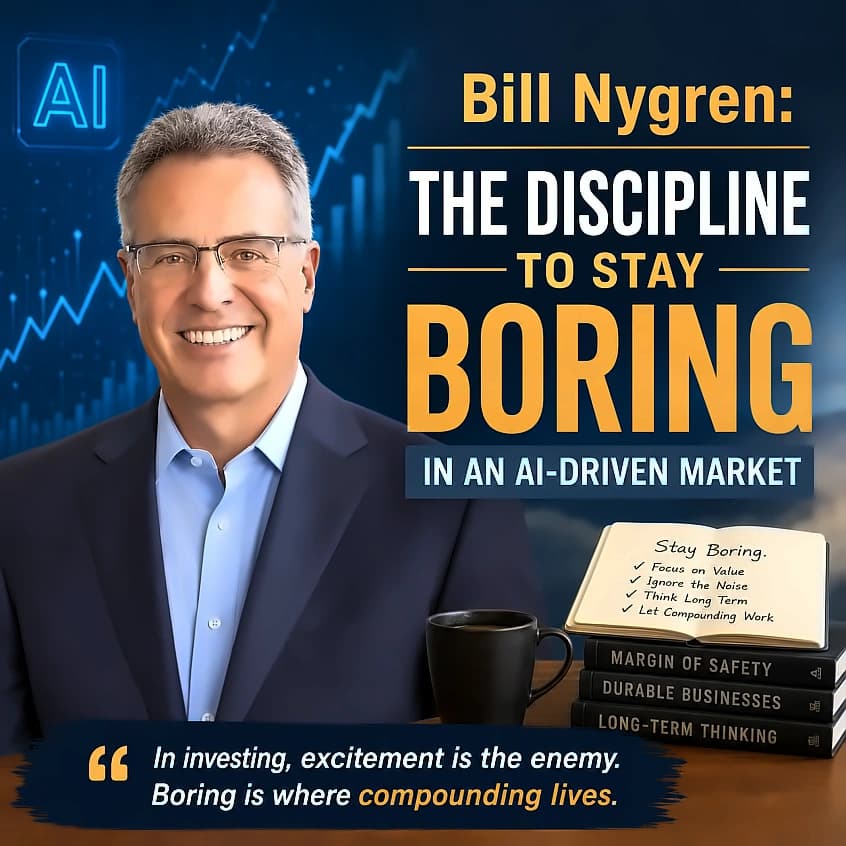
Eveillard's insight highlights that the greatest risk may not be temporary declines in portfolio value but allowing short-term noise to dictate long-term decisions. As reported by The Economic Times, the statement serves as a timely reminder that successful investing requires maintaining discipline through periods of uncertainty. Nygren's approach demonstrates this by 'staying grounded by following the operating performance of the businesses we own rather than the share prices of the businesses we don't'. For long-term investors, the focus should be on maintaining strategic discipline rather than reacting to short-term market volatility, particularly as the belief that exceptional stock market returns are easy to achieve can encourage overconfidence in current market conditions. Nygren emphasizes that 'We don't define portfolio risk by what we don't own' and remains focused on fundamental analysis rather than benchmark performance.