Michael Burry's decision to accelerate his AI bubble timeline has been reinforced by record-breaking valuations that now exceed entire national economies. According to latest reports, Anthropic is targeting a $2 trillion IPO valuation, while SpaceX successfully engineered an $1.8 trillion valuation - neither company operates traditional businesses but are valued primarily for their AI capabilities. OpenAI is reportedly avoiding public markets because it can raise $30 billion-plus in private capital through phone calls, with Sam Altman believing the company could achieve several trillion dollar valuations if excitement continues. These valuations exceed the gross domestic product of South Korea ($1.9 trillion) and Taiwan ($980 billion), even though both nations are critical AI infrastructure cogs. The subsumption argument suggests AI's valuations are justified if it runs all key technologies and orchestrates all innovation, potentially holding the world to ransom.
Michael Burry has swapped his short stock positions for put options, fundamentally moving his timeline for the AI bubble burst up from his previous 2028 base case. According to his Monday post on Cassandra Unchained, the Big Short investor covered his shorts in Micron, Nebius, Caterpillar, CoreWeave, Nvidia, Palantir, Oracle, and the iShares Semiconductor ETF (SOXX) with puts, though he has yet to find CoreWeave puts at an attractive price. Micron and Nebius puts expire in June, while Nvidia, Palantir, and SOXX puts run to September 2027. As Burry explained, 'Fundamentally, I am moving timelines up. As such, I want more leverage in my short positions. Better timelines make leverage more palatable'. He also opened a new MetLife short using long-dated puts, with the shift coming just one week after Burry named a copper miner as his indirect AI bet. Citing fresh research, Burry said he was stepping up the leverage attached to his bearish bets as he continues to flag concerns over elevated valuations across the sector.
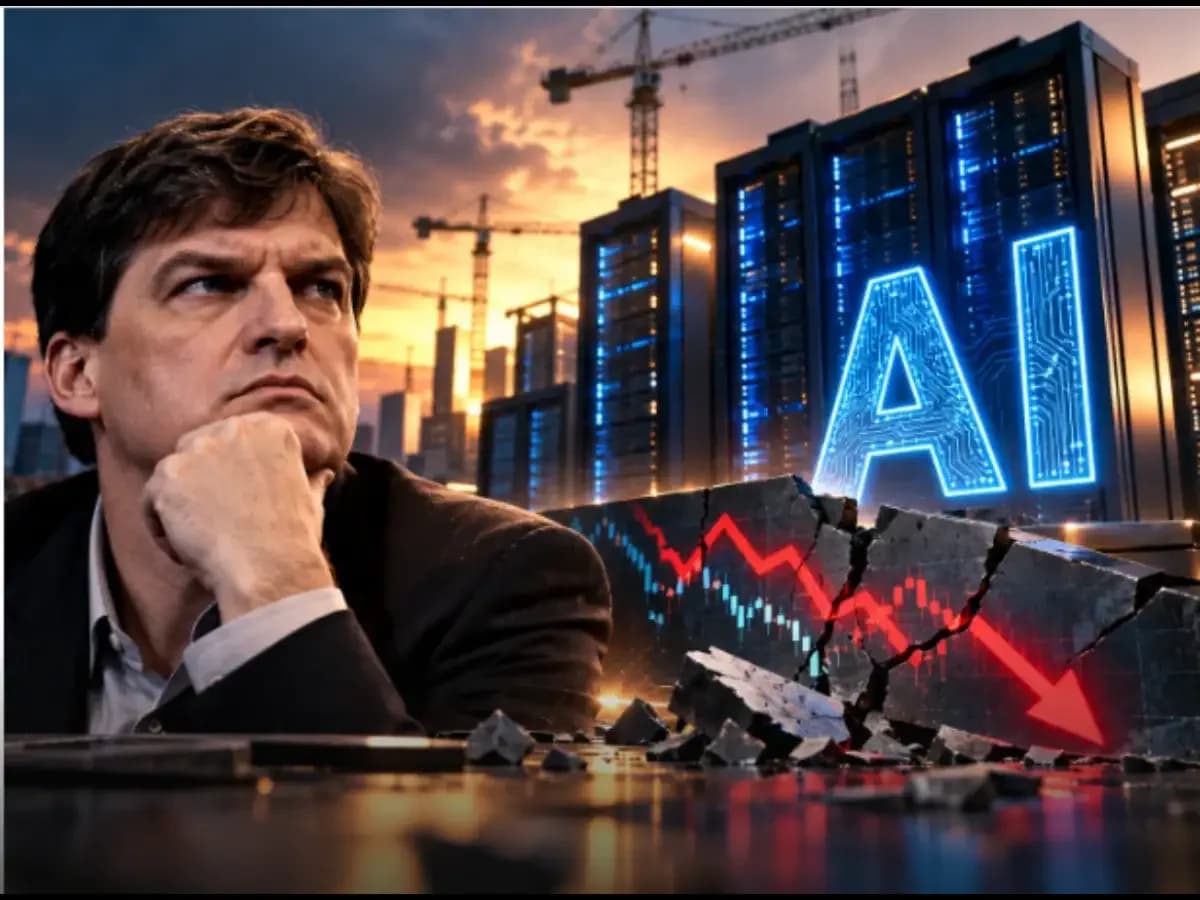
Burry's decision to accelerate his AI bubble timeline was primarily driven by weekend research that convinced him the 'bubble in AI may burst sooner than later'. According to his latest post, he cited a report from Ares Management that argues the AI boom relies on continued capital spending and revenue that remains unproven. The report suggests that 'it would take only a season in which AI revenue disappoints the capital expenditure underwriting it'. Burry noted that tax-loss harvesting accounted for part of the reshuffle, but weekend research drove most of it. Despite markets moving against him, with the Nasdaq Composite closing at a record last week and Nvidia CEO Jensen Huang saying AI has entered a high production ramp, some of his targets still trade below their peaks - Micron sits 16% below its record high, while Palantir is about 10% below its own. This comes after Burry said in August that the AI crash could begin from 2028, but his latest comments imply he expects this to happen sooner. His confidence has grown significantly, with 'I am more confident than ever before that my bearish view will play out over the next year'.
Burry's major thesis centers on the AI boom being part of a larger capital cycle, where companies invest heavily when demand and returns appear strong. According to his latest analysis, net investment by S&P 500 companies as a share of US nominal GDP stood at about 2.07% as of June 30, the highest level seen in nearly four decades apart from the period around the dot-com boom of the late 1990s. He compared this cycle to the technology, media and telecom boom that ended with the Nasdaq peak in March 2000, explaining that heavy investment can continue even after markets peak. During the dot-com period, capital spending continued to rise even as technology stocks eventually fell sharply, and Burry believes the same pattern could happen in AI. The current cycle shows heavy investment continuing even if the financial returns from that spending begin to weaken.
Burry has detailed massive spending commitments by the biggest technology companies, with recent reports showing Alphabet, Amazon, Meta, Microsoft, Oracle, Nvidia, Broadcom, SpaceX and Advanced Micro Devices had disclosed around $3 trillion in commitments largely connected to AI infrastructure. The commitments reportedly include about $1.2 trillion in leases that have not yet started and $1.9 trillion in purchase commitments covering chips, energy and data centre infrastructure. This figure is much larger than the roughly $600 billion in capital expenditure reported by these companies over their latest 12-month periods. AI-related infrastructure under planning today will cost over $10 trillion over the next five years, representing roughly 7-8% of 2025 global GDP. That would mean capex on AI would annualise to around 2% of global GDP. Burry's concern is that companies could be locked into expensive infrastructure spending even if AI demand does not grow as quickly as expected, with many contracts being difficult to cancel.
Burry has repeatedly questioned how companies are depreciating their AI chips and servers, claiming some hyperscalers are giving Nvidia chips and other AI equipment useful lives of five or six years, while he believes their economic life could be closer to two or three years. A shorter useful life would mean companies would have to recognize higher depreciation expenses sooner. Burry has estimated that the difference could suppress depreciation expenses by about $176 billion between 2026 and 2028. He described this practice as 'one of the more common frauds of the modern era'. His calculations suggest that Oracle's 2028 earnings could be overstated by 26.9%, while Meta's could be overstated by 20.8% if his depreciation assumptions prove correct. This creates a three-way compression: demand weakens, earnings fall as expenses catch up, and financing becomes more expensive.
Despite Michael Burry's persistent warnings about a 1999-2000 bubble-like scenario in big tech stocks, the market has continued its upward trajectory. The S&P 500 is up approximately 13% through September 2026, trading just over 1% below its 52-week high as of late September. However, recent market performance shows signs of cooling, with the SPDR S&P 500 ETF Trust (SPY) and SPDR Dow Jones Industrial Average ETF Trust (DIA) each slipping about 0.6%, while the tech-heavy Invesco QQQ Trust (QQQ) lost 1.1%. This rally occurred four months after Burry posted his warning in May 2026, when he wrote that stocks had stopped reacting to jobs or consumer sentiment and felt like the final stretch of the dot-com bubble. The market's continued climb into record territory through August demonstrates the challenge of timing bubble calls, as Burry's own sentence allows for potential delays in the resolution. The current valuations, with Anthropic and SpaceX together potentially worth $4 trillion - roughly equivalent to the entire South Korean stock market - highlight the unprecedented nature of current AI market dynamics.
Michael Burry, the Big Short investor known for his bearish bets, has taken full positions in five beaten-down stocks according to reports from The Economic Times and his latest Substack post. The portfolio includes QXO (roofing distributor), Sprouts Farmers Market (grocery store), Build-A-Bear (custom stuffed animal store), Birkenstock (footwear brand), and MercadoLibre (eCommerce site). As reported by The Economic Times, Burry believes these stocks have 'corrected tremendously' and now offer extremely 'attractive' valuations. The market veteran's strategy focuses on companies far removed from the wild swings of the artificial intelligence trade.