As US and European stocks hit fresh records amid the ongoing AI-driven market rally, the European Central Bank has issued a stark warning that the boom could be setting the stage for a sharp correction. According to ECB economists, "overconfident, overoptimistic investors" typically drive stock prices higher than their fundamental value, resulting in a crash when that frenzy fades. The central bank emphasizes that a drop in prices is likely even if the present current valuations are a correct indication of AI's ability to redefine the global economy and push corporate profits up. This warning comes as the ECB previously highlighted that economic research on past technological revolutions points to a correction in current stock market valuations being likely, with experts identifying similar patterns to other moments of technological disruption throughout history.
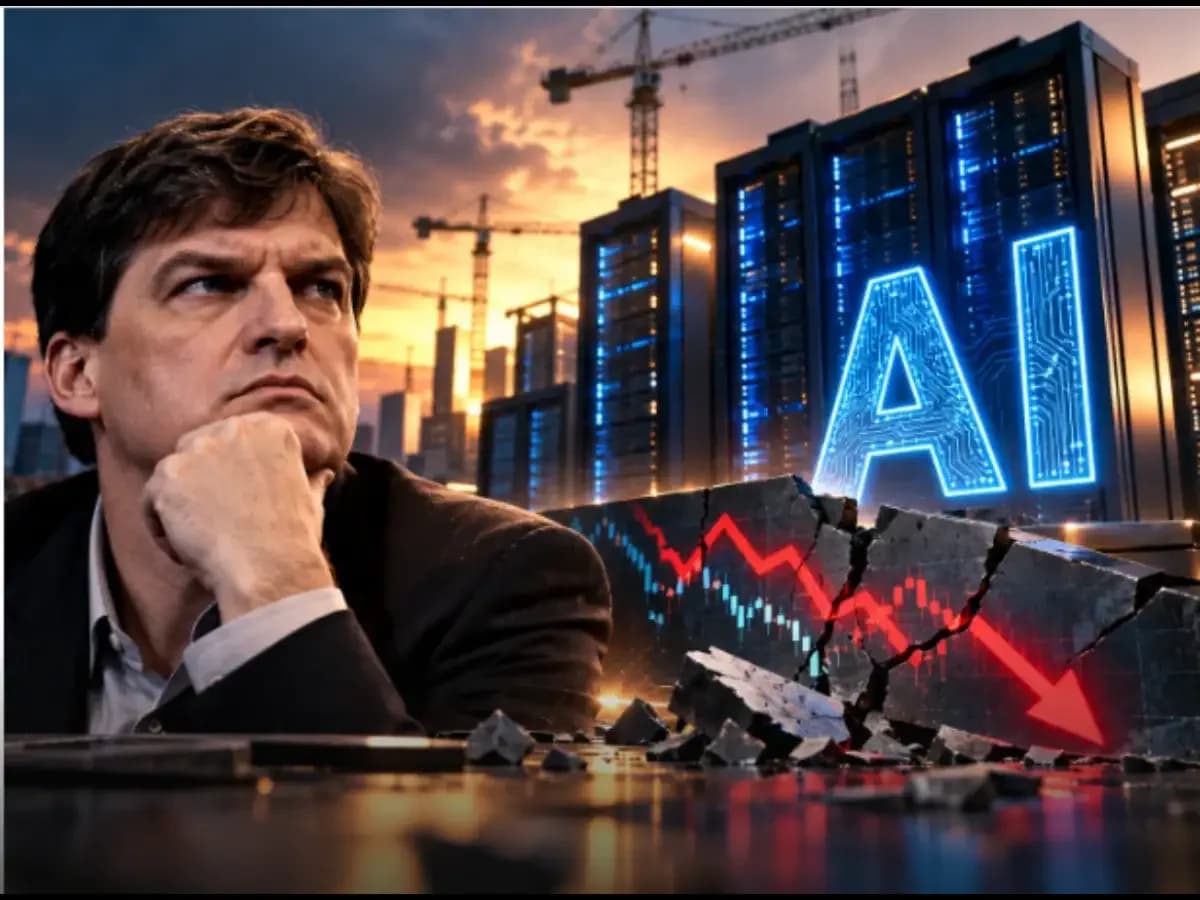
Veteran investor Michael Burry has revived his AI bubble warnings after discovering that nine technology giants have amassed around $3 trillion in off-balance-sheet commitments related to artificial intelligence infrastructure. According to The Wall Street Journal report shared by Burry on X, Google-parent Alphabet, Amazon, Facebook-parent Meta and Microsoft together reportedly disclosed $3 trillion in commitments largely for AI infrastructure, but these obligations are not yet recognized as liabilities on corporate balance sheets. Burry, who gained fame through his successful bet against the housing market depicted in The Big Short, continues to hold short positions in major AI-related stocks including iShares Semiconductor ETF, Micron, Nvidia, Caterpillar, Palantir, Tesla and Applied Materials. He warns that the market is close to a major top, comparing current conditions to the 1987 crash that saw the Dow Jones record a historic 23% plunge. As reported by The Economic Times, Burry argues that massive venture capital flows, rising AI debt issuance, and extreme market optimism are creating conditions where valuations may detach from economic reality. Burry has doubled his bet against Nvidia (NVDA) and called the company's $500 billion funding pact with major financial institutions a public relations stunt, comparing it to the tricks that sank Enron.

Fundstrat's Tom Lee has pushed back on the Enron warning, arguing that the $3 trillion in off-balance-sheet AI deals tells investors little about real risk. According to Lee, "The revelations from the journal article are actually helpful, but they're giving people an incomplete picture of how financial systems work." He pointed out that gross obligations in finance always dwarf the assets underneath them, citing options and swaps where paper exposure runs far above cash at stake. Lee noted that the commitments also come with exits - they hit balance sheets only when construction starts, and companies can cut future spending without facing lawsuits. Lee, who lived through the fiber firm era of the 1990s, argued that today's spenders are different - the Magnificent Seven earn some of the highest margins in corporate history. As reported by The Economic Times, unlike in the dot-com episode, today's starting point leaves markedly less room to cut interest rates or use fiscal policy to cushion the fallout.
The ECB compared the current AI boom with earlier technological revolutions, including the railway boom of the 19th century, the expansion of electricity and radio in the 1920s, and the internet boom of the 1990s. According to the central bank, transformative technologies attracted investment and valuations of companies adopting them rose sharply before falling. ECB economists referred to examples such as the dot-com bubble of the early 2000s, where investors remained concerned over whether the technology-led shift would boost the broader economy. As reported by the ECB, "as adoption spreads...uncertainty becomes economy-wide. If something then goes wrong with that technology, the whole economy suffers," requiring a higher risk premium that is likely to push stock prices down over time, even if growth in profit remains strong. The Economic Times notes that similar frenzies in history show that even if the technology succeeds and profits rise, stocks may still fall because it is hard to fulfil markets' excessively optimistic profit growth bets. Pence Capital Management's Dryden Pence estimates that AI spending already absorbs 2% to 2.5% of US GDP, similar to the transcontinental railroad in the 1850s, with only 30% of companies reporting productivity gains from AI so far and just 7% calling their rollout complete.
The ECB emphasized that the current scenario leaves much less room for maneuver to cut interest rates or use fiscal policy to cushion the impact of broader market instability. According to the central bank, a US AI fallout would not remain a US problem, as the effects could extend beyond financial markets to euro-area sentiment, financing conditions and hiring. While the euro area's own technology sector presents a smaller risk of a home-grown correction due to lower valuations and dominance by 'old economy' stocks, the central bank warned that a Mag7 correction is a question of financial stability for the euro area, rather than just a private one. The ECB noted that European stock markets are markedly less dependent on AI euphoria – due to the practical absence of European champions in this field – but the exposure of local investors to US assets is high enough to worry experts. As reported by The Economic Times, unlike in the dot-com episode, today's starting point leaves markedly less room to cut interest rates or use fiscal policy to cushion the fallout.