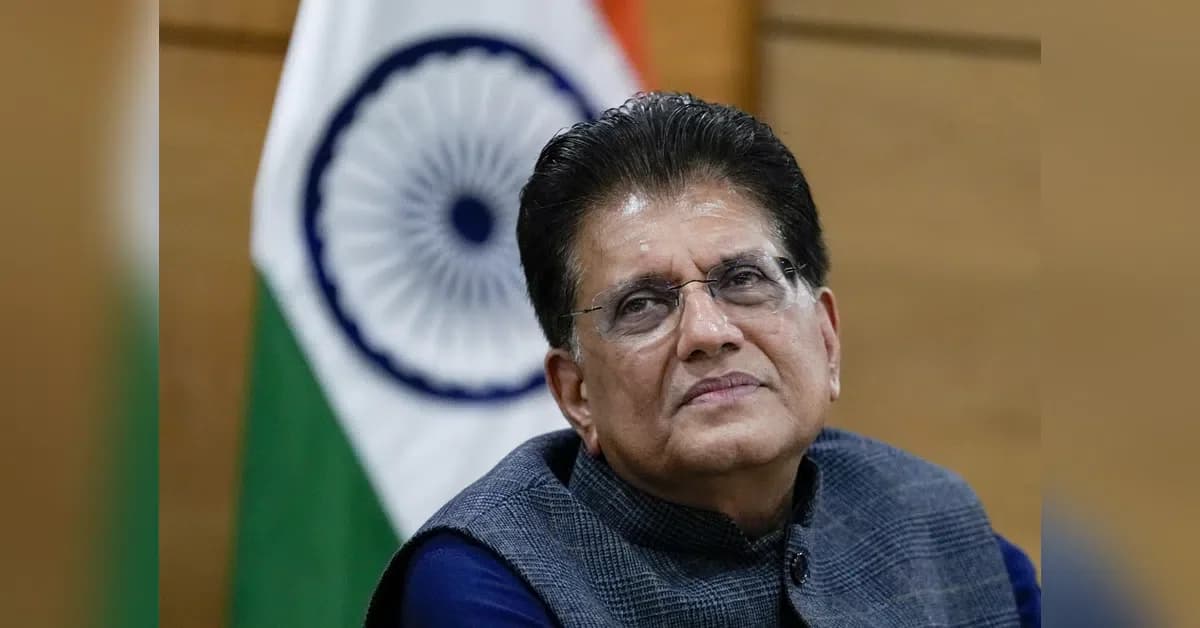
Commerce and Industry Minister Piyush Goyal announced on Tuesday that India and Canada are negotiating the proposed free trade agreement with full sincerity, and the talks could even be concluded before the end of this year, possibly by October. Speaking at a business event in Toronto, Goyal said that the prime ministers of India and Canada have "tasked both (Canada's Trade Minister) Maninder (Sidhu) and me to make sure that we work in a mission mode and finalise a very comprehensive economic partnership agreement (CEPA) before the end of the year." The minister added that Canadian Prime Minister Mark Carney has suggested concluding the negotiations by the end of November, that is, before the G20 Summit. Goyal emphasized that "don't be surprised if they actually can deliver even faster than targeted," citing the sincerity he has seen in both negotiating teams. The 2026 G20 Summit is scheduled to be held on Dec. 14-15, 2026, in Miami, United States, under the presidency of the US.
Union Commerce Minister Piyush Goyal met Canadian Prime Minister Mark Carney in Ottawa as both countries intensified talks on the proposed Comprehensive Economic Partnership Agreement (CEPA). In a post on X, Goyal said he called on Carney and conveyed greetings from Prime Minister Narendra Modi while discussing ways to deepen ties between the two countries. "Called on the Prime Minister of Canada, Mark J Carney, and conveyed warm greetings from Prime Minister Narendra Modi. Fondly recalled his recent visit to India, which has imparted fresh momentum and renewed confidence to the India-Canada partnership," Goyal stated. He added that "We had forward-looking discussions on further deepening bilateral cooperation and expressed optimism towards the early conclusion of the India-Canada Comprehensive Economic Partnership Agreement (CEPA), which would unlock new avenues of growth and prosperity for both nations." The minister's optimism came in response to Carney's X post where he emphasised the economic significance of the proposed trade pact, describing it as "a game changer" for Canadian industries and workers. Carney further emphasized the urgency of the negotiations, stating "We're working fast — I met Minister Piyush Goyal to review our progress so far and explore the opportunities ahead for both our countries in energy, agri-food, tech, and education."
Commerce and Industry Minister Piyush Goyal has led India's largest-ever business delegation of over 100 companies to Canada from May 25-29 to accelerate negotiations for the proposed Comprehensive Economic Partnership Agreement (CEPA). The delegation comprises top executives from sectors such as artificial intelligence, clean energy, critical minerals, pharmaceuticals, textiles and infrastructure, signaling New Delhi's renewed push to deepen economic engagement with Ottawa amid shifting global trade dynamics. According to NDTV Profit, the minister will call on Canadian Prime Minister Mark Carney and hold bilateral meetings with his counterparts Maninder Sidhu (International Trade Minister) and Anita Anand (Foreign Minister). Goyal confirmed that he has arrived in Ottawa with the largest Indian business delegation in the country's history, showcasing India's commitment towards the relationship. The minister also expressed confidence in the leadership of Maninder Sidhu to drive rapid progress in the relationship, stating "I have full confidence that under Maninder's leadership, we will make rapid progress." During the visit, Goyal said he had arrived with "the largest ever business delegation that stepped out of India ever in our history. At last count early this morning, at about five o'clock I was reported 112 Indian businesses had already taken off from India."
As conflict in West Asia raises concerns over energy security, Canada's High Commissioner Chris Cooter is making a compelling case for energy cooperation between the two nations. According to Business Standard, Canada's West Coast infrastructure will soon be able to deliver about 1 million barrels per day, with the country producing approximately 6 million barrels daily. For LNG, Canada is targeting 50 million tonnes per year by 2030, potentially rising to 100 million tonnes, which matches India's current import requirements of about 50 million tonnes annually. Cooter emphasized that "we're building the infrastructure on the West Coast of Canada that will allow us to change from just selling to the U.S. to also selling to Asia and India in particular," providing India with a secure alternative to Gulf imports amid current geopolitical uncertainties. The energy sector is anticipated to take centre stage during these interactions, with officials pointing out that India's surging energy requirements, coupled with Canada's vast natural resource wealth, position the two nations as natural partners across the entire energy spectrum, ranging from traditional hydrocarbons to clean energy transition initiatives. Goyal highlighted that India and Canada are "two very consequential economies, democracies, and sets of people who believe in the shared prosperity of not only their countries but to their contribution to global economies and global peace and security."
Goyal addressed businesses of both sides at a Toronto event, highlighting immense opportunities for collaboration in innovation, seafood, education, finance, insurance, biotechnology and pharmaceuticals. The minister emphasized that India offers huge opportunities as it has a talented workforce, 1.4 billion consumers and a fast-growing economy. "The opportunities are so huge that ultimately good economics will ensure a good partnership today," Goyal said, adding that "investors get good returns on their investments in India." He suggested that India's digital public infrastructure, like UPI, can help in reducing transaction costs in Canada. Critical minerals from Canada can help India become a manufacturing hub for sectors like electric vehicles and electronic goods. Both sides can explore dual-degree in the education sector and, in the future, consider campuses of eminent Indian institutions in Canada while also inviting Canadian institutions to teach Indian students in India. The Indian business delegation represents different sectors, including energy, mining, automotive goods, education, pharmaceuticals, telecommunications, artificial intelligence, leather, and textiles. Goyal also highlighted that Canada is home to over 4,25,000 Indian students and a strong Indian community.
Goyal highlighted that the government engaged with global industry leaders from Airbus, L'Oréal Groupe, Carrier and LVMH to deepen investments and strengthen manufacturing in India. According to the minister's post on X, discussions with LVMH focused on strengthening manufacturing in India, promoting local talent and enhancing exports, while talks with L'Oréal explored opportunities in India's beauty and personal care sector following the company's recent investment plans in Hyderabad. The minister also held key meetings to review the progress of India's FTAs, export promotion strategies and sanitary and phytosanitary approvals aimed at improving global market access for Indian agriculture and fisheries products. During the Canada visit, Goyal is also expected to discuss Canadian participation in India's SHANTI (Sustainable Harnessing and Advancement of Nuclear Energy for Transforming India) initiative, which aims to expand private sector participation in the country's nuclear energy ecosystem. The initiative proposes allowing private companies and joint ventures to apply for licenses to build, own and operate nuclear power plants, marking a major shift in India's traditionally state-led nuclear power framework. India and Canada, which had bilateral trade of $7.96 billion in FY26, aim to raise it to $50 billion by 2030. India's key exports to Canada include drugs and pharmaceuticals, iron and steel, seafood, cotton garments, electronic goods, and chemicals. India had a trade surplus of $1.39 billion with Canada in FY26. Key exports from India to Canada include pharmaceuticals, iron and steel, seafood, cotton garments, electronic goods and chemicals, among others. Imports include pulses, pearls and semi-precious stones, coal, fertiliser, paper and petroleum crude. India's main services sector exports include telecommunications, computer and information services, and other business services.