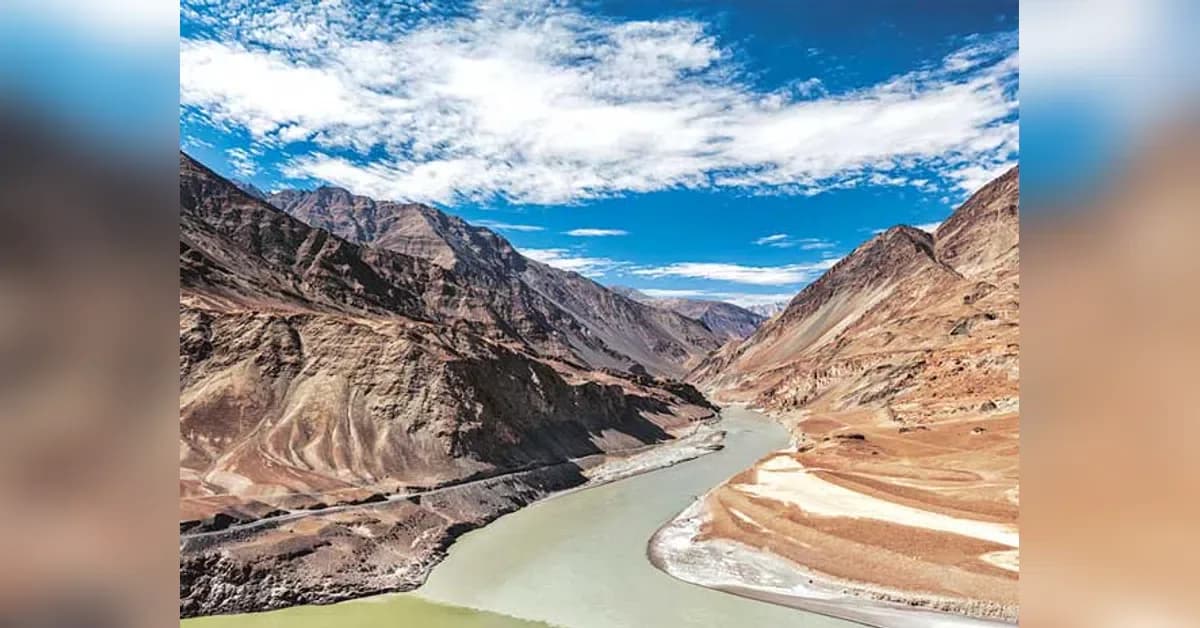
The Indus Water Treaty (IWT) will remain in abeyance, and India retains the option of exiting it entirely, according to latest government sources. As reported by Business Standard, the treaty, negotiated under the aegis of the World Bank and signed in 1960, allocates waters of the Indus, Jhelum, Chenab, Ravi, Beas and Sutlej between the two neighbours. Any revival of the pact, in any form, depends on two conditions: renegotiation of the terms of the agreement, and Pakistan ending its support for cross-border terrorism. Sources emphasized that "Any forward movement on the treaty rests entirely with Pakistan. We have seen no indication that Pakistan has done anything to abjure its support for cross-border terrorism or shown readiness to renegotiate the terms of IWT." The treaty, in its present form, "stands eroded" and cannot proceed without renegotiation of the original 1960 terms.
Canadian Foreign Minister Anita Anand, of Indian origin, made her maiden official visit to Pakistan on Monday, marking the first visit by a Canadian foreign minister to the country in nearly two decades. According to Firstpost, Anand held talks with Pakistan's Deputy Prime Minister and Foreign Minister Ishaq Dar soon after arriving in Islamabad. The visit comes at a time when Pakistan has been rattled by India's decision to place the Indus Waters Treaty in abeyance following the April 22 Pahalgam terror attack, in which 26 civilians were killed. During their meeting, Dar raised the Indus Waters Treaty issue, stating that "We seek the support of our friendly countries, including Canada, towards India's immediate restoration of the IWT and upholding international law and treaty obligations." The joint press interaction took place during Anand's two-day visit to Pakistan.
During her visit, Anand announced more than $47 million in development and security assistance for Pakistan, including over $2.2 million for new security initiatives through Interpol, the United Nations and other international organisations. According to Firstpost, the initiatives will focus on border management, counterterrorism, financial crime investigations and training for Pakistani law enforcement agencies. Calling Pakistan an "important partner" in Canada's trade diversification strategy, Anand said Ottawa was looking to expand cooperation with Islamabad. The visit also included a "warm and cordial" meeting with Prime Minister Shehbaz Sharif", as quoted by Pakistan's Prime Minister's Office. According to the PMO, Canadian Prime Minister Mark Carney had directed Anand to expand Canada's engagement with Pakistan.
Pakistan is attempting to push a false narrative claiming that India's decision to keep the treaty in abeyance is causing water scarcity, according to government sources cited by Business Standard. In reality, Pakistan has 140 million acre feet (MAF) of water in the Indus, but 35 MAF goes to waste in the sea because no major dam has been built since 1976. Of the remaining 105 MAF, another 45 MAF is lost due to seepage and a poor canal network. India's share from the three western rivers — Indus, Jhelum and Chenab — is just 33 MAF, which is less than the amount of water Pakistan wastes and allows to flow into the sea. Sources pointed out that within Pakistan, Punjab draws more water than Sindh, and unless these internal issues are addressed, attempts to create a narrative against India will not hold.
Indian officials have provided evidence supporting their position on Pakistan's continued support for terrorism. As reported by Business Standard, sources stated that proscribed individuals and entities sanctioned by the UN Security Council's 1267 sanctions committee continue to appear at public events in Pakistan and continue to have platforms to propagate their messages. The evidence from Indian agencies suggests that there are no credible steps that have been taken so far to control terrorist activities across the Line of Control. Pakistan's conduct under the IWT has also reflected a consistent pattern of obstruction rather than cooperation since the early years of implementation, with virtually every Indian project on the Western Rivers facing similar resistance. Sources emphasized that "Pakistan, in the last two cases, chose to go directly to the Court of Arbitration," calling the process illegal, and that New Delhi will not participate in the proceedings of the Court of Arbitration initiated by Pakistan.