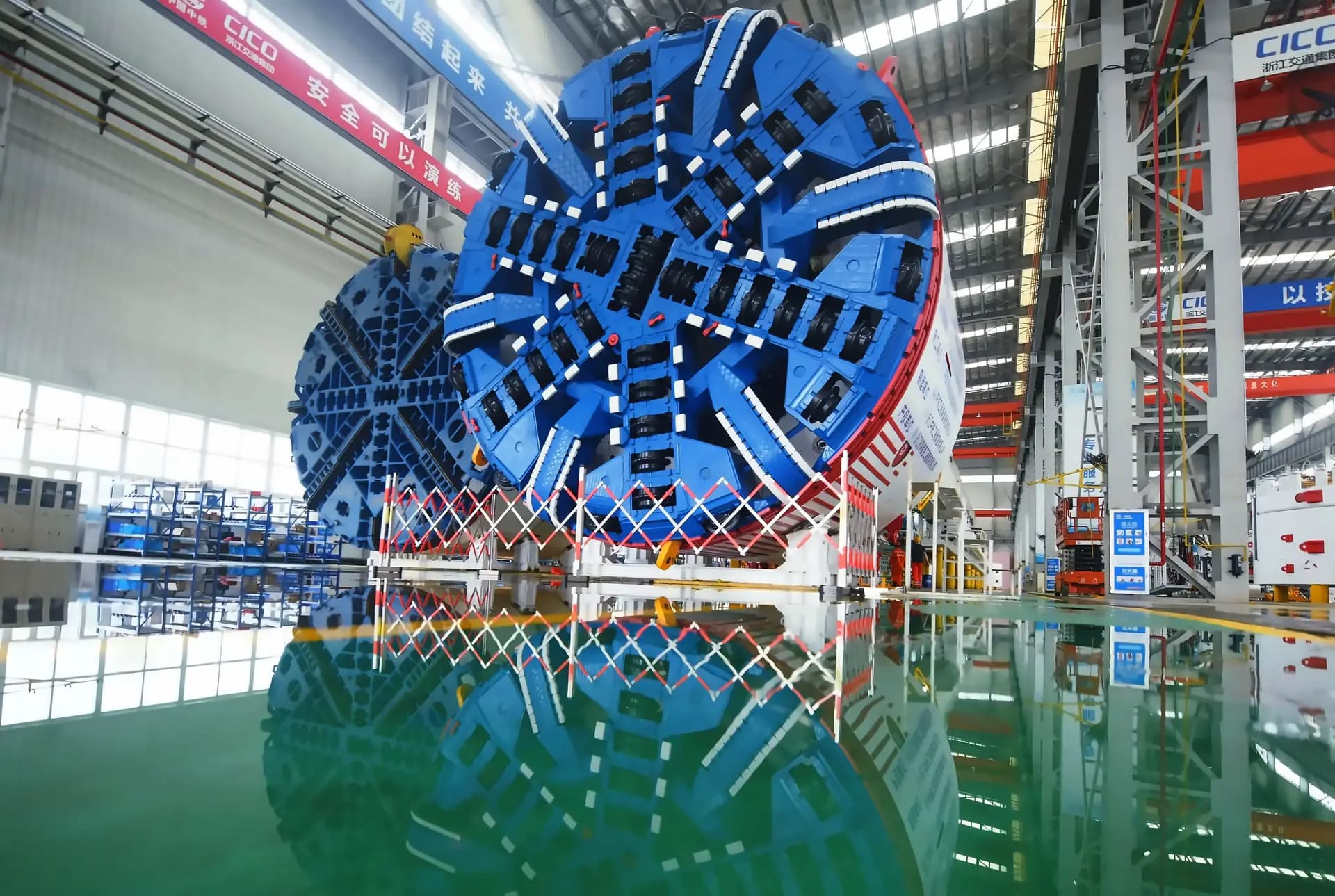
China has implemented new export controls targeting construction equipment, including tunnel-boring machines - some of the world's largest and most complex industrial devices. According to reports from Business Standard, these machines are used to build subways or drill roads and railways through mountains. China dominates the global market with approximately 70% global share, making it a near-monopoly position. The new restrictions, set to take effect later this month, apply to other construction equipment including machines for spraying concrete at high altitudes, with Beijing invoking potential dual use in military as well as civilian projects. As Kyle Chan, a fellow at the Brookings Institution, noted, "Beijing increasingly sees its position as a key global producer of construction equipment in strategic terms."
The new curbs carry particular significance for India due to ongoing border tensions between the two countries. As reported by Business Standard, the Himalayan border between the world's most populous countries has long been a flashpoint, with tensions flaring again just last week. India is building railway lines and roads in the area with an eye on reducing troop mobilization times, requiring substantial tunnel construction. The inclusion of high-altitude machinery suggests particular attention to strategically sensitive terrain, with experts noting that China's central concern is where Chinese engineering capabilities are used and whether they could strengthen another country's military infrastructure. Sun Chenghao, a fellow at Tsinghua University's Center for International Security and Strategy, explained that "for China, the central concern is where Chinese engineering capabilities are used and whether they could strengthen another country's military infrastructure."
China has previously demonstrated its ability to flex its muscle as chief exporter of tunnel-diggers, as reported by Business Standard. In 2024, China delayed efforts by Germany's Herrenknecht AG to sell tunnel-boring machines to India for use in projects like the Ahmedabad-Mumbai bullet train and the Delhi metro. A spokesperson for Herrenknecht confirmed the firm is studying the latest Chinese restrictions. The company faces challenges as China's new curbs apply to components as well, requiring regular supply of parts for heavy wear and tear in existing machines. Ajay Srivastava, founder of the New Delhi-based Global Trade Research Initiative, noted that "there'll be an impact on the existing stock of machines as well as procurement of new ones."
India has ambitious infrastructure plans requiring significant tunnel-boring capabilities. According to Business Standard, Road Transport and Highways Minister Nitin Gadkari has announced that India aims to invest up to $9.6 billion on tunneling over the next five years, and urged local industry to manufacture boring machines. The government is reportedly considering a $1.2 billion incentive plan for makers of construction equipment. However, domestic manufacturing faces challenges as India is at an earlier phase compared to China's scale operations, with no way to compete on cost when compared to Chinese prices. R. Shankar Raman, president of Mumbai-based engineering giant Larsen & Toubro Ltd., said his company is building a prototype tunnel-borer and "if our experiment proves successful" might be able to source its own machinery and sell to others. But with India at an earlier phase of manufacturing, and China doing it at scale, there's no way to compete on cost.
While China dominates the global market, there are alternatives available in the long run. As reported by Business Standard, besides Herrenknecht, there are other manufacturers in the US and Japan that build potential substitutes. China Railway Engineering Equipment Group Co Ltd, the top producer, says its equipment is used in 36 countries including Denmark and France. However, most customers face difficulty in making an immediate switch away from Chinese suppliers, and building domestic capacity remains challenging for large countries like India with ambitious infrastructure plans. The new export controls could prove a boon to alternative manufacturers in the long run, but immediate switching is difficult for most customers. Ajay Srivastava from Global Trade Research Initiative noted that "for any priority project, India can shift equipment from other sites," but the component restrictions create additional challenges for existing machinery.