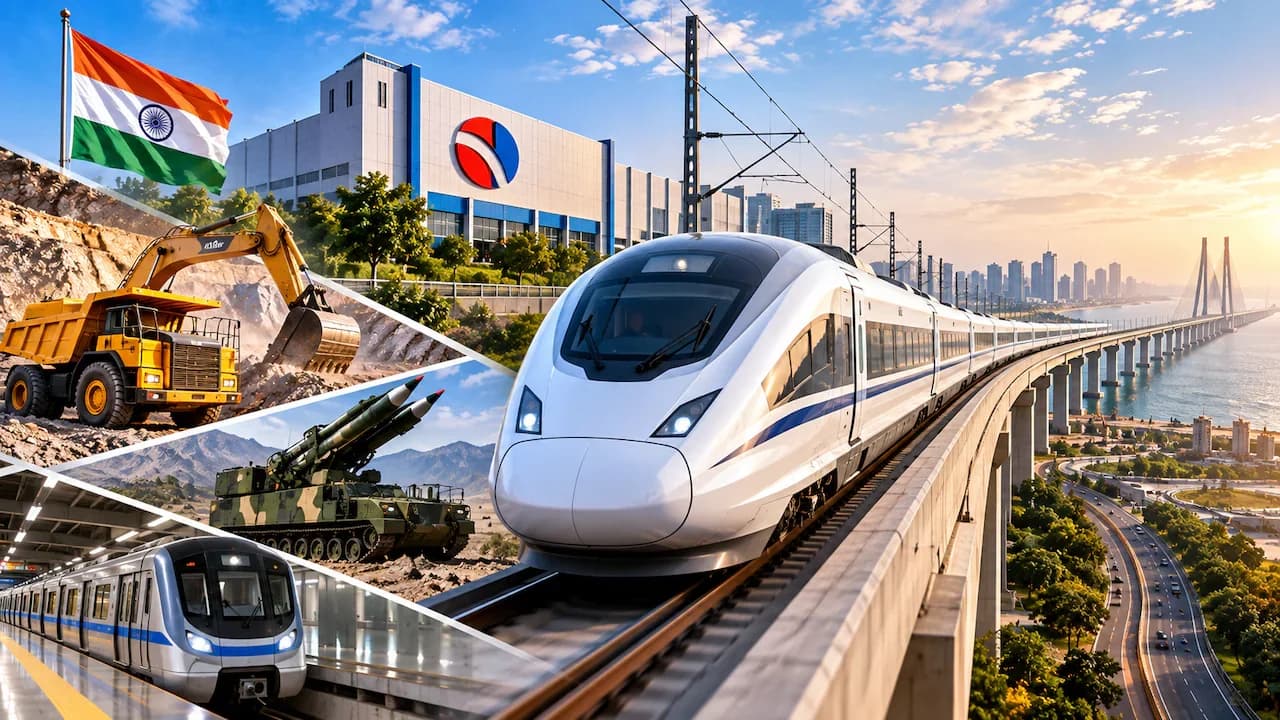
Union Minister of Railways Ashwini Vaishnaw announced that Indian Railways is moving towards four-laning the entire high-density railway routes, as reported by The Times of India. The initiative targets seven high-density routes that span nearly 11,000 kilometres and carry a major share of the country's rail traffic. These routes include Delhi-Howrah, Howrah-Chennai, Chennai-Mumbai, Mumbai-Delhi, Delhi-Chennai, Mumbai-Howrah and Delhi-Guwahati corridors. Vaishnaw emphasized that the expansion will help create more capacity across the network and support the future growth of passenger and freight traffic.
According to the minister's statement, these seven high-density routes account for around 41% of railway traffic while covering 16% of the railway network. The expansion aims to increase passenger and freight carrying capacity significantly across these critical routes. The four-laning process involves expanding existing railway corridors from two tracks to four, allowing more trains to run and easing congestion on these routes that connect some of India's biggest cities and regions. As reported by The Times of India, these routes often see demand outpace supply, making the capacity expansion crucial for handling growing traffic.
The Cabinet Committee on Economic Affairs recently approved four railway projects with a combined estimated cost of approximately ₹9,450 crore, as reported by The Times of India. The approved projects include: Kharagpur–Bhadrak (Ranital) 4th Line covering 173 km, Bhadrak–Haridaspur 4th Line covering 75 km, Gummidipundi–Gudur 3rd and 4th Line covering 90 km, and Cuttack–Paradeep (Badabandha) 3rd and 4th Line covering 72 km. Together, these projects will cover eight districts across West Bengal, Odisha, Tamil Nadu and Andhra Pradesh and add around 410 km to the existing Indian Railways network. The projects have been planned under the PM-Gati Shakti National Master Plan with emphasis on improving multi-modal connectivity.
The announcement has provided a positive read-through for railway infrastructure, EPC and rail-equipment stocks. As reported by Upstox, the Nifty India Railways PSU Index was trading flat in early trade. Individual stock performance showed Bharat Electronics (BEL) shares up 0.76% at ₹410 on the NSE, while Titagarh Rail Systems was up over 1% at ₹835.15. Other notable gainers included Ircon International trading 0.27% higher at ₹124.38, Indian Railway Finance Corp (IRFC) up 0.23% at ₹85.90, and Jupiter Wagons up 0.22% at ₹247.40. Additionally, Airfloa Rail Technology shares rose to ₹454.95 following the company's recent ₹1.92 crore railway order win, as reported by HDFC Sky. On Thursday, Titagarh Rail Systems, IRCON International, Texmaco Rail & Engineering, RailTel Corporation of India, IRFC and RVNL were all trading in the green, according to Essential Business Intelligence.
Vaishnaw highlighted that the four-laning initiative is part of a larger effort to build a railway network with greater capacity, lower transport costs and cleaner mobility under the leadership of Prime Minister Narendra Modi. The minister also underlined the environmental and economic advantages of rail transport over road transport, positioning this as a strategic move for sustainable infrastructure development in India's railway sector. The expansion supports growing movement of people and goods nationwide while promoting cleaner mobility across the country. As reported by The Times of India, the multi-tracking works will help ease congestion and make train operations more streamlined, with the additional capacity expected to strengthen rail connectivity to major tourist destinations including Kuldiha Wildlife Sanctuary, Bhitarkanika National Park, and other key locations.