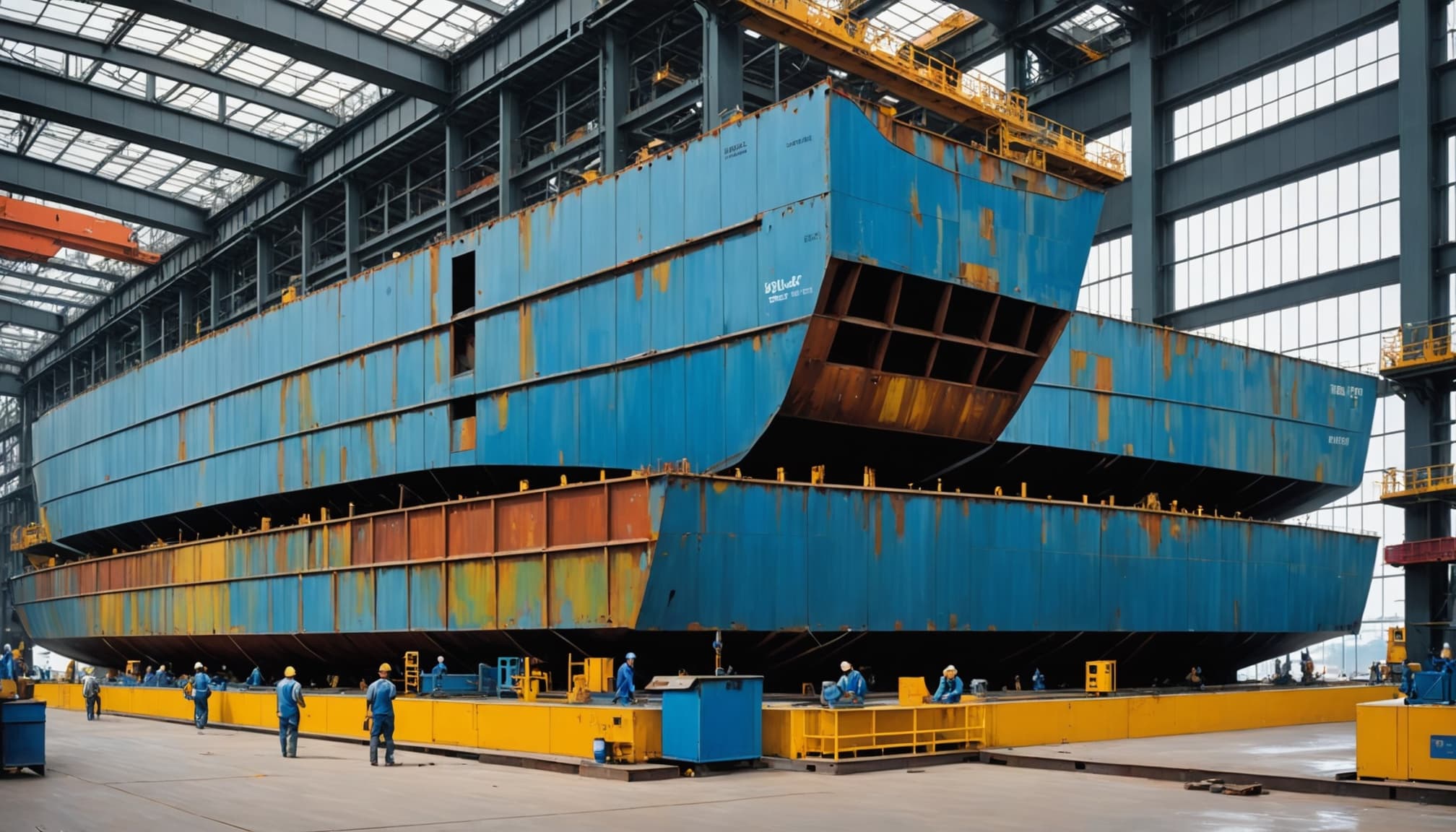
Mazagon Dock Shipbuilders has seen its order book shrink dramatically from approximately ₹49,700 crore at FY21-end to ₹18,218 crore at Q1 FY27. That's a 63% decline from the Q4 FY25 level of ₹32,000 crore, leaving just 1.4 years of revenue visibility based on FY26 revenue of ₹12,500 crore. The culprit? Faster execution than new order inflows. The company invoiced roughly ₹24,000 crore from its ₹32,000 crore order book over two years, while major defense projects like P75I submarines, LPD vessels, and P17 Bravo frigates remain stuck in the pipeline. Transcripts +2
Cochin Shipyard tells a different story. Its order book stands at ₹21,900 crore covering 78 vessels, with 5+ years of revenue visibility based on FY26 turnover of ₹5,021 crore. The diversification helps: defense (54%), commercial exports (33%), domestic commercial (7%), and ship repair (6%). With L1 declared for five Next Generation Survey Vessels worth ₹5,000 crore, the order book will swell to ₹27,000 crore. InvestorPresentations +2
The ₹69,725 crore government shipbuilding package mentioned in market discussions doesn't appear in corporate filings. However, related initiatives exist: a ₹70,000 crore Maritime Development Fund to support domestic shipbuilding, plus major defense projects in pipeline—P17 Bravo frigates (₹70,000 crore), MCMV project (₹44,000 crore), and next-generation destroyers (~₹70,000-80,000 crore). Transcripts +1
The Profitability Paradox
Here's where it gets interesting.
Mazagon Dock's operating margins expanded from 7.38% in FY22 to 16.97% in FY25, driven by defense specialization and repeat orders on destroyers, frigates, and submarines. AnnualReports +1
Cochin Shipyard's margins tell a story of contraction. Net profit has effectively stagnated around ₹600-800 crore over five years (excluding FY23's decline and FY24's recovery), despite revenue growth from ₹1,324 crore to ₹1,915 crore. Operating margins peaked at 32% in FY21 and FY24 but compressed to 26.28% in FY25 as high-margin aircraft carrier projects wound down. AnnualReports +1
The margin differential comes down to business models. Mazagon Dock's defense-focused execution delivers higher asset turnover and operational efficiencies on familiar projects. Cochin Shipyard's diversified model balances shipbuilding margins (10-12%) against ship repair (22-24%), but requires separate asset bases and is still ramping up new facilities. Transcripts
The Other Income Trap
Both companies rely heavily on other income, raising sustainability questions. Mazagon Dock's other income hit ₹1,00,584 lakh in FY25—nearly triple from FY22 levels—primarily from interest on customer advances. At ₹1,139 crore, this represents 35% of pre-tax profit. The risk? As the order book contracts without new awards, future customer advances will decline unless the pipeline materializes. AnnualReports +1
Cochin Shipyard's dependence is even starker at 46% of pre-tax profit. The ₹38,907 lakh in FY25 other income included ₹14,054 lakh (36%) from provision write-backs—non-recurring items that won't repeat. Strip these out, and dependence drops to ~30%, still significant but more manageable. AnnualReports
The Cash Flow Conundrum
Both companies reported negative operating cash flow in FY26, but for different reasons. Mazagon Dock swung from +₹2,102 crore to -₹2,654 crore.
Contract liabilities dropped from ₹15,494 crore to ₹10,303 crore. Core operations remained healthy with operating profit before working capital at ₹2,714 crore. Transcripts +2
Cochin Shipyard's deterioration from -₹284 crore to -₹1,253 crore reflects structural working capital intensity. Trade receivables consumed ₹1,300 crore as milestone billings outpaced cash collection across 75 vessels in various stages. Trade payables reversed from +₹559 crore inflow to -₹212 crore outflow, suggesting supplier pressure. Inventory turnover declined to 0.59 from 0.95 in FY24, indicating execution bottlenecks. AnnualReports +1
The Valuation Disconnect
The market's pricing seems contradictory.
Mazagon Dock's P/B of 9.23x reflects expectations of higher ROE from defense specialization, while Cochin Shipyard's 6.19x P/B suggests lower return expectations .
The order book multiple tells another story: Mazagon Dock at 5x order book versus Cochin Shipyard at 1.7x. The market appears to be pricing Mazagon Dock on potential large defense inflows (management expects order book to exceed ₹1 lakh crore by FY'26-'27) and Cochin Shipyard on current execution strength and diversification benefits. Transcripts +1
What Must Materialize
For Mazagon Dock, the P75I submarine contract (negotiations ongoing), LPD project (₹35,000-40,000 crore, RFP in 4-5 months), and P17 Bravo frigates (₹50,000-60,000 crore, RFP February-March) must convert to justify valuations. For Cochin Shipyard, the ₹5,000 crore survey vessel order and defense pipeline of ₹2,85,000 crore need to materialize while maintaining execution efficiency. Transcripts +4
The divergence comes down to this: Mazagon Dock is a high-return defense specialist betting on order book recovery, while Cochin Shipyard is a diversified player trading at premium multiples for revenue visibility and long-term export potential. Both face execution risks, but the nature of those risks—and the market's tolerance for them—couldn't be more different.