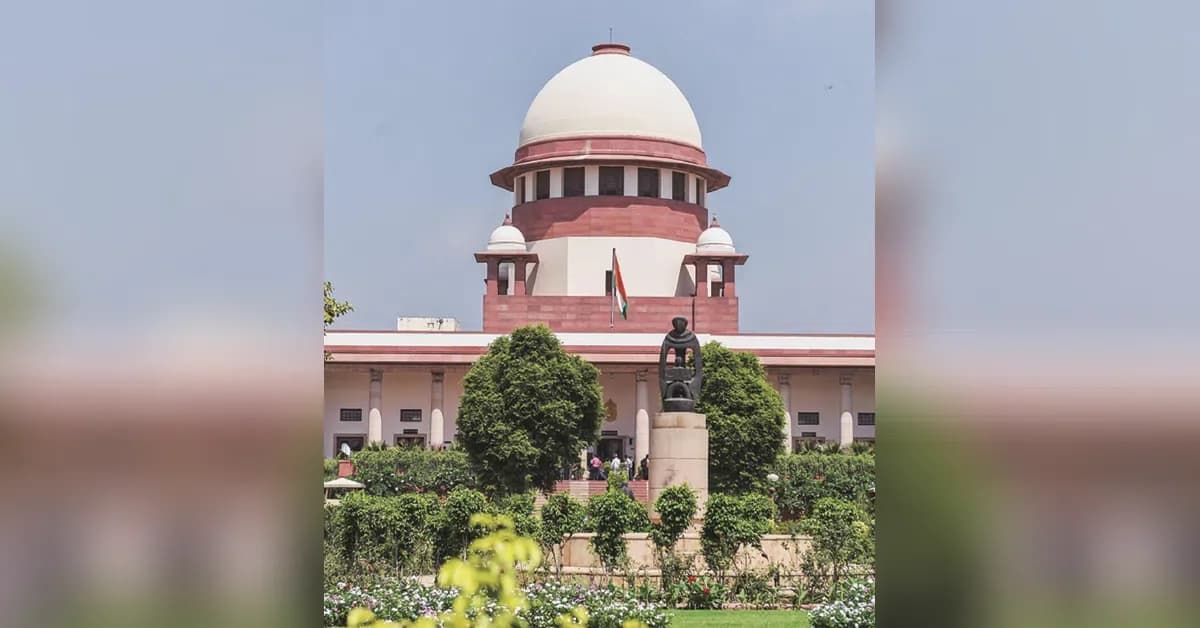
The Supreme Court on Friday (June 19) ruled that the right to walk on safe and demarcated footpaths is a fundamental right under Part III of the Constitution, with priority over movement by motorised vehicles. According to reports from Business Standard, a bench of Justices P S Narasimha and A S Chandurkar emphasised that citizens are entitled to enforce restitutionary remedy in case of violation of their right to walk. The declaration came in a motor accident compensation case where a five-year-old child was killed while walking to school with his father when a tanker struck him from behind. Justice Narasimha, who authored the judgment, held that "If a road exists, there must then be a duty to ensure that a footpath is demarcated and maintained for the walkers. This is an enforceable duty. The fundamental right to walk on demarcated footpaths shall override the privilege of a motorised vehicle." The Court stated that this fundamental right forms part of the right to movement guaranteed under Article 19 (1) (d) and other fundamental rights, including Article 21- Right to life and liberty. Justice Narasimha observed that walking safely and carefree along wide footpaths, without danger lurking at every turn, was the most basic of rights and described it as "the simplest of the simple human activity, inextricably connected to life."
The Supreme Court called for the establishment of a dedicated regulatory body to effectuate this fundamental right. As reported by Business Standard, the bench stated that such a regulator should work with perpetual seal and succession to develop and retain institutional memory. Justice Narasimha emphasised that "To enhance and effectuate the fundamental right to walk on demarcated footpaths, it is necessary to establish a regulatory body. Institutional expertise is critical, and such a regulator will employ human resources with domain expertise and talent." The court noted that the fundamental right to walk on demarcated footpaths has a correlative duty and if the road exists, there is a duty to ensure that there are demarcated and well-maintained footpaths for walkers. The Court observed that Indian cities and towns have systematically prioritised motor vehicles at the cost of pedestrians, resulting in the exclusion of millions of citizens from public spaces and that pedestrians are often treated as "a nuisance" on roads that should belong to everyone. Justice Narasimha criticised that "Moving on wheels have eclipsed human imagination. Governments and local bodies paralleled wide roads and expressways to growth, busily building motorways while leaving little space for the essential pleasure of walking."
The top court clarified that the restitutionary remedy under the Constitution or under Sections 38-40 of the Specific Relief Act, 1963 can be enforced against Urban Development Authorities, Municipal Corporations, Municipalities or the Panchayats. According to Business Standard, the bench noted that Part III of the Constitution has a unique relationship with Parliament and state legislatures, which envisages a positive role for legislature to effectuate fundamental rights. The Court observed that remedies under the Motor Vehicles Act, 1988, are not sufficient to protect pedestrian rights and that the Motor Vehicles Act has been an impediment and, in many ways, undermined the precious rights of walkers. Justice Narasimha wrote that "The Motor Vehicles Act is built upon 'vehicle' as the subject of the legislation, while 'human' interests are incidental, which a motor vehicle must avoid violating – that's all, and no further." The court made clear that citizens whose right to walk on demarcated footpaths is violated can seek constitutional and legal remedies against the responsible authorities for restitution and compensation, with this route being separate from claims available under the Motor Vehicles Act, 1988. The Court referenced modern legislative frameworks including the Right to Information Act, Right to Education Act and National Food Security Act of 2013 as examples of institutional governance through regulatory bodies.
The Supreme Court highlighted that though the right to walk on demarcated footpaths is integral to Articles 21 and 19(1)(d) of the Constitution, there is no express legislation for its execution. As reported by Business Standard, the bench stated it is "compelling to lay down a statutory framework not only for declaring the right but also for recognising the duty bearers." The Court emphasised that the fundamental right to walk on demarcated footpaths cannot be interpreted merely as the existence of a physical pathway and that the constitutional guarantee necessarily requires accessible, continuous, unobstructed, and universally designed pedestrian infrastructure. Justice Narasimha asked the government "In reality, how much does it take to create a well-demarcated footpath wherever a road exists? All that the fundamental right to walk demands is a comfortable space for an easy and carefree walk. Should this not be the minimum of the minimum duty that a municipal authority owes to the citizens?" The court directed the registry to send copies of the judgment to the Centre through ministries of housing and urban affairs, rural development, and road transport and highways to reflect on the necessity for initiating legal framework. Additionally, a copy was sent to the Law Commission for examining the statutory framework for protecting this fundamental right.
The judgment has profound implications for persons with disabilities, older persons, children, and all vulnerable road users, as the Court noted that a footpath that cannot be used safely and independently by persons with disabilities cannot be regarded as a constitutionally compliant footpath. The Court reinforced obligations under the Department of Empowerment of Persons with Disabilities' notified accessibility standards, the Rights of Persons with Disabilities Act, 2016, the Rules framed thereunder, and the Harmonised Guidelines and Standards for Universal Accessibility in India. For decades, persons with disabilities have argued that inaccessible footpaths deny them the ability to access education, employment, healthcare, recreation, justice, and participation in community life. Justice Narasimha observed that "Walking plays a pivotal role in politics and social reform. Walking is a struggle for the not-so-fortunate, meditation in motion for many, resistance for others, discovery for the inquisitive, a cohesive strategy for sharp socio-political minds." He noted that walking embodies expressional, congregational and associational rights under Article 19(1)(a), Article 19(1)(b) and Article 19 (1)(c). The Court emphasised that for persons with disabilities, the right to walk on demarcated footpaths cannot be interpreted merely as the existence of a physical pathway and that the constitutional guarantee necessarily requires accessible, continuous, unobstructed, and universally designed pedestrian infrastructure including step-free and barrier-free footpaths, accessible kerb ramps at crossings, tactile guiding and warning indicators, adequate width for wheelchair users, removal of encroachments, and accessible wayfinding and signage.