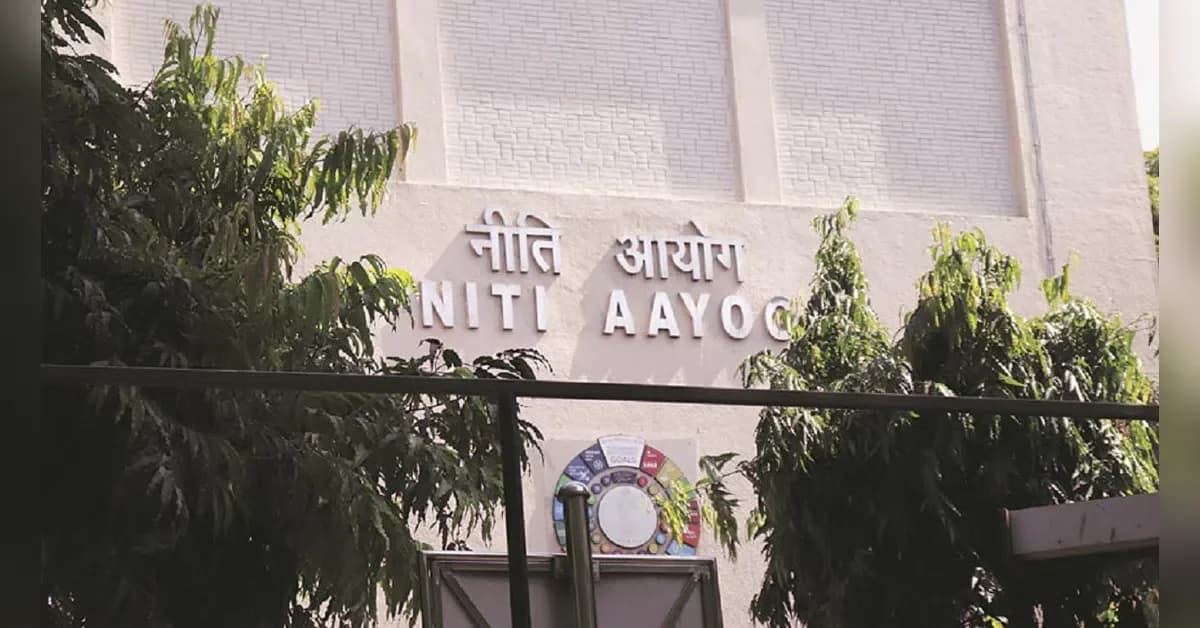
The 11th meeting of the NITI Aayog Governing Council on Thursday marked a historic milestone as Chief Ministers of all 28 states attended the meeting for the first time. According to reports from Business Standard, the meeting, themed 'inclusive human development', saw participation from CMs, lieutenant governors and administrators of 28 states and five Union Territories. Previous meetings had seen some non-NDA CMs, including West Bengal's Mamata Banerjee and Tamil Nadu's M K Stalin, boycotting the same, though Karnataka CM D K Shivakumar attended Thursday's meeting. Karnataka CM D K Shivakumar emphasized that around 40 per cent of Bengaluru's residents come from other states, requiring strong central assistance for infrastructural upgradation. "We believe that the Government of India and states must work as equal partners in designing solutions tailored to diverse regional realities," he added.
Odisha CM Mohan Charan Majhi highlighted the state's exceptional economic performance, announcing that Odisha recorded 7.9 per cent growth in FY26 while maintaining fiscal discipline. As reported by Business Standard, the state has secured the top position in NITI Aayog's Fiscal Health Index 2026, demonstrating how strong fiscal governance can coexist with accelerated development. The chief minister emphasized that Odisha has kept both fiscal deficit and debt levels within the limits prescribed under the Fiscal Responsibility and Budget Management (FRBM) framework even as it continues to invest heavily in infrastructure, social welfare and human development. Majhi attributed a significant part of Odisha's growth momentum to enhanced central support for infrastructure projects, thanking the Union government for allocating ₹10,928 crore for railway development in the 2026-27 Union Budget. Railway projects worth more than ₹90,000 crore are currently under implementation across the state, with these investments expected to strengthen connectivity and boost industrial activity.
Rajasthan CM Bhajanlal Sharma announced that the state has signed agreements worth ₹35 trillion in investments, of which projects worth over ₹9 trillion have seen groundbreaking. According to Business Standard, he said the state aims to become a $350 billion economy by 2029, supported by a current GSDP growth rate of 10.24 per cent. Maharashtra CM Devendra Fadnavis shared a road map to transform the state into a $5 trillion economy by 2047. Telangana CM A Revanth Reddy proposed an 'M-6 Task Force' under the Prime Minister's Office for the development of Delhi, Mumbai, Kolkata, Chennai, Hyderabad, and Bengaluru, seeking a special fund of ₹6 trillion for infrastructure development - ₹1 trillion per city. The state government aims to make Telangana a one-trillion-dollar economy by 2034.
Chhattisgarh CM Vishnu Deo Sai presented a road map focused on increasing the monthly income of families in Bastar to ₹30,000 over the next three years, with currently around 85 per cent of families earning less than ₹15,000. As reported by Business Standard, he proposed ushering in a dairy revolution, expanding irrigation facilities across 32,000 hectares, promoting tourism as a major industry, and attracting investments in emerging sectors such as artificial intelligence and semiconductors. Haryana CM Nayab Singh Saini sought a special incentive package from the Centre to develop the state into a semiconductor, data centre, and electronics manufacturing hub. Goa CM Pramod Sawant requested the Centre to extend the Centrally Sponsored Scheme (CSS) to the state on 90:10 basis, citing that over 60 per cent of Goa's land is under forests, eco-sensitive zones, coastal regulation zones, and the Western Ghats.
Karnataka CM D K Shivakumar highlighted that around 40 per cent of Bengaluru's residents come from other states, requiring strong central assistance for infrastructural upgradation. According to Business Standard, he proposed a one-time infrastructural grant to government schools and colleges, urged the Ministry of Corporate Affairs to strictly enforce CSR rules, and proposed that industries share job requirements through a centralised portal. Punjab CM Bhagwant Singh Mann sought special category status and a financial package for revitalising border area development, noting that only 107 villages have been covered under the Vibrant Village-II Programme while more than 2,000 villages and towns are located in close proximity to the border. Uttarakhand CM Pushkar Singh Dhami emphasised the need for special policy support and long-term financial assistance for Himalayan states.