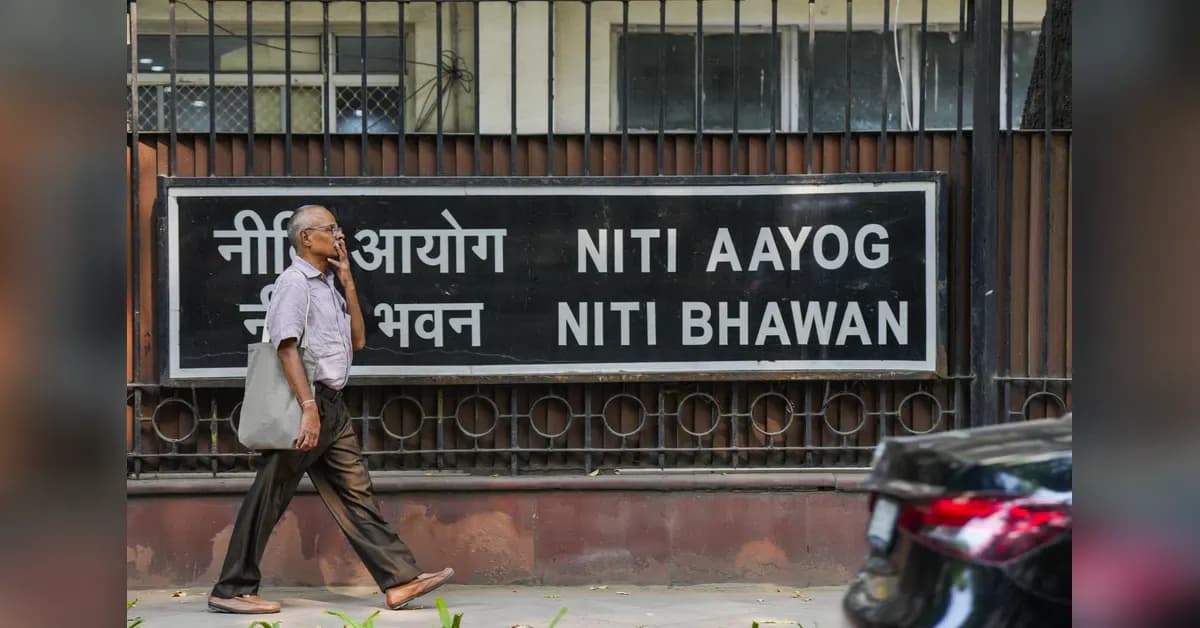
NITI Aayog has released India's first-ever Investment Friendliness Index 2026, assessing 36 states and Union Territories across 84 indicators on an aggregate score out of 100. According to the apex think tank, no state crossed the 60-mark despite five qualifying as top performers, with five states clearing 50 to be classed as 'top performers' — Goa, Gujarat, Maharashtra, Odisha and Tamil Nadu. The index evaluates states and UTs across eight key pillars: infrastructure, business climate, resources, government policy, regulatory ease, financial health, institutional environment and environmental resilience. As reported by Business Standard, Vice Chairman Ashok Lahiri emphasized that this is not a ranking exercise but an informative tool to help states identify areas of performance and improvement needed. NITI Aayog launched the Investment Friendliness Index (IFI) on July 17, with the index serving as a benchmark for states to improve their investment environment and supporting evidence-based policymaking.
Gujarat topped the overall rankings with a score of 56.6, followed by Maharashtra at 53.7 and Tamil Nadu at 53.3, with Goa at 53.1 and Odisha at 52.4 completing the top five performers. Delhi ranked sixth with 49.9, followed by Madhya Pradesh at 48.9, Andhra Pradesh and Karnataka jointly at 48.7 each. The relatively modest scores of even the leading states underline the scope for improvement, with the index designed to identify reform gaps rather than certify that top-ranked states have resolved all investor constraints. Gujarat's performance was attributed to efficient port operations, reliable electricity supply, a competitive power sector and its fiscal position, while Maharashtra scored strongly on its business climate, including its ability to attract private equity and venture capital investment and the highest number of Atal Tinkering Labs (ATLs). Tamil Nadu's position was driven by its ports, export performance and a near 100% conversion rate for investment memorandums of understanding.
Gujarat's top ranking was driven by its investor facilitation systems, industrial infrastructure and policies aimed at making business approvals faster and simpler. The state's Industrial Extension Bureau (iNDEXTb) provides a single-window platform that helps companies access multiple services and approvals through one system, along with time-bound processes for statutory approvals and No Objection Certificates (NOCs). The state benefits from strong logistics infrastructure, accounting for nearly 10% of India's state highway network, almost four times the national average, with the highest estimated expressway length at 635 kilometres. Gujarat's industrial ecosystem includes plug-and-play facilities such as Dholera Special Investment Region (SIR), GIFT City, Sanand, Dahej, Jhagadia and Saykha, which reduce time and cost for manufacturing unit setup. The Vibrant Gujarat Global Summit has played a role in attracting domestic and international investors by providing business partnership platforms and investment commitments.
In the 12 hilly and northeastern states category, Uttarakhand led with 47.5, narrowly ahead of Assam and Himachal Pradesh. Among the seven city states and Union Territories, Goa dominates with 53.1, comfortably ahead of Delhi and Chandigarh. According to the report, among the large states, Bihar, Jharkhand and West Bengal occupied the bottom three positions, while Odisha, Madhya Pradesh and Andhra Pradesh were placed fourth, fifth and sixth, respectively. The index assesses all 28 states and eight Union Territories, examining both factors that enhance a state's attractiveness for investment and hurdles faced by investors. NITI divided the 36 states and Union Territories into four performance groups: five top performers, 15 frontrunners, and eight each as emerging performers and aspiring states.
According to Shubham Jhuria, partner and CFO at venture capital firm Aeravti Ventures, three factors consistently distinguish the leading states: "First, the ability to attract, retain, and generate talent. This is a function of startup culture, university depth, and the quality of the broader professional ecosystem a state has built over time." Second, political and policy stability is equally important because investors value consistency across governments, while strong connectivity through ports, airports and freight corridors remains essential for manufacturing and exports. As reported by Business Standard, Rahul Ahluwalia, founder and director at Foundation for Economic Development, emphasized that "A culture of facilitation of business activities rather than obstruction is the single most important factor in attracting investors" and stressed the need to build this mindset across both political leadership and bureaucracy. Divakar Vijayasarathy, founder and CEO of DVS Advisory Group, noted that "For a market as federally complex as India, that's not a marginal improvement, it's a structural one that could accelerate capital formation at the state level."