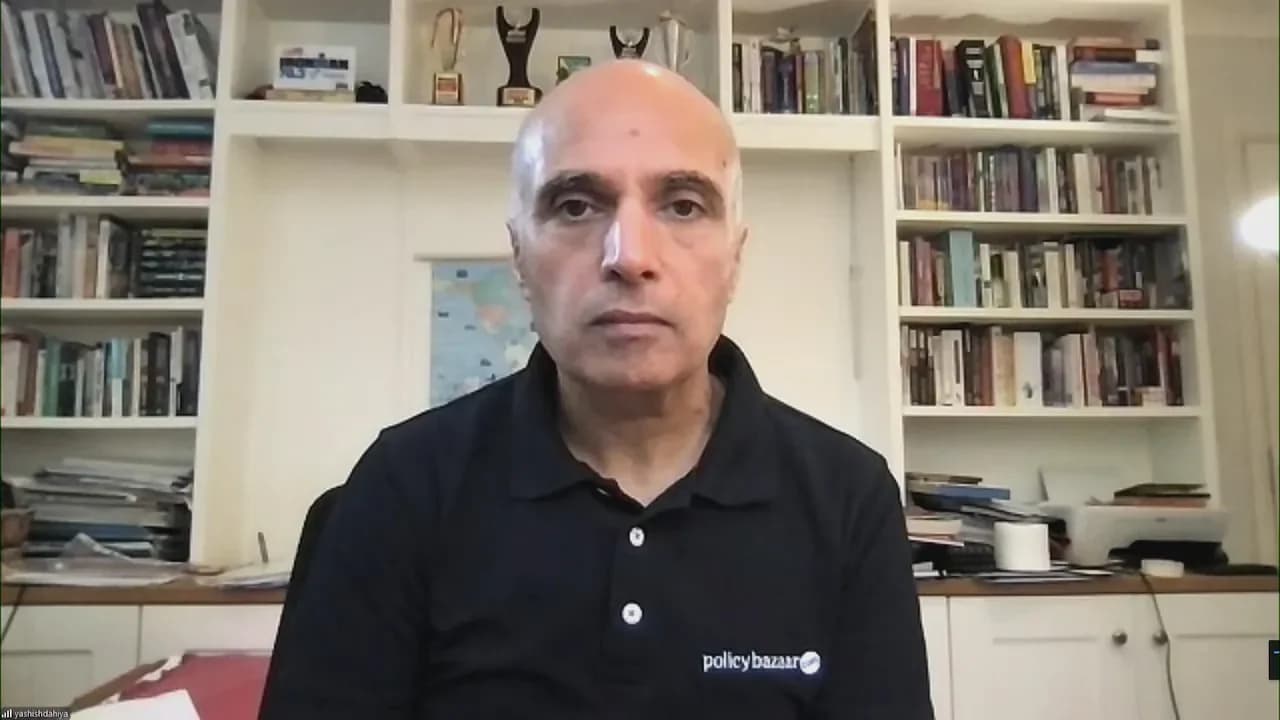
PB Fintech shares have plunged 43% in four consecutive sessions, hitting a fresh 52-week low of ₹1,077 during Tuesday's trading session, down from ₹1,886.30 on September 23, 2026. According to The Hindu BusinessLine, the stock fell 6.4% from Monday's closing price of ₹1,151.30, extending the four-session decline that has wiped out significant market value. The online insurance product distributor is among the companies with the highest MF ownership, with mutual funds owning 33% of the total share capital as of August-end. HDFC Midcap Fund, HDFC Flexicap Fund, Mirae Asset Large & Midcap Fund, Motilal Oswal Midcap Fund, and Mirae Asset ELSS Tax Saver Fund held the highest number of company stocks, with their holdings ranging between ₹1,835 crore and ₹865 crore. Notably, HDFC MF increased its bets on the company by investing ₹321 crore amid the correction on Thursday, even as the stock continued its downward trajectory.

The Insurance Regulatory and Development Authority of India (IRDAI) proposed a ban on 'dark patterns' on insurance websites, including practices that require customers to share personal details before accessing product features and pricing information. As per The Economic Times, the proposed IRDAI reforms could weigh on insurance stocks by pressuring the economics of distribution. The draft paper focuses on several key areas, including rationalising Expenses of Management (EoM), reintroducing segmental commission limits and prohibiting 'dark patterns'. PB Fintech management has indicated that the proposals in their current form could result in roughly a 30% hit to core revenue before offsets, with the pressure concentrated in general insurance. Kotak Institutional Equities noted that PB Fintech could face a relatively larger impact from the proposed commission cuts, given its position as a multi-insurer distributor. The brokerage highlighted that commissions on health insurance, a key focus segment for PB Fintech, are proposed to be capped at 15% for new policies and 5% for renewals, compared with 20% and 10% respectively, for agents. PB Fintech clarified in a BSE filing that the consultation paper is currently at a consultation stage and represents proposed policy changes open for public and stakeholder feedback, not constituting a final regulatory order.
In its recent analyst concall, PB Fintech management said the proposed framework could have a limited impact on the net present value (NPV) of its life insurance business. However, it expects a severe impact on general insurance, with the segments revenue NPV potentially falling to around one-third to 40% of current levels. Management estimated that a 60% compression in general insurance revenue could result in a 30% decline in total core business revenue. PB Fintech management indicated that commission income on a health insurance policy could fall from around ₹15,000 currently to approximately ₹3,500 to ₹3,750 under the proposed framework. Management questioned whether such economics would be sufficiently rewarding for individual agents, though it said some agents could potentially be brought on the company's payroll, in which case they could continue to earn around ₹15,000, partly offsetting the impact of the proposed commission changes. PB Fintech is evaluating cost rationalisation across digital marketing, brand spending and sales support, while ruling out mass layoffs. The company also expects hiring to slow and could see a 15-20% increase in volumes if lower commissions are passed on to customers through reduced insurance prices.
HSBC last week downgraded PB Fintech to 'Hold' and cut its target price to ₹1,150 from ₹2,100, while Motilal Oswal retained a 'Neutral' rating with a ₹1,150 target. According to Business Standard, Jefferies estimates a 10% cut in new business commission rates leads to 10-12% fall in earnings, with the stock price trading below the target price of ₹1,540. Jefferies has kept earnings estimates unchanged but cut Policybazaar's valuation multiple by 30% to 18x FY30E EBITDA due to uncertainty around take rates. Bernstein retained an 'Outperform' rating and a target price of ₹2,310 despite estimating that the proposed framework could cut insurance take rates by around 40% and potentially reduce FY28 profit by 34%. Morgan Stanley says that PB Fintech's health business NPV could decline 60-70% under the proposed framework, while life insurance NPV is expected to remain broadly stable. Elara Capital has cut its target price on PB Fintech to ₹1,400 from ₹1,990 but maintained its 'buy' rating, lowering its discounted cash flow-based target price while factoring in 48% and 35% cuts to FY28 and FY29 earnings per share estimates respectively.
On a consolidated basis, PB Fintech's net profit surged 92.54% to ₹162.89 crore while net sales rose 40.08% to ₹1,888.28 crore in Q1 June 2026 over Q1 June 2025. As per latest reports, commission revenue from general insurance could see about a 60% cut, translating to a ₹300 crore hit in a quarter. PB Fintech management expects about 15-20% volume growth due to lower commission costs potentially being passed on to customers, though this may not fully offset the revenue decline. PB Fintech has identified slower hiring, lower marketing expenditure and other cost adjustments among the measures that could help cushion the impact. PB Fintech is exploring additional revenue opportunities, including charging for services such as garage and hospital network management and reinsurance support. Management is also exploring insurance and reinsurance manufacturing and plans to seek regulatory approval for a Managing General Agent model. The company said the proposals are still in the consultation stage and would not affect FY27 financials, with implementation proposed from 1 April. Management described FY28 as a period of challenges and discovery as it adapts to the new framework, with an objective of returning to a similar financial position by FY29.