Karnataka Chief Minister DK Shivakumar has announced a new employment scheme that will pay entrepreneurs a monthly incentive of ₹2,500 for every fresh job created in the state's 10 most backward districts. According to reports from Moneycontrol, the incentive will run for two years and is expected to generate around one lakh new jobs. The scheme forms part of the state's broader CM's Jobs Mission, aimed at expanding employment avenues for the state's youth. As part of the Chief Minister Udyoga Sankalpa and Udyoga Nidhi schemes announced on August 15 during Independence Day celebrations, the initiative targets Karnataka's vision for a 'Young Karnataka–New India' under the theme 'Yuva Karnataka, Nava Bharat'.
Shivakumar announced that filling vacant government posts remains the administration's top priority, with the recruitment process for 72,000 key vacancies across departments already underway. As reported by Moneycontrol, recruitment notifications for all posts will be issued within the next six months. The government will also roll out Yuva Udyoga Setu, a digital platform intended to connect job seekers with employers and educational institutions. To strengthen private-sector employment, the government will introduce the 'Yuva Udyoga Setu' platform to connect job seekers with employers.
The Chief Minister outlined an ambitious technology and education agenda, with AI to be introduced in government schools from class 6, alongside the proposed AI Akshara Abhiyana and Coding Gurukula programmes. Bengaluru will get the country's first government-owned AI university, with certificate courses expected to begin by January 2027. The government also announced plans for a government-driven AI University aimed at strengthening AI education, research, innovation and industry collaboration, as Karnataka seeks to retain its position as a global technology hub amid rapid advances in AI. To improve access to professional education for rural students, the government introduced 'Vidyarthi Sahayahasta', reserving 7.5 per cent of seats within the existing 15 per cent rural quota for students from rural government schools seeking admission to engineering, medical and other professional courses.
As part of the employment push, 100 government Industrial Training Institutes will be converted into employment-focused campuses in partnership with private industry, a move the CM said could create opportunities for 10,000 young people. According to Moneycontrol, the state will set up an Advanced Manufacturing Cluster at Doddaballapura near Kempegowda International Airport, with investment commitments of ₹20,000 crore already secured and around one lakh jobs expected from the project. The government plans to integrate technology into agriculture through the Chief Minister Raitha Chaitanya scheme, under which drones and satellite imagery will be used for crop surveys, while the Raitha Mitra scheme will provide farmers owning three acres or less with a 50% subsidy on agricultural machinery rental charges. The state will establish five Global Technology Centres (GTCs) under the LEAP programme in Kalaburagi, Belagavi, Hubballi-Dharwad, Mangaluru and Mysuru to take high-end technology employment closer to talent outside Bengaluru.
Calling it a step toward reducing regional imbalances, Shivakumar announced that ₹4,291 crore has been earmarked for 2026-27 based on recommendations from the Prof Govind Rao Committee, which examined 236 taluks. The Chief Minister announced that Karnataka is targeting a $3 trillion economy, equivalent to ₹320 lakh crore, by 2047, with the state's per capita income having reached ₹4.33 lakh and Karnataka ranking second in GST and income-tax collections. On infrastructure, 1,663 km of State Highways, 3,000 km of major district roads, and 125 bridges had been constructed over the past year, while development of 7,100 km of rural roads is under way under the Pragathi Patha scheme with an investment of ₹5,200 crore. For Bengaluru, infrastructure projects worth ₹1.56 lakh crore have been sanctioned, with the Namma Metro network expected to expand to 220 km after completion of Phase III, while a 117-km ring road under the Bengaluru Business Corridor is planned at a cost of ₹26,000 crore. The government also plans to reorganise the Bengaluru Police Commissionerate into five separate commissionerates and establish a dedicated Anti-Rowdy Squad to strengthen law and order.
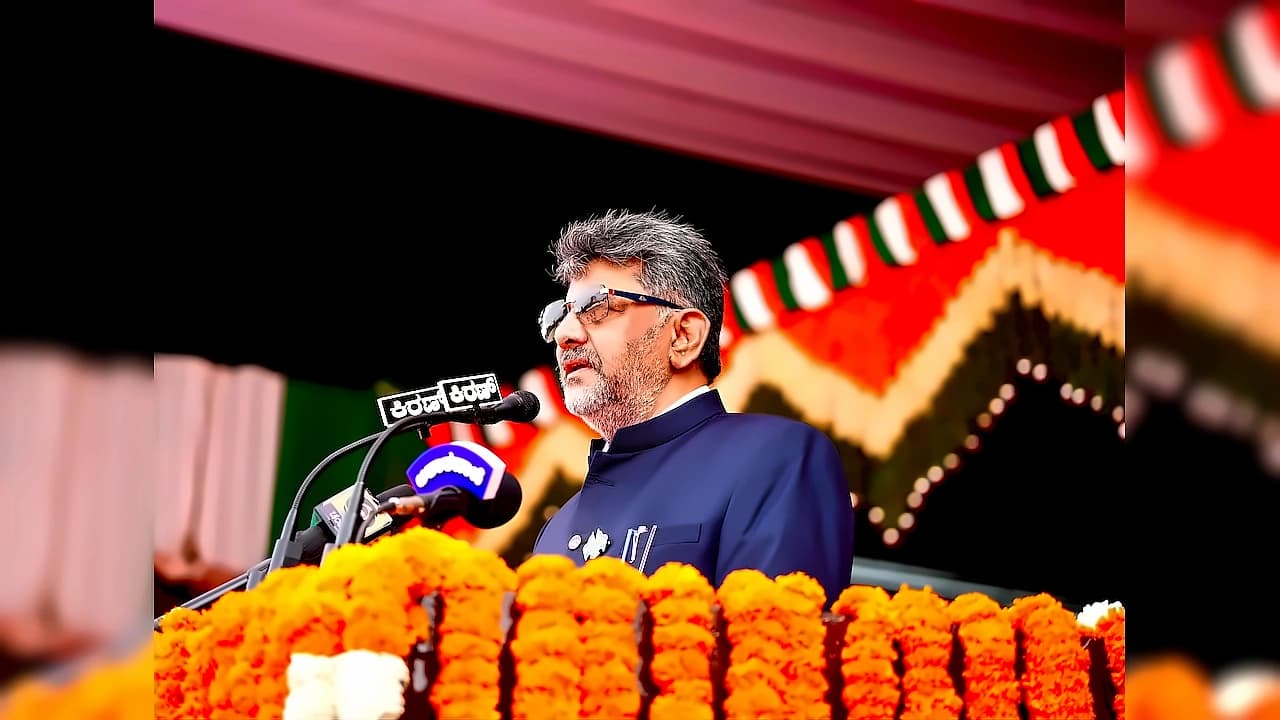
Highlighting the government's welfare measures, Shivakumar said that ₹77,000 crore had been transferred directly to 1.28 crore women under the Gruha Lakshmi scheme, while 1.65 crore households were receiving free electricity under Gruha Jyothi. Women in Karnataka had made around 796 crore free journeys under the Shakti scheme. The government has prioritised water security, with 112 major water-resource projects worth ₹16,000 crore approved this year, and the first phase of the Yettinahole Integrated Drinking Water Project is nearing completion, with water expected to reach Tumakuru district by November. The Chief Minister also announced plans to establish the Karnataka State Motor Vehicle Insurance Corporation to provide simpler insurance services to vehicle owners. Calling for collective participation in Karnataka's development journey, Shivakumar said the progress of states is essential for the nation's growth, stating "If India is a temple, the States are its pillars" and urging citizens to contribute towards building a stronger and more prosperous Karnataka.