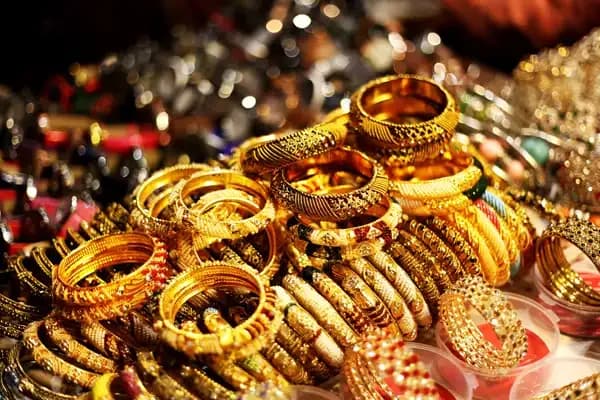
The government on Wednesday increased customs duties on gold and silver to 15 per cent from 6 per cent, while raising the duty on platinum imports to 15.4 per cent from 6.4 per cent. According to reports from Business Standard, the revised structure comprises a 10 per cent basic customs duty (BCD) and a 5 per cent Agriculture Infrastructure and Development Cess (AIDC), taking the effective tax on gold and silver imports to 15 per cent. The Finance Ministry issued the notification on May 12, with the new rates taking effect from May 13. The decision covers gold and silver dore, coins, findings and other related items, as reported by Business Standard. Following the hike, gold prices in Chennai rose to ₹1,14,640 per sovereign (₹14,330/gram), while silver touched ₹300 per gram (₹3 lakh/kg), as reported by DTNext. The sharp increase in import duties triggered a strong rally in domestic bullion prices on Wednesday, with silver prices on the Multi Commodity Exchange (MCX) hitting their 6% upper circuit limit at ₹2.95 lakh per kg, while gold prices also surged to the 6% upper circuit at ₹1.62 lakh per 10 grams.
Despite being the second largest consumer of gold, India does not produce significant quantities of gold, and nearly all domestic demand is met through imports paid for in US dollars. As reported by Business Standard, in 2025–26, gold imports accounted for around 9-10 per cent of India's total import bill, with the country spending a record ₹6,22,000 crore ($71.98 billion) on gold imports to meet domestic demand. High gold imports can widen the trade deficit, increase pressure on the current account deficit (CAD), and lead to higher foreign exchange outflows. India's foreign exchange reserves have also eased from recent highs amid the Iran conflict and elevated crude oil prices, adding to external sector pressures. The move comes days after Prime Minister Narendra Modi urged citizens to avoid gold purchases, reduce fuel consumption and limit unnecessary foreign exchange spending amid disruptions caused by the West Asia conflict. The Prime Minister had also appealed to offices and citizens to adopt "Covid-era" practices such as work-from-home, virtual meetings and car-pooling to conserve fuel and reduce pressure on the economy.
The sharp increase in import duties has significantly impacted both domestic bullion prices and jewellery stocks. In the international market, spot silver rose 1% to $87.40 per ounce, while spot gold traded near $4,713.39 per ounce. US gold futures for June delivery climbed 0.7% to $4,721.80 per ounce. Despite the surge in bullion prices, jewellery stocks remained under heavy pressure as investors worried about weaker consumer demand following the government's push to reduce gold consumption. Shares of Kalyan Jewellers led the decline, falling over 5%, while Sky Gold and Diamonds also dropped more than 5%. Titan Company slipped over 1%, while PN Gadgil Jewellers traded lower along with other jewellery stocks. Analysts said the tariff hike, combined with elevated geopolitical uncertainty and sticky US inflation, has strengthened safe-haven demand for precious metals globally.
India's gold import duty regime has undergone significant shifts over the years, reflecting the government's efforts to manage imports and protect forex reserves. According to Business Standard, before 2012, India imposed a flat nominal customs duty of ₹2,500 per 10 grams on standard gold imports. In 2012, the government revised the duty structure to a value-based system at 2 per cent of gold's value, nearly doubling the effective burden. Between 2013 and 2014, duties were raised three times from 4 per cent to 10 per cent amid record-high current account deficit and weakening rupee. The duty was increased to 12.5 per cent in 2019 and reduced to 6 per cent in 2024 before the latest increase. The Centre had cut the rates from 15 per cent to 6 per cent and from 15.4 per cent to 6.4 per cent in the Union Budget 2024-25 when the external sector position was more comfortable, but the latest hike reverses that cut in response to fresh external risks.
Data from the Directorate of Revenue Intelligence (DRI) shows that the previous duty cut achieved its objective of curbing smuggling. As reported by Business Standard, enforcement agencies seized only about 2,600 kg of gold in 3,005 cases in FY 2024-25, which is roughly half the quantity seized in the previous year (4,972 kg in 6,599 cases). Nearly half of the FY24-25 seizures occurred before the July 2024 duty reduction, with the highest monthly seizure recorded in April 2024. DRI alone seized 1,073 kg of gold worth ₹785 crore during the year, with a notable dip in seizures after the duty was lowered. Industry officials warn that sharply higher import duties could revive gold smuggling activity, which had declined after tariff cuts introduced in mid-2024. Higher import duties generally widen the price gap between domestic and international gold markets, making illegal imports more profitable. India has historically witnessed spikes in gold smuggling whenever import duties were raised sharply, particularly during periods of high domestic demand and elevated global prices.