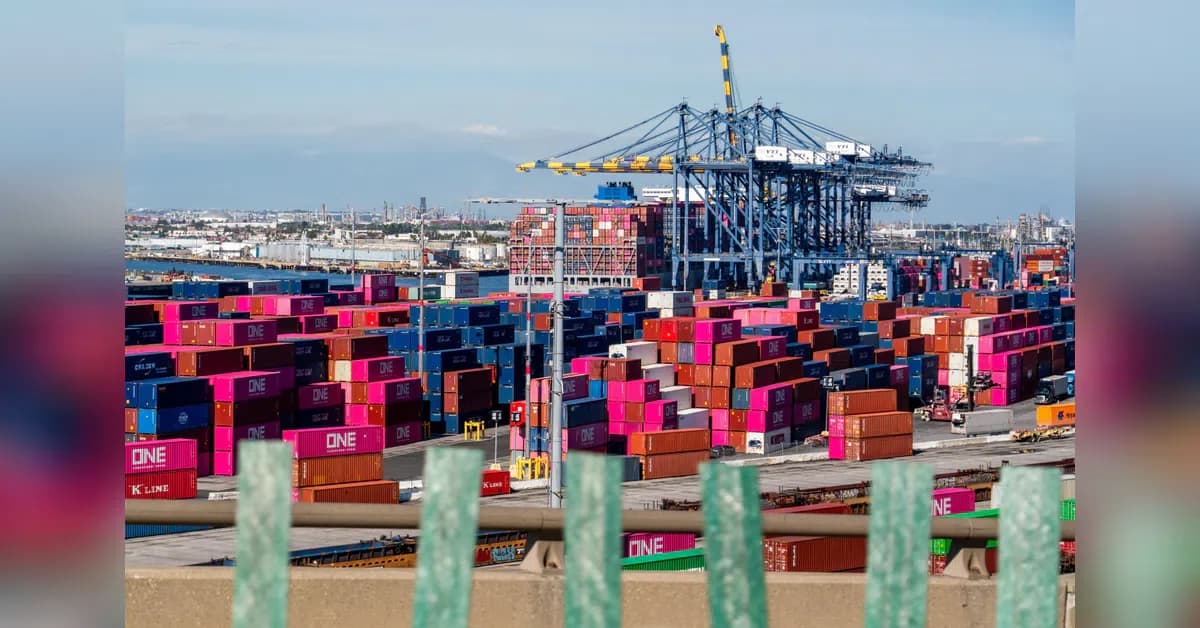
India can save ₹28,540 crore annually in foreign exchange if the Ministry of Finance implements all currently pending anti-dumping duty recommendations by the Directorate General of Trade Remedies (DGTR), according to a report by the Centre for Development and Economic Policy Research (C-DEP) and the Centre for WTO Studies (CWS). The report titled 'Impact of Anti-Dumping Duties in India', released on Tuesday, estimates that implementing these recommendations would yield approximately ₹28,540 crore in annual foreign exchange savings. The report was released by Pritam Banerjee, Head, Centre for WTO Studies, Ministry of Commerce during a roundtable discussion attended by leaders from sectors including chemicals, polymers, textiles and other manufacturing industries. The event brought together industry leaders from sectors whose domestic manufacturing capacities have been deeply impacted by dumping from China and other countries, with these domestic manufacturers representing over ₹2 lakh crore of turnover.
The non-implementation of anti-dumping duties on 56 DGTR-recommended products has resulted in an annual economic loss of ₹11,938 crore to the domestic industry, as reported by the C-DEP and CWS study. The report estimates that economic losses from dumped imports across 33 studied products currently stand at around ₹1.54 lakh crore and could rise to between ₹2.68 lakh crore and ₹2.70 lakh crore by 2030. The study adds that jobs at risk could increase from around 24,000 currently to nearly 38,000-42,000 by 2030 due to import-driven market distortions. During the same period, imports from China increased significantly across several industrial sectors, with sustained dumped imports forcing shutdowns in sectors such as sublimation-transfer paper, phone back covers and Nylon Filament Yarn. Non-implementation of anti-dumping duties is leading to catastrophic impact on domestic industries, including MSMEs, and has led to increased import dependence and domestic capacity destruction.
Analysis of 56 DGTR-recommended cases where duties were not implemented showed that the median impact on final consumer prices would have been just 0.023 per cent, while more than 91 per cent of cases would have seen price impact below 0.10 per cent. The report further noted that inflation contribution from 21 pending anti-dumping duty products would remain below 0.01 percentage points even under a conservative 50 per cent pass-through assumption. Non-implementation of anti-dumping duties has disproportionately impacted MSMEs, leading to shutdowns in sectors such as sublimation-transfer paper, phone back covers and Nylon Filament Yarn. At the same time, sectors where timely anti-dumping duties were implemented, including cable ties, ceramic ware and vacuum flasks, witnessed continued operations, production expansion and fresh investments by MSMEs. The report indicates that timely imposition of anti-dumping duties will ensure adequate investments in domestic capacities today, prevent a large demand-supply gap by 2030, reduce India's dependence on imported goods, strengthen industrial resilience, and contribute to fulfilling the Prime Minister's vision of Viksit Bharat by 2047.
The report addresses concerns of inflation usually associated with anti-dumping duty implementation. According to the study, even under a 50% cost pass-through assumption, the collective contribution of 21 products where DGTR has completed investigation and issued recommendations to the Ministry of Finance is only in fractions of a basis point to headline inflation. Most of these cases concern intermediate inputs, industrial chemicals, fibres, polymers, and feedstock, which generally have low direct weight in the Consumer Price Index (CPI) basket. The study stated that anti-dumping duties have very limited impact on consumer inflation and downstream costs, demonstrating that duties do not meaningfully increase prices for end consumers while helping restore fair competition for domestic producers.
Speaking on the sidelines of the report launch on May 26, Jaijit Bhattacharya, founder and president of C-DEP, emphasized that anti-dumping measures can reduce import expenditure and strengthen India's external position, though they are only one part of a larger picture. Bhattacharya noted that anti-dumping measures could save India around $3 billion in import expenditure, which becomes more meaningful when energy prices rise sharply. He explained that if the oil import bill goes up by another $10 billion, then saving $3 billion becomes meaningful. Bhattacharya linked India's external-sector outlook and the rupee's trajectory to developments in West Asia, stating that the rupee's recovery hinges on West Asia peace. "We are now seeing a lot more gold and dollar investments because that is seen as a safe haven," he said. "Once there is peace, you will see de-risking and the rupee coming back to its prior status." The West Asia conflict has encouraged investors to move money into safe-haven assets, while also fuelling concerns over oil supplies and import costs.