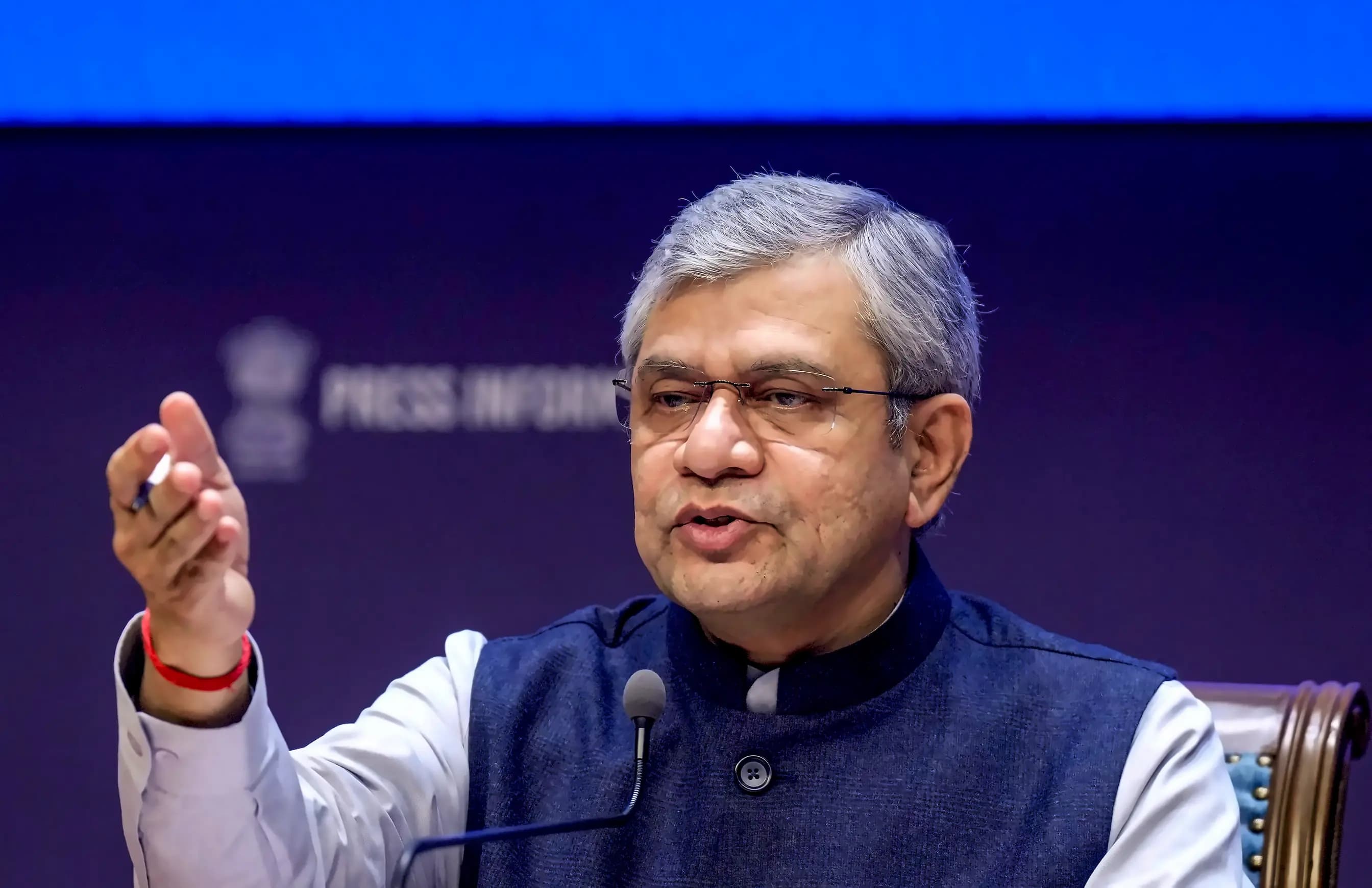
Union Electronics and Information Technology Minister Ashwini Vaishnaw announced that the government will release a draft consultation paper on artificial intelligence regulations within the next 30 days. According to reports from Business Standard, the draft regulations will encompass key aspects such as safety and security in AI, push for a human-first approach, focus on skilling and reskilling, be inclusive on all counts and ensure that harms are restricted. Vaishnaw emphasized that the consultation paper will form the basis for AI regulations, stating that AI cannot be regulated by just having a law, we have to take a techno-legal approach and bring such solutions. The IT Minister noted that "the time has come for AI regulation" as the technology poses increasingly complex challenges. Speaking at an event on the release of the World Development Report on October 8, 2026, Vaishnaw said "I'll request the department to come out with a regulation-focused consultation paper, which focuses on safety. That's the most important point: safety related to AI use."
The forthcoming consultation paper will establish five core priorities for India's legislative approach to AI governance: safety, a human-first orientation, workforce skilling, digital inclusion, and the active mitigation of societal harms. As reported by Business Standard, Vaishnaw outlined these priorities while speaking at the World Development Report event, emphasizing that "humanity has to be the most important part" of this regulatory approach. The Minister highlighted that "the quality of deepfakes was improving every day, leading to people being misled about issues that may not be true" and termed deepfakes a "nuisance which can cause huge problems in society" that "sets a totally wrong precedent and people get lured into doing wrong things and believing wrong things." The consultation paper will primarily focus on AI safety and the growing risks posed by deepfakes and other potential harms from AI, with Vaishnaw noting that "People believe them, and it sets a totally wrong narrative, and people get lured into doing wrong things and believing wrong things."
As reported by Storyboard18, Vaishnaw highlighted that a bulk of these regulations will have to be undertaken by the industry. Speaking at the World Development Report event, the Minister made it clear that "The industry has to take the primary responsibility" and listed out issues such as cybersecurity, safety, user harm, psychological disorders and deepfakes. The government's India AI Governance Guidelines, released earlier this year, have already outlined a principle-based approach centred on trust, people-first governance, and responsible AI innovation. The framework also identifies misinformation, deepfakes, algorithmic bias and unintended societal harm among the big risks that need to be safeguarded against. The upcoming consultation paper will build upon these guidelines, expanding the principle-based framework into actionable regulatory proposals that address key legal gray areas including platform liability, data protection, copyright infringement, content authentication, and generative AI misuse. The government has maintained that a techno-legal approach is necessary rather than just legislative solutions. Earlier this year, the Ministry of Electronics and Information Technology constituted the Artificial Intelligence Governance and Economic Group (AIGEG), an inter-ministerial body tasked with coordinating AI policy across key ministries, their respective departments and sectoral regulators. India currently lacks a unified law on AI, and most governance of AI-led tools and services falls under the Information Technology Act of 2000 or the Information Technology Rules of 2022.
According to Business Standard, to ensure adequate use of graphics processing units, the government will guarantee usage for up to five years in phases, so bidders are assured of the commercial value of the GPUs they onboard. The government has floated a request for proposals to onboard another 10,000 GPUs, of which 3,000 will be onboarded directly for government use while 7,000 will be open to bidding by different companies. Vaishnaw noted that the government is also looking at home-grown solutions for GPUs, at least for the inference bit in AI, with a roadmap appearing visible now. The upcoming regulatory framework will advance plans to institute an AI Governance Group, a Technology and Policy Expert Committee, and an AI Safety Institute as part of the broader IndiaAI Mission's Safe and Trusted AI pillar.
As reported by Business Standard, the government has onboarded more than 38,000 GPUs under the IndiaAI Mission across three rounds of bidding after which the government allowed companies to onboard GPUs continuously, provided they procure and supply them at the average L1 price of nearly ₹115 per GPU-hour. With nearly 15,000 GPUs onboarded in January and a bid for another 10,000 now being opened, the total number of GPUs in the country is likely to exceed 50,000, according to government estimates. Companies will procure and supply all these GPUs as part of the ₹10,372 crore IndiaAI Mission, approved by the Union Cabinet in March 2024. The upcoming regulatory framework will align with these mission objectives and advance the country's AI infrastructure development.
According to Business Standard, after the first round of GPU bidding, the Ministry of Electronics and Information Technology opened a continuous empanelment process for companies wishing to bid to procure and supply these high-end computing processors. The ministry now empanels new bidders every quarter. In the first round, the government empanelled 10 companies to procure and supply 18,693 GPUs, including 12,896 Nvidia H100 GPUs, 1,480 Nvidia H200 GPUs, and MI325 and MI300X GPUs. Key players that passed muster include Reliance Industries-owned Jio Platforms, Tata Communications and Hiranandani Group-owned Yotta Data Services, along with other firms such as CMS Computers India, CtrlS Datacenters, E2E Networks and Locuz Enterprise Solutions.