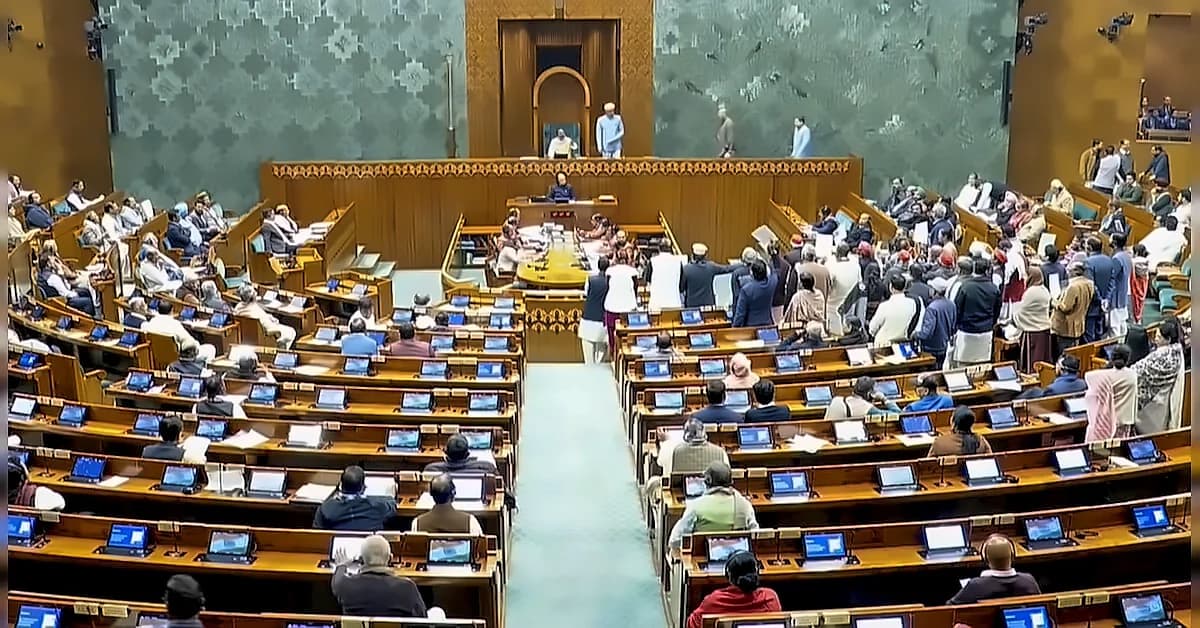
Parliament on Tuesday approved the Tribunals Reforms Bill, 2026, with the Rajya Sabha passing the Bill on Tuesday, a day after it was cleared by the Lok Sabha. According to Business Standard, the Bill will now seek ratification by the President before becoming law. Minister for Law and Justice Arjun Ram Meghwal said during the debate that the National Tribunal Commission (NTC) is the core of this Bill, emphasizing that it will be headed by a former Supreme Court judge or former Chief Justice of a High Court and will comprise two judicial members and two technical members. The Minister noted that the NTC will make appointments to ensure transparency, independence and merit-based selection.
The Bill addresses a severe vacancy crisis that has significantly impacted tribunal functioning. As reported by Business Standard, in a written reply to the Rajya Sabha in December 2025, the Ministry of Law and Justice said 94 of 518 sanctioned posts of tribunal members were vacant, amounting to about 18 per cent. According to government data, more than 5.24 lakh cases are pending across 16 tribunals, with the Debt Recovery Tribunals accounting for 2,33,901 pending cases, followed by the Customs, Excise and Service Tax Appellate Tribunal (71,454), Central Administrative Tribunal (69,102) and Income Tax Appellate Tribunal (42,502). The Parliamentary Standing Committee on Personnel, Public Grievances, Law and Justice said in March 2026 that 27 member posts in the ITAT — 15 Accountant Members and 12 Judicial Members — were under recruitment. The 2025 parliamentary response recorded seven tribunals without chairpersons, including the Central Government Industrial Tribunal, CESTAT, Appellate Tribunal for Forfeited Property, DRT, DRAT, Railway Claims Tribunal and Armed Forces Tribunal.
The proposed National Tribunals Commission (NTC) will be headed by a retired Supreme Court or high court judge for five years or till he or she turns 70 years. As reported by Business Standard, the commission will be headquartered in the national capital and will comprise a chairperson and four members. The commission will consist of two judicial members and two technical members, with the chairperson qualified to head the panel. The 2026 Bill makes several changes to the 2021 framework, with the NTC now having wider powers to oversee the selection of tribunal Chairpersons and Members, review tribunal performance, handle complaints against members and maintain a National Tribunals Data Grid. The Central Government will appoint the members, after consulting the Chief Justice of India before appointing the Chairperson and Judicial Members.
The 2026 Bill makes significant changes to the selection process compared to the 2021 Act. Under the new framework, Search-cum-Selection Committees will be constituted by the NTC and will include members of the Commission, retired High Court judges, a government secretary and experts who assess candidates. The recommendation process changes with the committee now recommending one suitable candidate, along with another name to be kept on a waiting list, replacing the 2021 Act's requirement of recommending two names for each vacancy. The tenure has been increased to five years from four years, while retaining the existing upper age limits of 70 years for Chairpersons and 67 years for Members. The Bill also removes the 2021 Act's provision that a person below 50 years could not be appointed as a Chairperson or Member, and adds incompetence or inefficiency and undertaking a paid assignment during the term as grounds for removal.
Legal experts have raised concerns about the Bill's effectiveness in addressing fundamental tribunal issues. Ruby Singh Ahuja, a senior partner and Advocate-on-Record at Karanjawala & Co, warned that the proposed commission could add another layer of administrative and judicial bureaucracy to an already overburdened system. Aishwarya Kaushiq, Partner at BTG Advaya, noted that while the Bill represents a necessary institutional correction, it cannot be considered a complete solution to vacancies, emphasizing that real reform lies in ensuring vacancies are anticipated rather than reacted to. The experts suggest that selection of new members should begin before an incumbent demits office, with fixed timelines and accountability at every stage. Amit Kapur, Senior Partner at Cyril Amarchand Mangaldas, acknowledged that while the proposed NTC could help streamline selection and performance review, much would depend on implementation, noting that vacancies should not continue for months after retirements and the system must ensure a continuing pool of eligible legal and technical experts.