The Ministry of Finance has sanctioned an additional ₹1,000 crore specifically for electric two-wheeler incentives under the PM E-DRIVE scheme, as reported by government sources. This brings the total allocation to ₹11,900 crore from the original ₹10,900 crore, with the extension until March 2028 providing nearly two more years of policy support. The additional funding comes after the government sought additional funding to continue supporting electric two-wheelers beyond the scheme's earlier July 2026 deadline. According to a Ministry of Heavy Industries official, the ministry had requested the Ministry of Finance for additional funds so that the scheme could continue until March 2028, with the Finance Ministry agreeing to their request. The official stated that electric two-wheeler penetration has risen to 7.6%, but the segment still requires continued policy support to sustain its growth momentum.
Under the revised provisions, registered electric two-wheelers will receive purchase incentives from April 1, 2025, to March 31, 2028. The scheme supports 4.57 million electric two-wheelers with total funding support of ₹2,767 crore, up from the previous ₹1,772 crore allocation. The incentive has been halved to ₹2,500 per kWh from the previous ₹5,000 per kWh, while the cap remains at ₹5,000 per vehicle compared with ₹10,000 per vehicle in FY2024-25. The government has clarified that the per-kWh incentive could be reviewed depending on reductions in vehicle costs and will remain limited to the specified amount or 15% of the vehicle's ex-factory price, whichever is lower. The last date for claiming the e-two-wheeler subsidy has been extended to December 31, 2027.
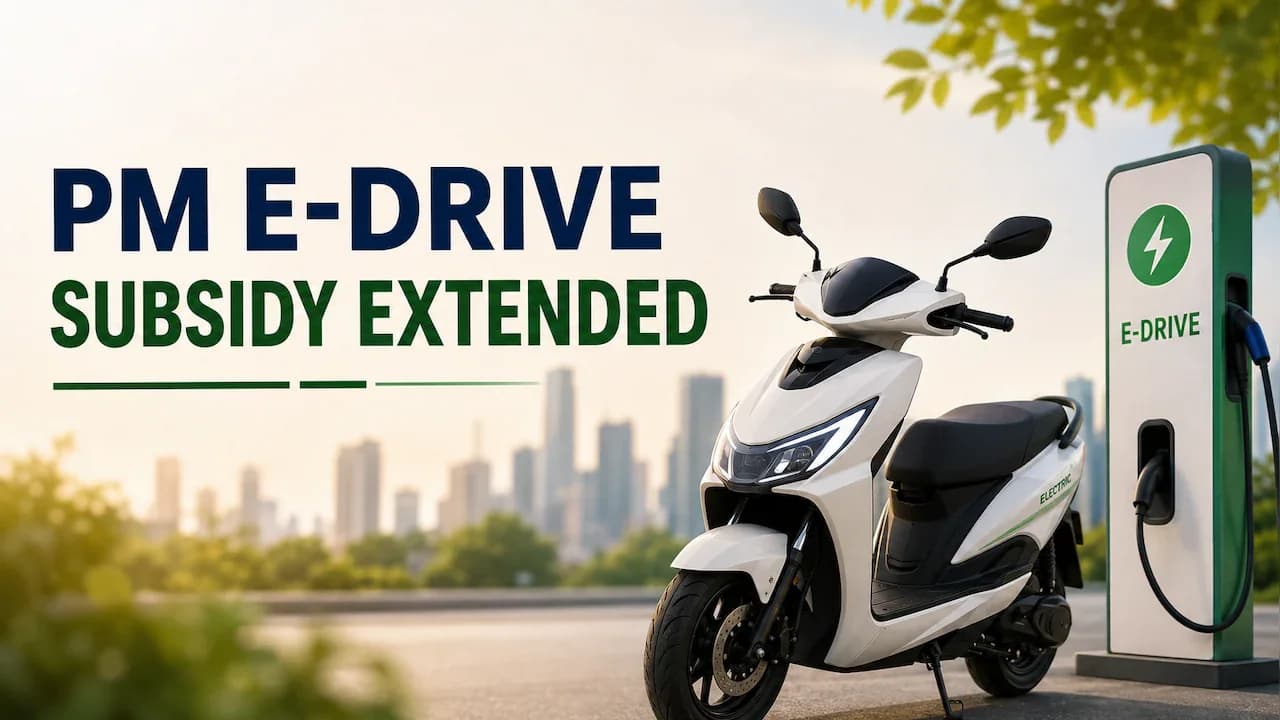
The government has set ambitious targets for electric two-wheeler adoption, aiming to raise penetration from the current 7.6% to 9-10% by March 2028, as stated by the Ministry of Heavy Industries official. The official emphasized that two-wheelers are used by the mass public and by a large number of citizens, addressing the last-mile mobility issue and affecting the lives of a lot of people. India is already the world's second-largest market for e2Ws by volume, behind China, with the domestic industry having built substantial research and development capabilities over the past five to six years. The PM E-DRIVE scheme has given incentives to about 2.5 million electric two-wheelers to date, with the official expressing confidence that the industry will make further progress in the next two years and achieve the required milestones within the scheme's extended timeline.
The government is working on a financing support mechanism to bring down borrowing costs for electric buses and trucks, as reported by The Times of India. A Ministry of Heavy Industries official confirmed that the government is discussing with banks and vehicle manufacturers an interest-subvention mechanism and credit guarantee for electric trucks that could help bridge the roughly 3-4 percentage-point financing-cost gap between electric and diesel trucks. Lenders typically price loans for electric trucks higher because of uncertainty around battery life and resale value, according to officials. Bringing down financing costs is seen as important for electrifying the segment, given MHI's estimate that heavy trucks account for only about 3% of vehicles but contribute 42% of vehicular pollution and consume around 60% of diesel.
Electric two-wheeler stocks surged by 5% on August 11 after the government extended subsidies under the PM E-DRIVE scheme until FY28, increasing the allocation to ₹11,900 crore from ₹10,900 crore. According to Business Standard reports, the number of eligible vehicles for subsidies rose to 4.57 million from over 2.4 million, boosting market sentiment significantly. The extension comes after the government had earlier indicated that benefits could be extended, with the move following a push from the industry body Society of Indian Automobile Manufacturers for continuation of the incentives as the original two-year PM E-DRIVE scheme approached its FY26 end date. The PM E-DRIVE scheme was originally notified in September 2024 with a total outlay of ₹10,900 crore and was initially scheduled to run from October 1, 2024, to March 31, 2026, with subsequent extensions to July 31, 2028.