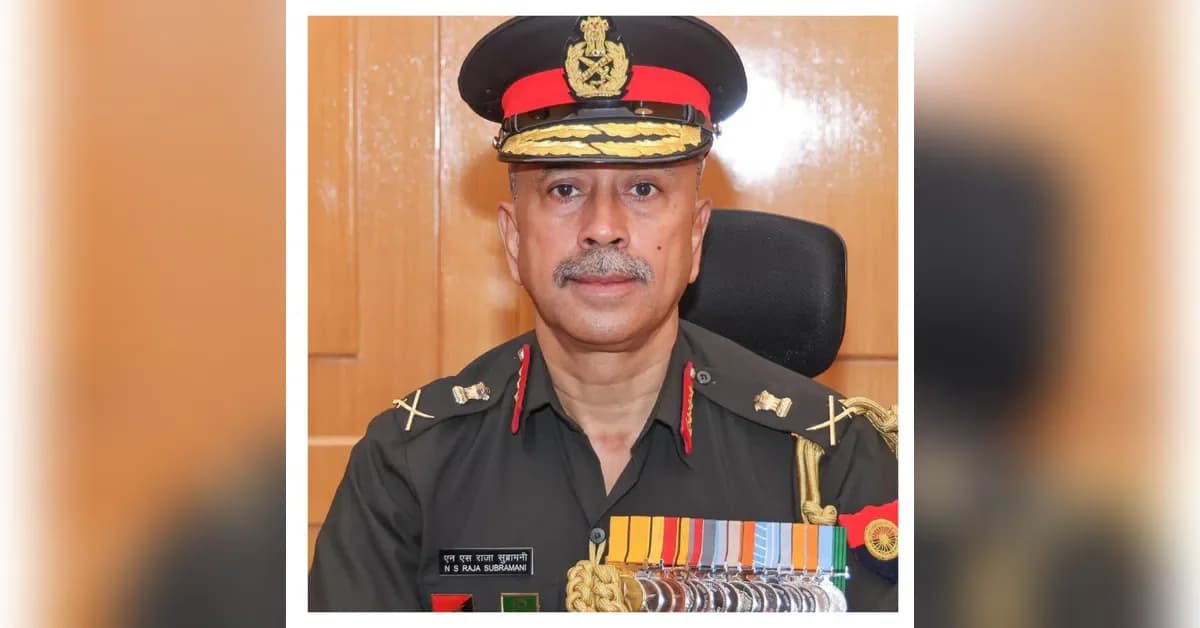
Lt Gen N.S. Raja Subramani (retd) took charge as India's new Chief of Defence Staff on Sunday, May 31, 2026, succeeding Gen Anil Chauhan who completed his tenure as the country's senior-most military commander on Saturday, May 30, 2026. In his first address as CDS, Gen Subramani expressed gratitude for the nation's trust in the armed forces and outlined his strategic priorities. According to Business Standard, Gen Subramani emphasized that "We are committed to implementing the vision of our Prime Minister, 'JAI'- Jointness, Atma Nirbharta and Innovation." He stated that "Transformation of the armed forces and organisational reforms to enhance jointness, synergy and integration will be the primary focus." The CDS also highlighted that "Atma Nirbharta is a central pillar of our national security. We will accelerate the development, induction and integration of indigenous weapons in our armed forces."
Outgoing Chief of Defence Staff Gen Anil Chauhan described his three-year-and-eight-month tenure as "very satisfying" as he wrapped up his stint at the top military post. As reported by Business Standard, during his tenure, Gen Chauhan focused on ensuring tri-services synergy to enhance India's military prowess in view of the evolving regional security scenario. The Chief of Defence Staff also initiated a number of measures towards India's plan to roll out the theaterisation model by creating integrated military commands. Gen Chauhan played a key role in planning and implementation of Operation Sindoor along with the three service chiefs. Speaking to reporters after receiving a ceremonial tri-services guard of honour, Gen Chauhan said, "I had a very satisfying and excellent tenure. It's a matter of great honour for me to superannuate with a tri-services guard of honour. I thank the three services and Headquarters IDS for it."
Gen Subramani, widely known as an expert on Pakistan and China, was serving as the Military Advisor at the National Security Council Secretariat (NSCS) before his appointment. As reported by Business Standard, he retired as the Vice Chief of Army Staff on July 31, 2025, after serving in that position from July 1, 2024 to July 31, 2025. His previous role was as General Officer Commanding-in-Chief of the Central Command from March 2023 till June 2024. Gen Subramani has served in several key operational and strategic roles over a four-decade-long career, holding a range of command, staff and instructional appointments across diverse operational environments, reflecting extensive experience in both field leadership and higher defence planning. The CDS position was created in 2019 following the recommendations of the Kargil Review Committee and was first held by General Bipin Rawat, with the role established to strengthen coordination among the three services and enhance the country's military preparedness through integrated planning and operations.
According to Business Standard, Gen Subramani's primary task as Chief of Defence Staff will be to implement the theaterisation model by rolling out integrated military commands. The new CDS is expected to fast-track the establishment of joint services commands, a key objective of the theaterisation drive. These commands will integrate military elements, assets, and personnel from the three services under a single commander-in-chief. As reported by Business Standard, Gen Subramani's primary mandate will be to implement the ambitious military theaterisation plan and bolster tri-services synergy, stepping into the role at a time when the armed forces are pushing ahead with long-delayed structural integration reforms. The appointments arrive at a pivotal moment as the armed forces advance theaterisation, a long-awaited reform designed to integrate the military's resources for future conflicts.
Admiral Krishna Swaminathan took over as Navy Chief from Admiral Dinesh K Tripathi on Sunday, coinciding with Gen Subramani's appointment as CDS. According to Business Standard, Swaminathan is an alumnus of the National Defence Academy, the Joint Services Command and Staff College in Shrivenham, UK, the College of Naval Warfare in Karanja, and the US Naval War College in Rhode Island. His tenure coincides with India finalising a multi-billion dollar deal to build next-generation conventional submarines domestically. The theaterisation model involves raising a China-centric northern theatre command in Lucknow, a Pakistan-centric western theatre command in Jaipur, and a maritime theatre command in Thiruvananthapuram, as recently submitted by Chauhan to the defence minister.