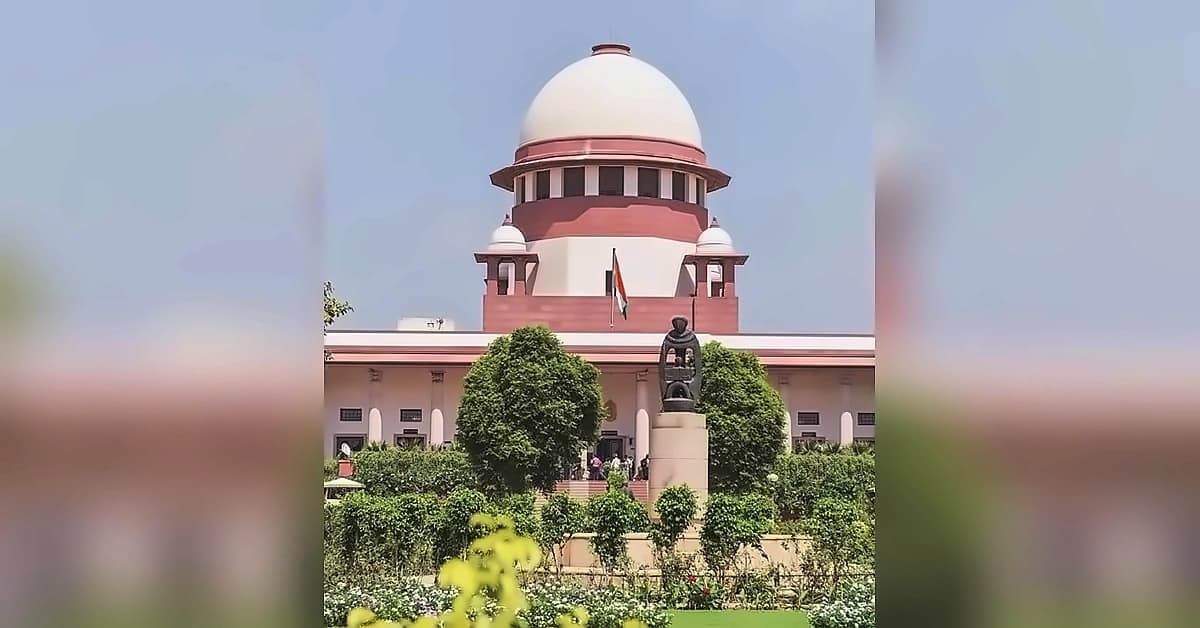
The Supreme Court has raised significant concerns about the compensation framework under the Sustainable Harnessing and Advancement of Nuclear Energy for Transforming India (SHANTI) Act, 2025. A bench of Chief Justice Surya Kant and Justices Joymalya Bagchi and V Mohana issued limited notice and asked the Centre to clarify whether courts are precluded from granting fair and just compensation in case of nuclear accidents. The court specifically questioned whether there was any conflict of interest in appointing members to the regulatory body under the SHANTI Act. Advocates Prashant Bhushan and Neha Rathi, appearing for the petitioners, argued that the law caps the liability in case of any accident, effectively allowing operators to cut corners on safety. The petition was filed by a group of petitioners, including professors and scientists, led by former bureaucrat EAS Sarma, who submitted that the 2025 Act violated fundamental rights under Article 14, 19 and 21 of the Constitution.
The Department of Atomic Energy (DAE) has finalized draft rules for nuclear power plants under the Sustainable Harnessing and Advancement of Nuclear Energy for Transforming India (SHANTI) Act, 2025. According to reports from Business Standard, these comprehensive regulations establish mandatory requirements for financial security and operational standards for nuclear facilities across India. The rules provide for operator liability, financial protection, nuclear material accounting, radiation safety and radioactive waste management. Companies seeking to establish a nuclear power plant will have to apply for a licence and undergo a screening process, with applicants first needing to secure an 'in-principle approval' before entering negotiations with reactor technology suppliers. The proposed framework provides for a single composite licence covering the construction, ownership, operation and eventual decommissioning of a nuclear power plant or reactor, bringing different stages of a facility's lifecycle under a common regulatory framework.
The finalized rules propose a mandatory insurance policy, financial security, or a combination of both for nuclear power plants. As reported by Business Standard, the regulations state that financial security must remain in place until all spent fuel has been removed from the concerned storage pool. This requirement ensures ongoing financial protection throughout the entire nuclear fuel cycle, from operation to decommissioning. The draft also provides for a Nuclear Liability Fund, to be funded through a levy on operators. For specified government-owned installations, the Central Government would assume liability under the conditions set out in the rules. The rules propose that the operator of a nuclear installation will be liable on a 'no-fault basis' for nuclear damage, including damage during the transport of nuclear material. If compensation for a nuclear incident exceeds the prescribed liability amount, including for damage occurring beyond India's territorial waters involving an Indian-registered ship or aircraft, the Centre may exercise its rights as a Contracting Party to the Convention on Supplementary Compensation for Nuclear Damage.
The Supreme Court has raised serious concerns about the appointment process for the Atomic Energy Regulatory Body (AERB) under the SHANTI Act. Advocates Prashant Bhushan and Neha Rathi argued that the Atomic Energy Commission is responsible for running atomic power stations in the country and cannot recommend members to the regulatory body, which constitutes a conflict of interest. The bench asked the Centre to clarify its position on appointment of members of the Atomic Energy Regulatory Body under section 17 (4) of the SHANTI Act on the recommendation of the search and selection panel constituted by the Atomic Energy Commission. CJI Kant pointed out that even if Parliament has capped the liability of operators, it does not preclude the court from granting fair and just compensation, addressing concerns about the limited liability framework.
According to Business Standard, Rohit Vijay, associate fellow, Centre for Social and Economic Progress, describes it as 'a genuine step forward: A single lifecycle licence, entry for private and industrial players, and the costs of spent fuel and decommissioning charged into the tariff rather than left to the future.' He adds that it addresses the lifecycle discipline most Indian infrastructure lacks. However, experts note that there is still no clarity on what will ultimately determine nuclear power's cost and build speed. "Tariff methodology, levy rates and lender protection are yet to be settled. Nuclear can supply firm, low-carbon capacity for a solar-heavy grid. Whether these rules deliver it at a price the system will pay remains an open question," Vijay stated. The SHANTI Act, which replaced the Civil Liability for Nuclear Liability Act of 2010, permits private companies to set up civil nuclear power plants but exempts them from liability beyond ₹3,000 crore in the event of any unfortunate incident at a nuclear power plant. Addressing the nation on the 80th Independence Day, Prime Minister Narendra Modi had said: "With the SHANTI Act passed in Parliament, we have created the framework to achieve our goal... to achieve 100 gigawatts of nuclear power capacity. We aim to start five new nuclear reactors in this decade."