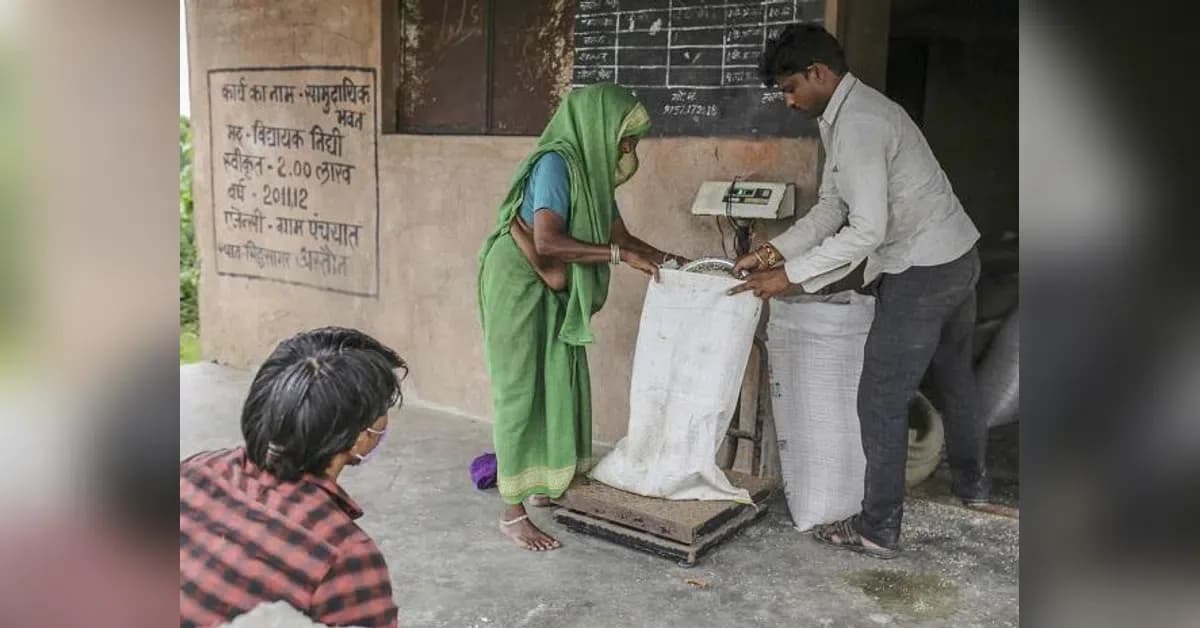
Tamil Nadu and Kerala have strongly opposed the Centre's proposal to revise Antodaya Anna Yojana (AAY) foodgrain entitlement, arguing the move will reduce monthly rations for their poorest households. According to Business Standard, the proposed formula would shift from the current 35 kg per household to 7 kg per person, capped at 35 kg monthly. This revision comes despite rising procurement costs, with rice prices up 18.05% and wheat nearly 20% between FY20 and FY26. The opposition from southern states is particularly significant as they face steeper cuts compared to northern states with larger household sizes.
An analysis by Business Standard data team reveals significant variations in impact across states. Bihar, with the country's largest average AAY family size, would retain its full quota even after the proposed revision. In contrast, southern states face substantial cuts: Kerala's average AAY household would lose 13.5 kg per month, Tamil Nadu 11.69 kg, and Andhra Pradesh, Telangana, and Puducherry each stand to lose close to 15 kg per household. On a national basis, the average family size of 3.59 members translates into a monthly loss of 9.87 kg, as entitlement would decline from 35 kg to about 25.13 kg. Chhattisgarh, a central-east state, would lose more than each of the south Indian states, highlighting the disparate impact across regions.
The Department of Food and Public Distribution has invited public comments on the National Food Security (Amendment) Bill, 2026 until July 13. The government has framed these amendments as part of its broader push to strengthen food and nutritional security through a "human life cycle approach" that ensures access to adequate quantities of quality food at affordable prices, in line with the objectives of the National Food Security Act, 2013. However, civil society and rights groups have opposed these changes, arguing they weaken the social security net and aim to reduce the Centre's food subsidy bill at the cost of beneficiaries. The revision comes as the government expects these changes to generate savings as economic costs of wheat and rice have risen by almost 20% and 18% respectively since FY20.
In February 2026, Home Minister Amit Shah launched India's first Central Bank Digital Currency (CBDC)-based Digital Food Currency pilot in Gujarat. According to Business Standard, under this programme architecture, digital coupons generated through the Reserve Bank of India will be credited directly to beneficiaries as programmable digital currency (e₹). The vouchers are Aadhaar-linked, non-transferable, and valid only for specific months, acting as digital currency equivalents without cash movement properties. The pilot is expected to be replicated in union territories of Chandigarh, Puducherry, Dadra and Nagar Haveli, and Daman and Diu. The concept note proposes integrating NPCI's e-RUPI platform with SBI as the Issuer Bank and NIC as the technical partner for secure, traceable transactions. These itemised vouchers will function as purpose-specific, non-monetary digital instruments, representing food entitlements under the National Food Security Act now called the Pradhan Mantri Gareeb Kalyan Ann Yojana (PMGKAY).
The Communist Party of India (Marxist) has intensified its opposition to the Centre's proposed amendments to the National Food Security Act (NFSA), with its Central Committee meeting from July 11-13, 2026 in New Delhi releasing a strong communique against the government's reforms. As reported by The Hindu, the CPI(M) has declared it will campaign against the proposed amendments and lead protests if the government proceeds with the changes. The party has positioned these amendments against the backdrop of existing challenges, noting that farmers in various states are complaining about fertilizer shortages, particularly urea, while unemployment continues to remain high. The CPI(M) characterizes the BJP government's approach as "most insensitive" and argues that the reforms come at a time when the country faces multiple economic and agricultural challenges.