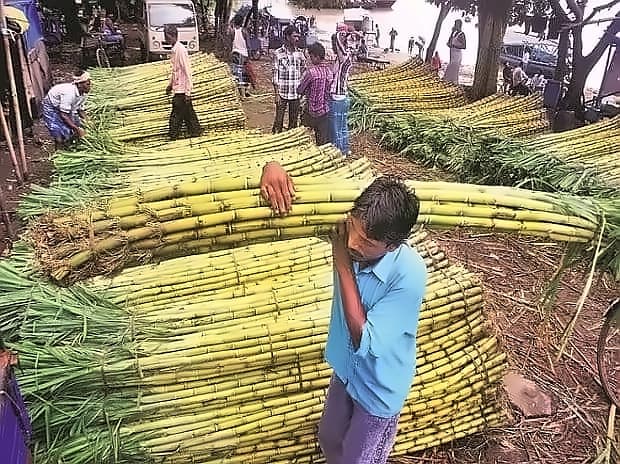
The ongoing agitation by sugarcane growers has severely disrupted the 2026-27 crushing season across India's top sugar-producing states. In Maharashtra, only 15 of 55 sugar mills have begun crushing operations, with 40 mills performing the customary puja but not starting full-fledged operations due to the agitation. According to sources, fifteen mills started operations from October 8 onwards, with sugar produced expected to cool down prices. In contrast, Karnataka has yet to begin crushing, as only eight of the state's 28 mills are running, crushing cane grown in the special season. Maharashtra and Karnataka are the country's second and third largest sugar-producing states respectively, making this disruption particularly significant for national production.
Farmers in both states are demanding a higher support price and an increase in the minimum selling price (MSP) of sugar to ₹60 per kg. The Karnataka Sugarcane Growers Association has demanded a higher support price of at least ₹550 per quintal, given the increase in production cost. Some farmers also flagged discrepancies in weighment after harvest and demanded digital weighing machines at all APMCs. The association has also sought a State Advisory Price (SAP), over and above FRP in Karnataka, on the lines of incentives provided in Uttar Pradesh, Punjab, Haryana, Uttarakhand and Bihar. Farmers in Karnataka began an agitation in Hubballi on September 29, demanding a higher cane price and an increase in the MSP of sugar from ₹31 per kg to ₹60 per kg, with threats of an indefinite highway blockade from October 13 if their demands were not met.
The Centre has constituted a high-powered committee under former NITI Aayog member Ramesh Chand to examine sugarcane farmers' demands, including higher remunerative returns, revision of the minimum selling price (MSP) of sugar and concerns over deductions in the weight of mechanically harvested cane. According to The Hindu BusinessLine, the committee was formed following a meeting between representatives of sugarcane farmers from Karnataka and Maharashtra and the Union ministers for agriculture and farmers welfare and consumer affairs, food and public distribution. The panel will examine demands for higher returns to sugarcane farmers, taking into account cultivation costs and other relevant factors, while also reviewing the demand for revising the ex-mill minimum selling price of sugar in light of production costs, market realisations and the financial viability of sugar mills. The committee includes Agriculture Commissioner, Joint Secretary (Sugar), Joint Secretary (Legal Metrology), and Director (sugar) from the food ministry.
The committee will examine deductions from the weight of mechanically harvested sugarcane and assess the extent of actual losses, if any, arising from mechanised harvesting. As reported by The Hindu BusinessLine, it will evaluate the financial impact of existing practices on the cane prices payable to farmers. Another key area of examination will be the mechanisms used to test and report sugar recovery, including measures to ensure transparent verification. The committee will also assess prevailing sugarcane weighment practices at mills and the adequacy of calibration, inspection and verification mechanisms. These technical aspects include harvest timing, scientific parameters for recovery, modern laboratory testing systems and accuracy of weighing, addressing ground-level issues including discrepancies in recovery figures reported by mills, weighing, wastage, laboratory testing and crop insurance.
Farmers' organisations have rejected the government committee move and are continuing their protest, despite the committee formation. According to sources, the government has notified the committee but has set no clear deadline for it to submit its report or for implementing its recommendations, which has irked the farmers who feel their demands will not be met immediately. Union Agriculture Minister Shivraj Singh Chouhan stated that "exploitation of farmers, who provide food, will not be tolerated under any circumstances," describing discrepancies in recovery rates, weight deductions and concealment of actual recovery figures by mills as highly sensitive matters. Food Minister Pralhad Joshi explained the scientific process for determining the Fair and Remunerative Price (FRP) of sugarcane and the methodology for cost assessment, stating the Centre was ensuring transparency at every level in coordination with states and farmers.
The committee will consult stakeholders, including farmers' representatives, sugar mill associations, state governments, experts and other organisations, as required. As reported by The Hindu BusinessLine, the committee includes authorized representatives from central government, concerned state governments (Karnataka and Maharashtra), farmers' organizations, and sugar mills, as well as subject-matter expert scientists. However, the food ministry has asked the official panel to "consult relevant stakeholders, including farmers, sugar mills, State Governments, concerned Ministries/Departments, research institutions and experts." The committee has been asked to "propose corrective and policy measures, specifying actions required by the Central Government, State Governments and other competent authorities," with no specific deadline for submission. The committee will address various issues including pricing, recovery rates and sugar mill irregularities, with administrative reforms and policy and technical frameworks to be strengthened on a scientific basis.