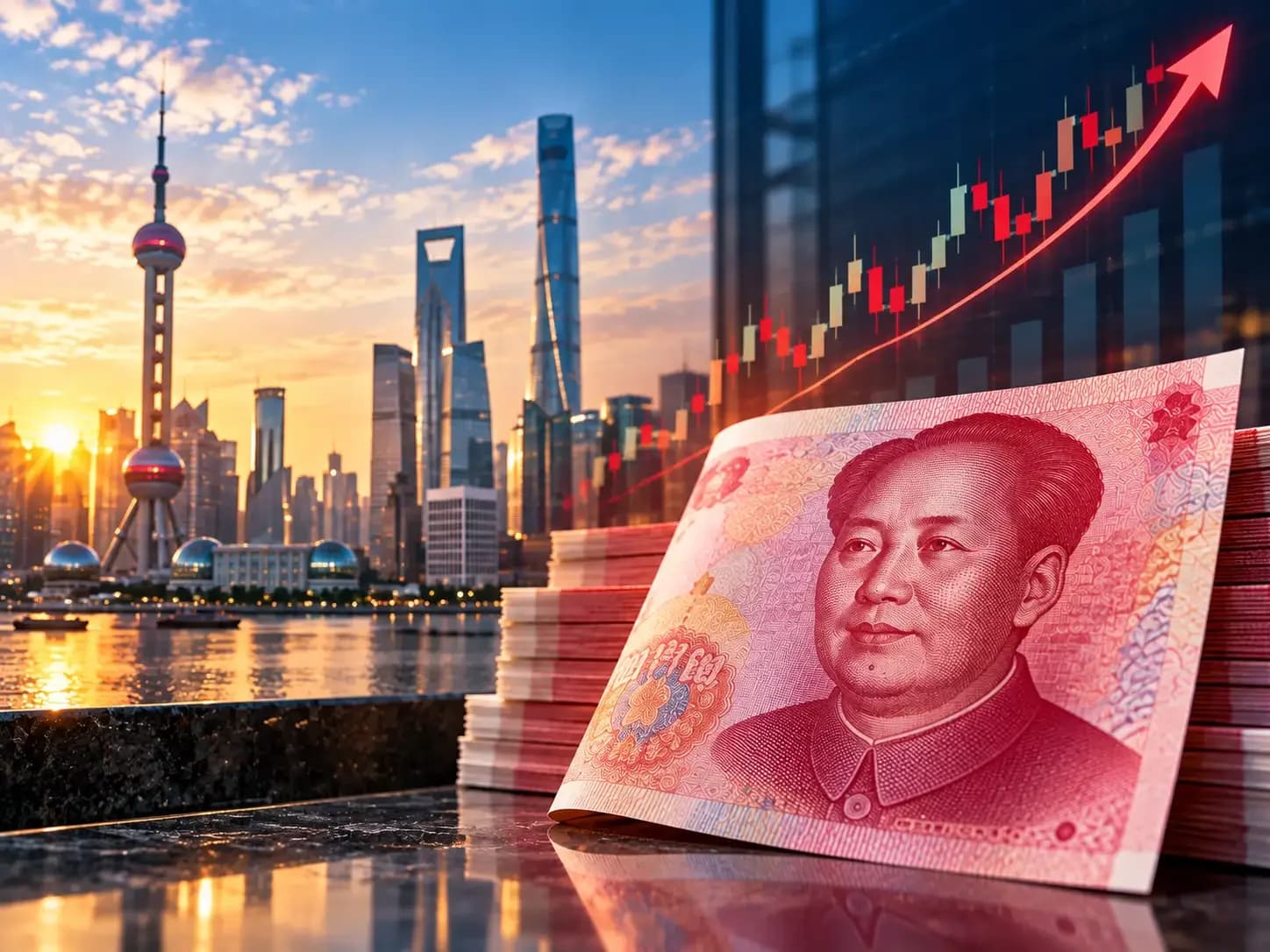
China's yuan clung to its three-year top of 6.7840 per dollar as President Xi Jinping told President Trump that trade talks were making progress, according to The Economic Times. The currency's offshore counterpart similarly touched its strongest level in more than three years at 6.7817 per dollar, as traders had pushed the currency higher ahead of the meeting anticipating deals between the world's two largest economies. However, analysts at Barclays noted that while the yuan is expected to hold steady in the near term, which would help ease discussions between the U.S. and China, pushback by authorities via fixings and intervention suggests limited patience with rapid appreciation. The central bank has been setting weaker-than-expected midpoints since November, a move that market participants believed was to prevent excess yuan gains and maintain currency stability.
China's President Xi Jinping hailed a 'new positioning' of ties with the United States after his summit with President Donald Trump in Beijing, according to Chinese state broadcaster CCTV. As reported by The Economic Times, Xi said both leaders agreed that building a constructive, strategically stable relationship will provide guidance for bilateral relations in the next three years and beyond. However, investors had very low expectations from the summit, hoping for at least reassurances about an extension of a Sino-U.S. trade tariff truce. The latest developments show 'extremely positive and constructive discussions' between the two leaders, with Trump describing Xi as a "friend" and his welcome in China as "magnificent." Trump said talks have been "all good" for both countries, inviting Xi to visit the U.S. in September, while Xi emphasized that the two nations should "become partners, not rivals" through mutual respect.
The 2026 Trump-Xi summit is viewed as a critical geopolitical event for financial markets, with investors primarily seeking signs of stabilisation in US-China trade relations, technology restrictions, and broader geopolitical tensions. Today's two-day meeting between Donald Trump and Xi Jinping in Beijing is shaping up to be one of the most consequential geopolitical events for global markets in 2026. Markets are likely expecting a de-escalation framework instead of a comprehensive trade agreement, with possible outcomes including partial tariff rollbacks or suspension of new tariffs, agreements to resume high-level economic dialogue, and China pledging increased purchases of US agricultural, energy, or industrial goods. A broad structural trade deal remains unlikely due to strategic rivalry between the two powers, with technology remaining the core battleground.
The U.S. dollar held steady on Thursday, with the greenback up more than 0.6% for the week against a basket of currencies, last trading at 98.48, according to The Economic Times. The dollar's strength comes as markets price in a 31.8% chance that the Fed will raise rates in December, up from just over a 16% chance a week ago, according to the CME FedWatch tool. Carol Kong, a currency strategist at Commonwealth Bank of Australia, noted that the inflation data received this week certainly won't be welcomed by FOMC officials, including incoming Fed Chair Kevin Warsh, with the bank forecasting three hikes in the cycle for now. The two-year yield was last at 3.9773%, holding near Wednesday's 1-1/2-month top, while the benchmark 10-year yield stood at 4.4669%, having touched close to a one-year high in the previous session.
The world's economy faces a murky outlook due to the continued closure of the Strait of Hormuz, a vital waterway off Iran's southern coast through which roughly a fifth of global oil flows. Brent crude futures, the global oil benchmark, were last floating above $105 a barrel, compared to a level of roughly $70 a barrel before the start of the Iran war in late February. This spike has fueled worries over an inflationary surge in countries around the world, a trend underlined by consumer and producer price data out of the U.S. this week. Investors have turned to the greenback during the conflict in the Middle East, viewing the currency as a safe haven. Some observers have also argued that the U.S., as a major energy exporter, could be insulated from the energy shock sparked by the shuttering of the Strait of Hormuz.