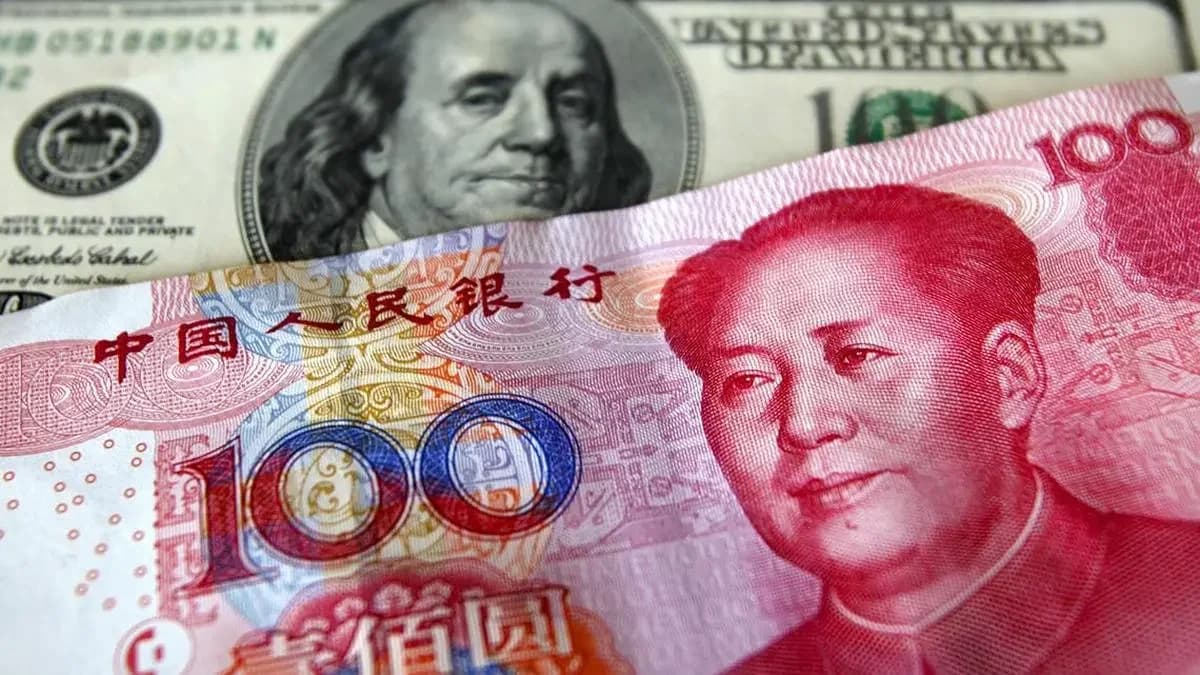
China's yuan climbed to a 3.5-year high against the dollar on Tuesday after the central bank set a stronger daily fixing for the 10th consecutive session. The People's Bank of China set the yuan's midpoint rate at 6.7459 per dollar before the market opened, its strongest level since February 3, 2023. In the spot market, the yuan strengthened to 6.6936 per dollar, its highest level since January 2023, before paring back some gains to 6.6969 per dollar as of 0302 GMT. The offshore yuan stood at 6.6965 per dollar. The fixing was, however, 470 pips weaker than a Reuters estimate of 6.6989, with the onshore yuan allowed to trade within a 2% range on either side of the central bank's daily midpoint.
Markets are sending mixed signals about the outcome of next week's meeting between US President Donald Trump and Chinese leader Xi Jinping, with 46% of offshore and 38% of onshore investors expecting Chinese stocks to rise after the talks, according to a Goldman Sachs survey. However, overseas exchange-traded fund flows and options positioning suggest foreign investors remain wary ahead of the summit. The September 24 talks are expected to focus on whether the leaders will signal an extension of a trade truce agreed last year that helped avert a major disruption to the global economy. Other sensitive issues, including Taiwan, could also feature in discussions. According to Reuters, U.S. Treasury Secretary Scott Bessent has expressed optimism about the trade relationship between the two countries ahead of the meeting.
The firmer fixing signals the PBOC is comfortable with a stronger yuan ahead of President Donald Trump's meeting with Chinese leader Xi Jinping, as reported by Investing.com. However, the central bank has kept its daily reference rates weaker than prevailing market levels, signaling a preference for gradual appreciation rather than a sharp move higher. The 10-session run is the longest since late 2023 and signals a recent shift toward allowing a firmer yuan. In late August, the PBOC set its fixing at the widest weak side deviation from market estimates in six months, shortly after the yuan hit a three and a half year high against the dollar. As per Reuters, this move was widely read as a sign of unease with the speed of the currency's advance rather than its overall direction, with analysts describing the central bank as applying the brakes rather than reversing the trend.
Shanghai Clearing House began central-counterparty services on September 14 for spot transactions in the Singapore dollar, New Zealand dollar and Thai baht, marking a significant expansion of RMB trading capabilities. A dozen banks participated in the debut, with 996 million yuan worth of trades going through the new clearing system. To encourage market participation, the operator waived clearing charges on the three new pairs through the end of 2028. According to Investing.com, the move broadens the currencies that can access China's onshore central-clearing network and could support greater use of the yuan in cross-border transactions. Shanghai Clearing House already provides central clearing for yuan transactions involving the U.S. dollar, euro, pound, Australian dollar and yen. As per Shanghai Clearing House, the new pairs are meant to back FX offerings serving the Belt and Road Initiative, alongside plans to expand the network and advance the yuan's global reach.
The yuan's recent strength has been driven by surging exports and robust conversion flows, with the advance persisting even as rising bets on a Federal Reserve rate hike push Treasury yields and the dollar higher. The currency's strength has been supported by strong exports, exporter dollar conversions, and seasonal year-end conversion of dollar receipts by Chinese companies. The yuan has gained about 4.4% against the dollar so far this year, making it one of Asia's better-performing currencies. However, the interest-rate differential between China and the United States remains wide and is close to a record level, which could limit the pace of further yuan appreciation. Analysts also expect currency markets to remain sensitive to developments from the upcoming Xi-Trump meeting, particularly any signals on tariffs, trade policy and the continuation of the existing truce.