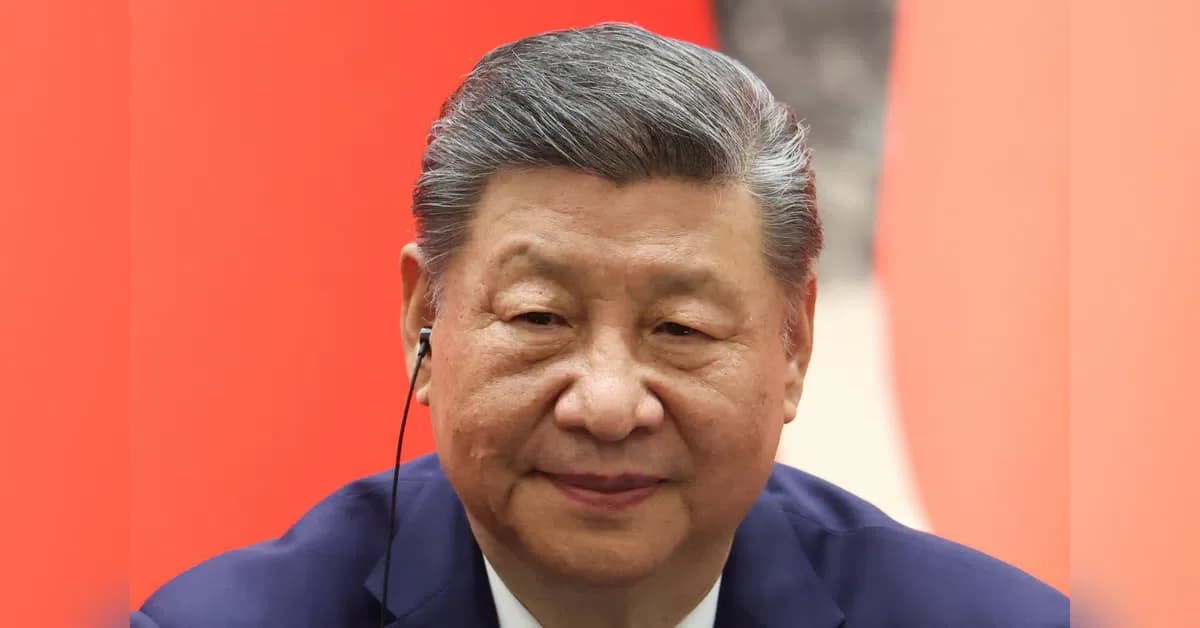
Chinese President Xi Jinping invoked the legacy of his predecessor Jiang Zemin to advance his own economic and global policy agenda, warning of 'high winds and rough waters' as China faces slowing growth and rising tensions abroad. Speaking at an event marking the centenary of Jiang's birth on August 17 at the Great Hall of the People, Xi connected the former leader's record of economic reform, Communist Party control and expanding international influence with his own initiatives to reshape global governance. According to reports from Reuters, Xi said China must 'remain committed to the purpose of China's foreign policy of safeguarding world peace and promoting common development'. In his 40-minute speech, Xi urged the Communist Party of China to carry on Jiang Zemin's political and ideological legacy, emphasizing that 'on the new journey ahead, we must heighten our sense of vigilance against potential dangers. With an indomitable fighting spirit and superb skill in struggle, we must proactively meet the major tests posed by high winds and rushing waters, or even by raging storms.'
In a significant development, Xi Jinping praised the ruling Communist Party's decision regarding the 1989 Tiananmen Square protests, describing Jiang Zemin as an 'outstanding leader' who 'implemented the correct decisions' to crush anti-communist dissent. As reported by Reuters, the speech recounted how Jiang - who had himself been a student protester in the 1940s - forcibly shut down a reformist Shanghai newspaper after it called for greater freedom of speech and voiced support for the pro-democracy demonstrations that culminated in the bloody Tiananmen Square crackdown in Beijing. This praise of the controversial crackdown represents a significant moment in Chinese political discourse, particularly as it comes during the commemoration of Jiang's centenary. The acknowledgment of the Tiananmen incident, which has been a sensitive topic in China, demonstrates Xi's willingness to address historical events while reinforcing the Communist Party's legitimacy.
China's economic momentum is proving increasingly difficult to maintain, with growth slowing to 4.3% in the second quarter, falling below the government's annual target range. As reported by Reuters, official data released Monday showed the economy got off to a sluggish start in the second half, with industrial output, consumption and investment all performing worse than forecast. The economic slowdown has left the economy increasingly reliant on exports and industrial production, with weak domestic demand contributing to the overall decline. Xi Jinping now faces different challenges: trade disputes with the United States and Europe, tensions over Taiwan, slowing economic growth, and demographic decline - stark contrasts to the reform era when China carried out sweeping economic reforms under Jiang Zemin and Zhu Rongji. Under their leadership, China pushed through painful changes including shuttering chronically unprofitable state firms, dismantling the old housing system in favour of a commercial property market, weathering the Asian financial crisis of the late 1990s, and joining the World Trade Organization in 2001.
The remarks come as Beijing and Washington prepare for an expected meeting between Xi and US President Donald Trump in September, with trade, technology and Taiwan among the strains hanging over relations. According to Reuters, the Middle East conflict has disrupted global trade and added economic pressure across Asia, while China is contending with a maritime feud with the Philippines and persisting tensions with Japan. The speech marked Xi's first public appearance in at least two weeks, following the annual summer break during which senior Chinese leaders are believed to gather at the seaside resort of Beidaihe. Former Premier Zhu Rongji, Jiang's co-partner in governance, died last week, with his funeral scheduled on Tuesday, marking a definitive end to the breakneck reforms that both represented during the 1990s and early 2000s.
Current and retired senior officials attended the ceremony, including Premier Li Qiang and Politburo Standing Committee members Wang Huning and Cai Qi, as well as former Premier Wen Jiabao and former Vice President Wang Qishan. As reported by Reuters, Former President Hu Jintao, Jiang Zemin's immediate successor, now 83, was not immediately seen on state media footage of the event, while Wen Jiabao and Wang Qishan's presence may indicate that they remain in favour with the leadership. Events involving President Xi like the Monday ceremony are closely monitored by China watchers for clues to the political pecking order, and for indications of the health and continued standing of the country's retired elite. A number of officials once associated with Wang have come under corruption probes in recent years, making their continued presence particularly significant.
Xi called on cadres to stick to the 'two upholds,' party shorthand that cements his own position at the core of China's political system, emphasizing that 'when we're developing the economy, we have to make sure that we adhere to the party leadership.' According to Reuters, the address echoed Xi's eulogy for Jiang days after his 2022 death, when he portrayed the former leader as having protected the party and sustained China's development despite Western pressure and political upheaval. On the eve of the anniversary event, China's state television broadcaster aired a 12-part documentary series about Jiang Zemin's life and political career, while China's central bank announced plans to issue a set of commemorative coins bearing Jiang's image later this month to mark the centenary. By highlighting Jiang's commitment to defending China's independence and stability amid Western pressure, Xi reinforced the political foundations of his own agenda through reform and Communist Party control.