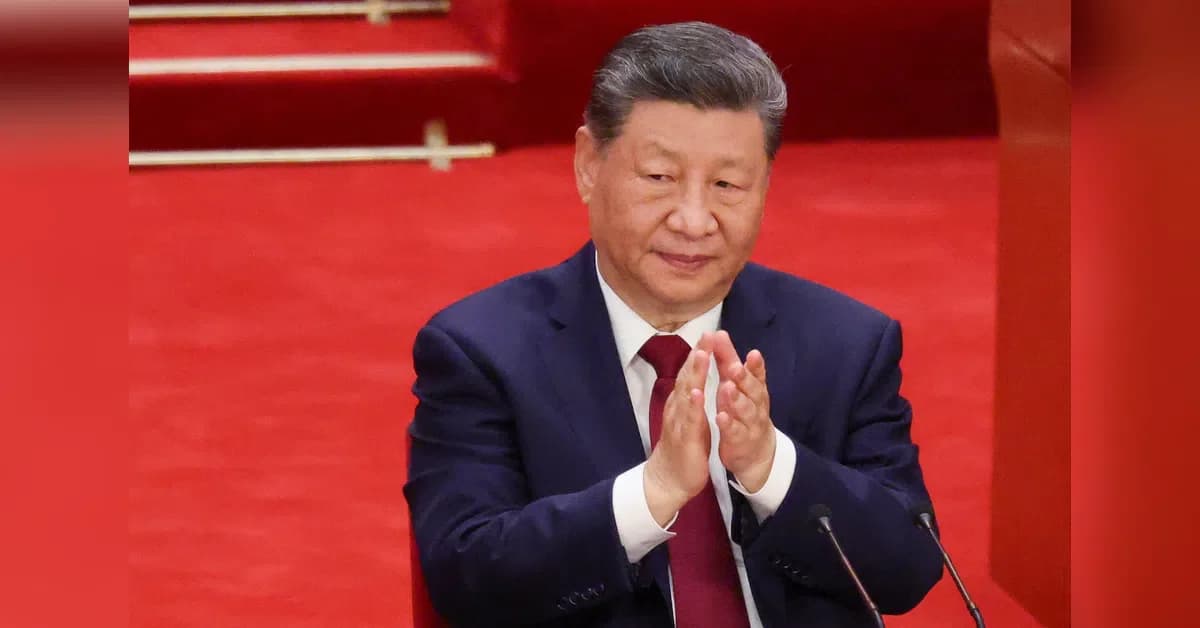
Chinese President Xi Jinping emphasized the importance of international collaboration in artificial intelligence development during his first in-person attendance at the 2026 World Artificial Intelligence Conference (WAIC) in Shanghai. Speaking at China's largest AI gathering, Xi stated that AI development should not be a 'solo performance' by one country, but a 'symphony of global collaboration.' He emphasized that with AI advancing at a staggering speed, its development must be positive and for the good of humanity, guided with human wisdom and international consensus. Speaking at China's annual World Artificial Intelligence Conference, Xi called for greater global collaboration on AI development and governance while highlighting risks and the potential for 'loss of control' as his country races the United States for dominance in the field. 'We should together oppose the practice of overstretching the concept of national security in the field of artificial intelligence, and of placing one's own security above that of other countries,' Xi said, repeating a longstanding Chinese complaint about American-led restrictions. The conference attracted more than 1,100 companies and 1,400 guests, with tech giant Huawei showcasing its powerful AI computing system, the Atlas 950 SuperPoD.
In his clearest articulation yet of China's ambition to shape global AI governance, Xi Jinping cast Beijing as the champion of a new global artificial intelligence order during his opening ceremony speech at WAIC 2026. The Chinese President urged countries to seize the 'historic opportunity' of open-source AI and pledged to help developing nations build AI capabilities, warning against the emergence of 'new historical injustices' from unequal access to the technology. Comparing AI's significance to the invention of the steam engine and electricity, Xi outlined a vision in which China shares AI technology and expertise with countries across the Global South while leading global efforts to create standards governing the emerging technology. The speech pitched China's AI coalition as a rival to the US-led 'Pax Silica' international initiative to secure global AI and critical mineral supply chains, though Xi avoided naming Washington directly. Chinese state media have increasingly portrayed Beijing's AI strategy as a response to what they call a US-led attempt to erect an 'AI Iron Curtain'.
China announced significantly expanded international AI cooperation initiatives to support global collaboration. Over the next five years, China will provide 5,000 training opportunities on artificial intelligence to developing countries, more than doubling the previous commitment of 1,000 opportunities. The country will expand AI cooperation with the Association of Southeast Asian Nations, the League of Arab States, the African Union, the Community of Latin American and Caribbean States, the Shanghai Cooperation Organization and the BRICS countries. China will also provide access for 30 countries to a Chinese-developed AI meteorological system that provides early warning systems, demonstrating practical applications of AI technology sharing. These initiatives emphasize 'equitable' access to strategically important AI technology, balancing innovation with security concerns as China competes with the United States for AI dominance. The remarks came a day after the launch of the World AI Cooperation Organisation (WAICO), which signed up 29 member countries and was described by Xi as a 'milestone in the history of world AI development' that responded to demands from Global South nations for greater participation in AI governance.
29 countries signed an agreement in Shanghai to establish the World Artificial Intelligence Cooperation Organisation (WAICO). The organization will be an independent intergovernmental international body headquartered in Shanghai, with founding members including representatives from Kazakhstan, Laos, Pakistan, Russia, Indonesia, and China, along with the United Nations Secretary-General Antonio Guterres. The signatory nations included Russia, Belarus, Serbia, Cuba, Brazil and Venezuela, along with 12 Asian and 10 African countries. Xi called the organization a 'milestone in the history of world AI development' and said it responded to demands from Global South nations for greater participation in AI governance. The institutional push reflects a broader Chinese effort to avoid being cast as a rule-taker in a sector increasingly shaped by US companies, US export controls and Washington-led technology partnerships, according to analysts. The timing of these remarks turned what might have been a routine policy speech into a statement linking China's technological advances to a formal diplomatic platform.
President Xi proposed a four-point framework for global AI governance to address the challenges posed by AI development. He called for expanding open and mutually beneficial cooperation, strengthening AI safety and risk management, promoting cultural diversity and inclusiveness, and reinforcing multilateral cooperation to establish fair and effective international governance mechanisms. The framework particularly emphasizes supporting developing countries and the Global South in AI development. Xi stressed that AI should serve as a shared public good rather than the exclusive domain of any single country, emphasizing that international cooperation is essential to ensure the technology benefits all humanity. While AI presents enormous opportunities for economic and social development, he said it also raises important challenges related to governance, ethics, security, and the widening digital divide. 'We should put in place laws and regulations, technological monitoring, early warning, and emergency response systems, in order to ... ensure AI is always under human control,' the Chinese leader said. Xi also called for AI systems to remain under human control and urged countries to establish early warning and emergency response mechanisms to manage AI risks, in his clearest remarks to date on AI safety.
China has positioned artificial intelligence as a national strategic priority, aiming to become the world's leading AI innovation center through heavy government investments in research, computing infrastructure, semiconductor development, and talent cultivation. China's five-year plan until 2030 has prioritized progress in frontiers of science and technology including AI. The country has made significant progress in several frontier technologies including AI, electric vehicles, and battery technology, aided by massive state support, a huge domestic market, strong manufacturing capabilities, and a large pool of engineers. China's open-source AI models, like DeepSeek, have been seen as appealing and often times more affordable alternatives globally to U.S. AI models, which are largely closed-source, and especially across the developing world. Some technology analysts now believe China has become an innovator in AI and is no longer just catching up with the U.S., as American-led restrictions have blocked China from accessing some of the world's most advanced technologies, spurring China's efforts to build its own know-how and intensifying the tech race between the world's two biggest economies. Reuters reported earlier this month that Beijing is weighing restrictions on overseas access to some of China's leading AI models, highlighting the growing tension between its promotion of open-source AI and an increasingly stringent national security agenda.