The World Economic Forum (WEF) has issued a stark warning about the global economy's future, predicting that full economic decoupling between the East and the West could wipe out as much as $6.9 trillion from global GDP in 2025-26. According to the WEF report, the global economy is entering a new era where globalisation is giving way to geo-economic fragmentation, with existing trade and financial policies already reducing global GDP growth by between $213 billion and $307 billion while adding 0.2-0.3 percentage points to inflation. The report emphasizes that an increasingly likely escalation could raise the economic cost to this substantial figure, as 2025 and 2026 marked a turning point from globalisation to geo-economic fragmentation. The WEF warns that countries are increasingly adopting unexpected trade and financial barriers, amplifying risks for businesses and economies worldwide, with governments increasingly using control over key economic chokepoints as a strategic tool to further deepen global fragmentation.
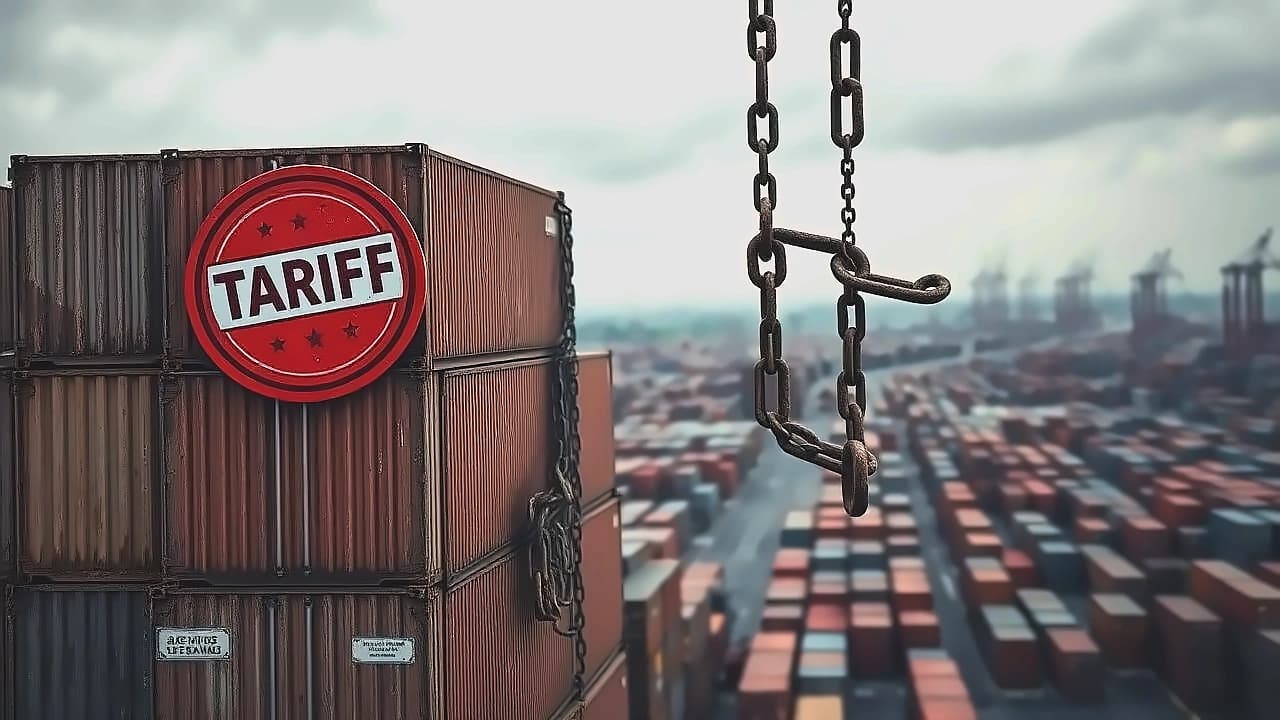
The report highlights the sharp escalation in the 2025 US-China trade conflict, during which tariffs briefly exceeded 100%. As reported by the WEF, the United States attempted to reshape global trade and financial systems through tariffs and other restrictions, particularly against China, while Beijing responded by using its dominance in critical minerals supply chains and redirecting exports. This response helped China record its highest trade surplus in 2025. The US also expanded the tariff war to allied countries, prompting retaliatory measures and encouraging countries to diversify their geo-economic partnerships. According to the WEF, "In 2025 and 2026, severe swings in policy and enforcement by countries reduced certainty and affected decisions on investing and hiring." The report stresses that the world economy needs to prepare for extreme scenarios as governments increasingly weaponise control over key economic chokepoints.
The WEF report reveals that rising nationalism, geopolitical tensions and declining institutional legitimacy have weakened the role of multilateral institutions such as the International Monetary Fund (IMF), the World Bank and the World Trade Organization (WTO). According to the report, with the WTO's dispute-settlement role diminished, countries are increasingly relying on bilateral agreements and local currency settlements, a shift that could reduce economic efficiency and increase risks to financial stability. The report also warns that governments are placing growing pressure on central bank independence by attempting to influence monetary policy through rhetoric and policy actions. This institutional weakness has created an environment where "an increasingly likely escalation could raise the economic cost to $6.9 trillion," as the WEF emphasizes the need for global preparedness.
The WEF estimates that the impact of current trade and financial policies differs across economies, with US output growth expected to be 0.4-0.6 percentage points lower than projected. As reported by the WEF, some neutral countries are less affected, including Indonesia, with a projected 0.1 percentage point hit to output growth. The report warns that in the worst-case scenario, economic growth could fall by up to 6.4 percentage points, while inflation could rise by as much as 6.1 percentage points. Emerging markets and developing economies are expected to face the greatest impact due to reduced access to capital and the shift toward bilateral agreements and local currency settlements that could reduce economic efficiency and heighten financial stability risks. In the most extreme fragmentation scenario, countries outside major geopolitical blocs, most of which are emerging and developing economies, could face output losses of 10.7%, compared with a global decline of 6.4%.