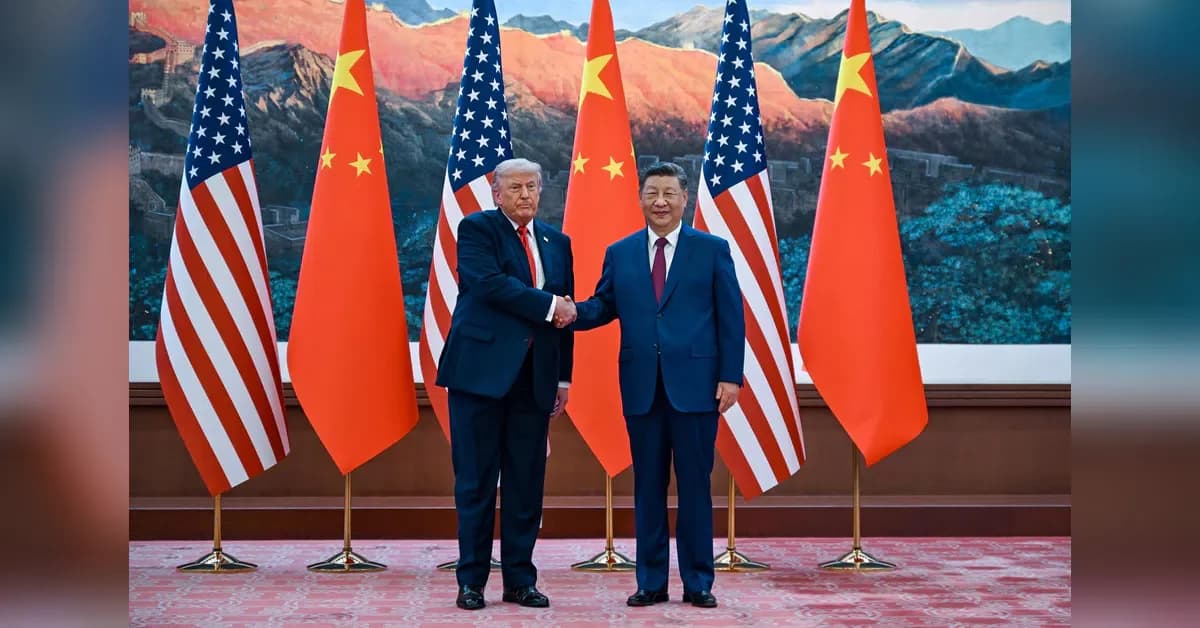
Chinese President Xi Jinping and US President Donald Trump held comprehensive talks on May 14, resulting in a significant breakthrough on bilateral relations. According to latest reports, the two leaders reached common understandings on the new vision of building a constructive China-US relationship of strategic stability. This development represents a substantial shift from previous tensions and marks a new chapter in US-China diplomatic relations, with Trump confirming that tariff issues did not come up in his conversations with Xi during the summit.
US Trade Representative Jamieson Greer revealed that President Donald Trump secured a commitment from China not to provide material support to Iran during their recent summit. Speaking to ABC News on Sunday, Greer explained that the US did not ask China for direct assistance in reopening the Strait of Hormuz, stating "When the president went in, he did not go in asking them to take action in the Straits of Hormuz. He was very focused on making sure that they didn't provide material support to Iran. That's a commitment he obtained and confirmed." Greer noted that China has "a clear interest" in reopening the strait but does not want to get involved directly, emphasizing that "The president isn't seeking to have joint military operations with the Chinese."
While tariff discussions were avoided at the leader level, trade negotiations did occur at the staff level between US and Chinese officials. According to Greer, "Before the leaders meet people, like me and [Treasury] Secretary [Scott] Bessent and our staff, we meet with our counterparts with the -- on the Chinese side, and we work out among ourselves a lot of issues, so that the presidents don't have to address it." The US is also considering establishing a "Board of Trade" with China to negotiate trading terms for specific goods. Greer highlighted several concrete agreements, including China's commitment to resume US exports from several meat-exporting facilities, review certain biotechnology trades, and purchase 200 Boeing planes, though China has not confirmed these details.
President Donald Trump announced that the US government has earned over $30 billion in recent months from its Intel investment, declaring in a Fortune magazine interview that "I should have asked for more" of a stake in the chipmaker. The government initially invested $8.9 billion to acquire a 10% stake in Intel, purchasing 433.3 million shares at $20.47 each. According to Intel, $5.7 billion of this investment came from funds made possible by the CHIPS and Science Act, with the remaining $3.2 billion from a different program designed to boost safe chip manufacturing. The deal has been particularly successful as Trump supported Intel while the chipmaker was facing increasing difficulties.