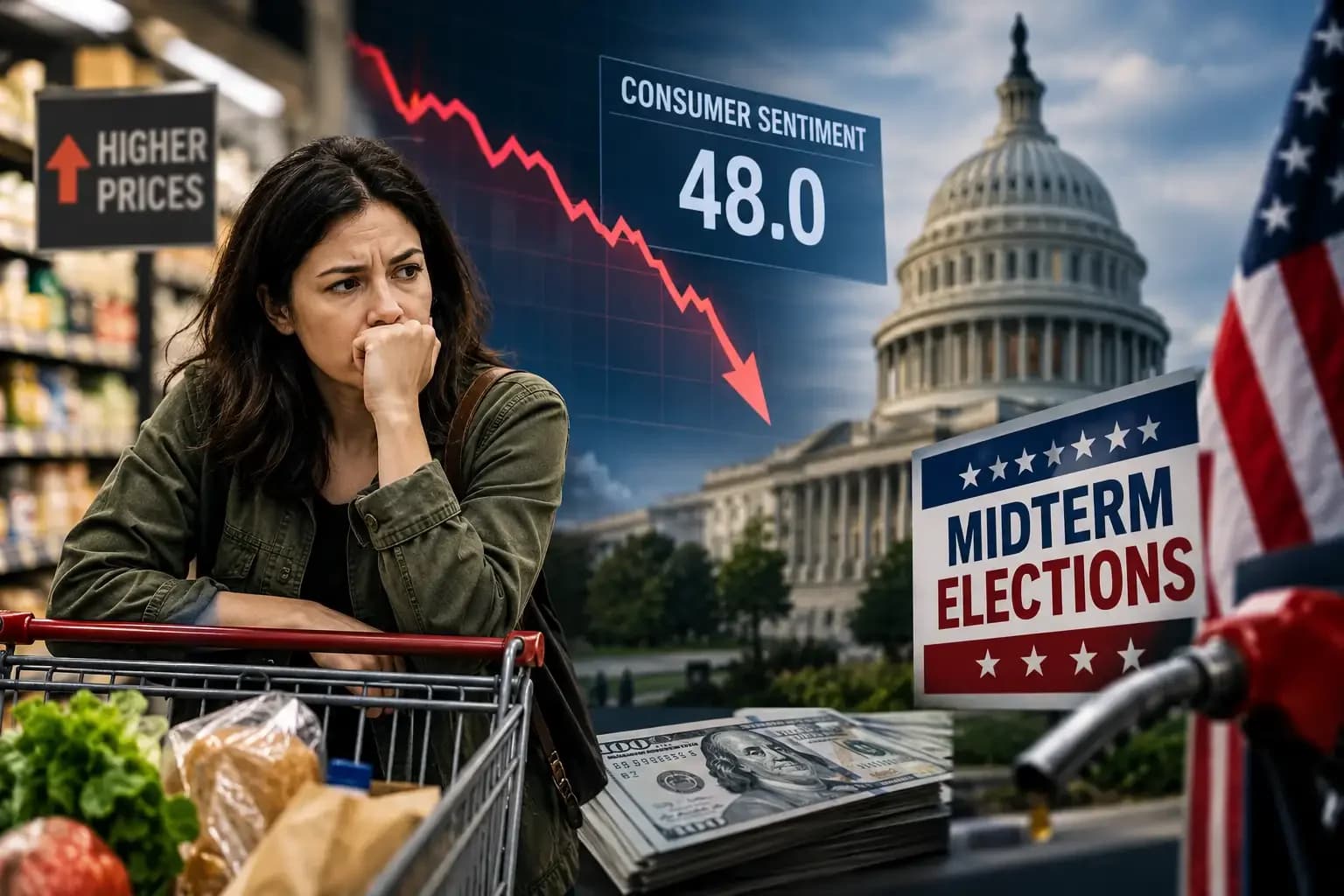
US consumer sentiment barely moved in October, holding close to the lowest level in the survey's history as worries over high prices and borrowing costs continued to weigh on households, according to the University of Michigan's Surveys of Consumers. The final Index of Consumer Sentiment came in at 48.0, just one-tenth of a point below September's final reading of 48.1 and down from 53.6 a year earlier. The final figure was better than the preliminary October reading of 46.3, which was also the level economists polled by Reuters had forecast. As noted by Joanne Hsu, director of the Surveys of Consumers, sentiment is now 10% below a year ago and 15% less than February, just prior to the Iran conflict. The survey results dovetail with political polling data showing voters have a dim view of the economy and President Trump's stewardship. The reading dropped to 48.0 this month from a final reading of 48.1 in September, leading to the second-lowest reading on record, with the lowest being only a few months ago in May when it stood at 44.8 points. The latest reading came as global oil prices crossed $116 a barrel on Friday, hitting a six-month high, while the average price of a gallon of gas in the U.S. is $4.29, amounting to a roughly 43% jump since the Iran war began in late February.
Independent survey respondents showed the steepest decline in confidence, with their sentiment score dropping to 42.4 from 47.7 in September, just above May's record-low 40.6, as reported by the University of Michigan. This critical bloc of swing voters has been significantly impacted by rising prices, with the proportion of respondents who spontaneously cited high prices as hurting their finances climbing to 56%, from 45% in January. The survey showed a significant upswing this year among independents — and also notably Republicans — citing high prices as a drag on their personal finances. Since January, the number of independents referencing inflation pressures as hurting their financial situation rose by 27%, while it has shot up by 52% among Republicans, as reported by Reuters. Hsu noted that consumers with no or very small stock holdings reported increased concerns about the effect of high prices on their personal finances, while those with large stock holdings did not report much of a change in their feelings about high prices burdening their lifestyles. Crucially, weaker sentiment was fuelled by self-identified political independents, with their sentiment dropping to 42.4 points, slightly above the all-time low of 40.6 points, which it reached in May.
The survey's findings coincided with political polling showing that voters held a dim view of the economy and President Donald Trump's and the Republican Party's handling of it, according to Reuters. Millions of Americans have already cast early ballots ahead of the November 3 midterm elections, which will determine control of Congress for the final two years of Trump's term. Polls indicated Republicans were likely to lose control of the House of Representatives, with the Senate also potentially at stake. Trump's approval rating in a Reuters/Ipsos poll stood at a record low, amid a surge in fuel prices following his decision to attack Iran in late February. The University of Michigan survey found that the decline in sentiment was driven by respondents who identified as independents, a group that includes swing voters, with their sentiment score falling to 42.4 in October from 47.7 in September, putting it just above May's record low of 40.6.
The housing market faces significant headwinds as 85% of consumers view now as a bad time to buy a house, with about 62% blaming high interest rates, up from 47% in the previous survey, according to the University of Michigan. The average rate for a 30-year fixed mortgage has risen to 7.32%, compared to 6.19% a year ago, according to Freddie Mac. The university reported that around 69% expect interest rates to rise over the coming year, the highest share since April 2023. More consumers are also concerned about buying a car, with 24% citing high interest rates in October compared with 18% who said so last month, according to Edmunds. The average new car loan has a rate of 7%, while the average transaction price for a new vehicle is $49,639.
Consumer expectations for inflation over the next five years increased to 3.5% from 3.4% in September and 3.2% in March, according to the University of Michigan survey. Gasoline prices were mentioned unprompted by more than 40% of those surveyed, highlighting the impact of Middle East conflict-related price increases on household finances. The national average for a gallon of gasoline on Friday is $4.29, up from $3.07 a year ago, according to AAA. The October survey found that expectations for inflation in the year ahead increased to 4.7% from 4.6% in September. One-year inflation expectations also ticked up to 4.7% from 4.6% in September, and are sharply higher than 3.4% in February. Prices rose at an annual rate of 3.7% in September, the most recent month on record, federal government data showed, with inflation standing more than a percentage point higher than the Federal Reserve's target rate of 2%. In an accompanying report, Hsu said persistently elevated inflation expectations in the period following the Covid-19 pandemic posed a risk to the Federal Reserve's efforts to bring inflation down to its 2% target. She also cautioned that relatively resilient consumer spending, despite negative views of the economy, required close attention, noting that if households were spending now to avoid expected price increases in the future, bringing inflation down could become more difficult.
Federal Reserve officials are scheduled to meet in Washington next week. Despite recent inflation readings that came in higher than expected, they were broadly expected to keep the policy interest rate unchanged at 3.75%-4.00%. The Fed had raised the rate by a quarter of a percentage point in September. Most officials had indicated a need for higher interest rates, while key policymakers had also expressed willingness to wait for more data before making their next move. Hsu noted that consumers broadly expect inflation to accelerate, and this year's increases in inflation expectations are not limited to one part of the political spectrum, with the target having remained unmet for more than five years.