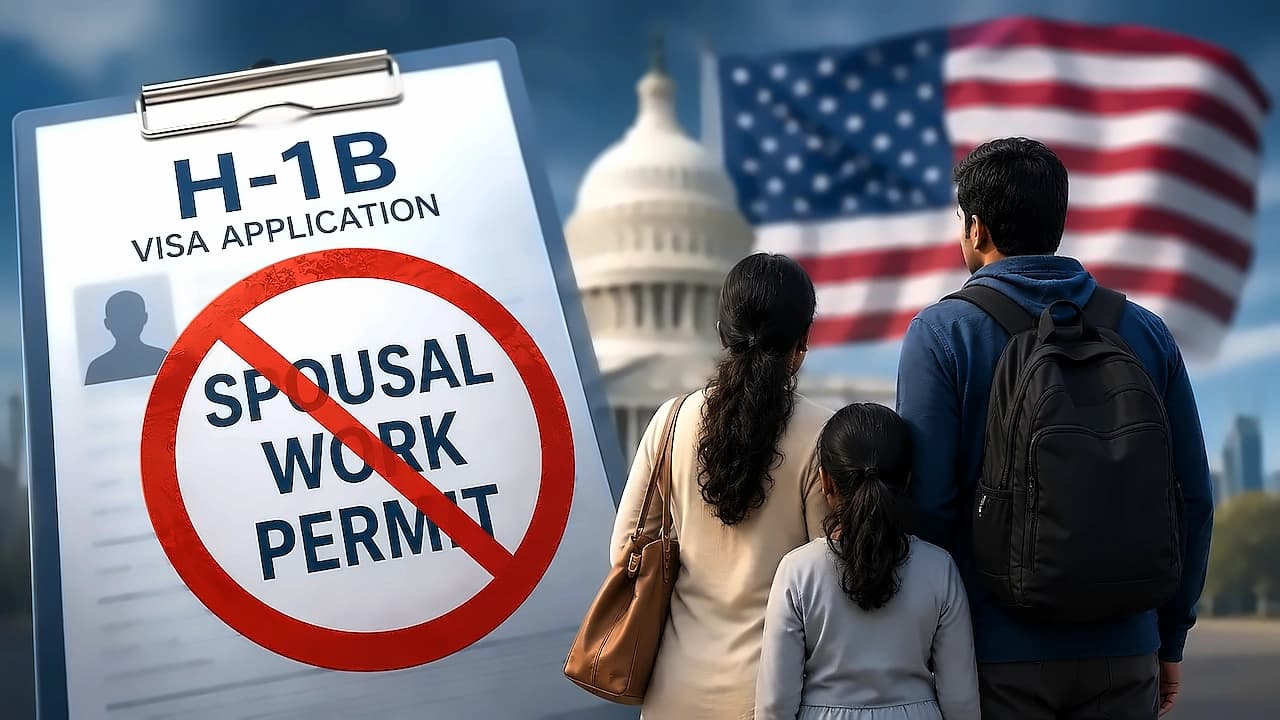
The US Citizenship and Immigration Services (USCIS) has provided important clarification regarding H-1B workers seeking green cards, stating that foreign professionals offering economic benefit or serving national interest may stay in the US during the green card application process. According to USCIS spokesperson Zach Kahler speaking to Newsweek, applicants who provide economic benefit to the US or serve national interest would 'likely be able to continue on their current path', while others could still be asked to apply abroad depending on individual circumstances. This clarification comes after a USCIS policy memo issued earlier last week that initially suggested temporary visa holders seeking permanent residency would generally need to return to their home country and complete the process through consular processing. The latest clarification indicates that H-1B visa holders remain relatively protected because the visa category allows 'dual intent', meaning H-1B workers can legally hold temporary non-immigrant status while also pursuing permanent residency. The evolving USCIS adjustment policy signals a sharp transition from the long-standing, predictable mechanics of employment-based immigration, with domestic adjustment now treated as 'extraordinary discretionary relief' rather than a routine administrative step.
The clarification follows a USCIS policy memorandum issued earlier last week, which changes how the agency views 'adjustment of status' applications filed inside the United States. Under the new interpretation, adjustment of status would now be treated as an 'extraordinary discretionary relief' instead of a routine immigration benefit. The original announcement appeared to signal a much stricter approach, with USCIS stating they were returning to the original intent of the law and that temporary visa holders wanting a green card would generally need to return to their home country unless there were 'extraordinary circumstances'. This sparked concern across the technology sector and among immigration lawyers, especially because Indian nationals make up the largest share of H-1B visa holders in the US. The updated clarification suggests that many H-1B visa holders may continue living and working in the United States while applying for green cards through the adjustment of status process, though uncertainty remains over how immigration officials will decide who qualifies under the 'economic benefit' or 'national interest' standards. The new memorandum explicitly notes that holding a dual-intent visa is no longer dispositive on its own to guarantee a domestic adjustment, requiring applicants to supplement standard filings with ironclad portfolios of tax compliance, long-term employment verification, and deep community roots.
The latest clarification indicates that H-1B visa holders remain relatively protected because the visa category allows 'dual intent', meaning H-1B workers can legally hold temporary non-immigrant status while also pursuing permanent residency. According to the USCIS memo, applying for adjustment of status is not inconsistent with maintaining H-1B status. However, USCIS also clarified that merely holding an H-1B visa does not automatically guarantee approval. Immigration officers will now exercise broader discretion while deciding whether applicants can continue the process from inside the US, with applicants who can demonstrate that their work benefits the US economy or serves the national interest expected to receive more favourable consideration. The development is particularly significant for Indian professionals working in technology, health care, engineering and finance sectors, as Indians account for the overwhelming majority of H-1B approvals in recent years and face some of the longest waits for employment-based green cards, especially under the EB-2 and EB-3 categories. The new policy memo mandates adjudicating officers to perform a rigorous 'totality of the circumstances' evaluation, balancing an applicant's positive equities against negative factors to determine if domestic approval is in the best interest of the nation.
The development is particularly significant for Indian professionals working in technology, health care, engineering and finance sectors, as Indians account for the overwhelming majority of H-1B approvals in recent years and face some of the longest waits for employment-based green cards, especially under the EB-2 and EB-3 categories. For many Indian workers, leaving the US during the green card process could create serious disruptions involving jobs, family life and children's education. Immigration experts have warned that mandatory overseas processing could expose workers to long visa appointment delays at US consulates abroad, increasing the risk of prolonged separation from employers and families. The concerns are more acute for workers facing layoffs because H-1B holders typically get a limited grace period to secure a new employer or leave the country. The recent policy confusion raised concerns that workers could face major disruptions to their jobs and personal lives, with some fearing they would need to leave the United States and wait abroad for visa appointments or immigration processing. Many H-1B visa holders also worry about layoffs in a slowing job market, as current visa rules require workers who lose their jobs to find new employment within a limited period or leave the country. The new policy particularly affects international students enrolled in American universities, who operate under strict non-immigrant intent restrictions and face extreme institutional pushback when moving directly from student status to green card applications.
The proposed shift has already drawn criticism from parts of the US technology industry, with LinkedIn co-founder Reid Hoffman describing the move as 'harmful' for technology companies and the broader US economy. Immigration lawyer Todd Pomerleau questioned whether the policy could survive court scrutiny, telling ABC News that administrative action alone cannot override immigration statutes passed by Congress. The Trump administration has defended the move, saying the changes are aimed at restoring the 'original intent' of immigration law and preventing misuse of adjustment-of-status provisions. Immigration lawyers are advising Indian professionals to remain cautious despite the clarification, recommending that applicants: - Maintain valid H-1B status wherever possible even after filing Form I-485 - Preserve documentation showing economic contributions or specialised skills - Monitor future USCIS guidance closely, as the agency is expected to issue more detailed operational rules in the coming weeks - Consult immigration attorneys before responding to any USCIS notices or requests. The latest clarification provides temporary relief for employers and workers, but immigration advocates say clearer rules will be necessary to avoid confusion among employers and foreign workers. The issue has also sparked debate within the Indian professional community, with business leader Sridhar Vembu encouraging Indians to consider returning home, though his comments received mixed reactions from professionals who have spent years building careers abroad.