The Trump administration is considering a significant policy change that could affect thousands of H-4 visa spouses currently working in the United States. According to reports from Reginfo.gov, the administration is weighing an end to a decade-old programme that has allowed some spouses of H-1B visa holders to work legally in the United States. The proposal, titled "Removing H-4 Dependent Spouses From the Classes of Noncitizens Eligible for Employment Authorization", would bar eligible H-4 dependent spouses from obtaining work permits in the United States. As per Reginfo.gov, the proposal says "DHS is proposing to remove from its regulations certain H-4 dependent spouses of H-1B nonimmigrant workers as a class of aliens eligible to request employment authorization under the (c)(26) category." The proposed rule (RIN: 1615-AD14) was added to the Department of Homeland Security's long-term regulatory agenda, but no target date has been set for its release. For the proposed DHS rule to take effect, the agency first has to publish a Notice of Proposed Rule-making (NPRM) in the Federal Register, provide an opportunity for the public to submit comments, and then issue a final rule. Until then, eligible H-4 spouses with valid EADs can continue to work under the existing rules.
The proposed rule change could have a disproportionate impact on Indian families, as reported by Reginfo.gov. About 93% of H-4 EAD approvals from 2014-2017 were granted to Indian nationals, indicating the significant presence of Indian families in this program. This concentration among Indian nationals suggests that Indian professionals and their families would likely face the biggest impact if the proposed policy is implemented, as they represent the majority of beneficiaries under the current H-4 work authorization system. The move could disproportionately affect Indian H-1B families, given that Indian nationals accounted for about 71% of approved H-1B petitions in FY2024, according to USCIS data. Many H-1B workers seeking permanent residency bring their spouses to the US on H-4 visas, with eligible spouses able to work if they obtain an EAD. A 2017 Congressional Research Service report found that, of roughly 126,853 H-4 EAD applications approved between 2014 and 2017, 93% were for Indian nationals and 94% were for women, with many Indian women with H-4 EADs working in highly skilled fields including medicine, STEM, education and technology. According to The Times of India, nearly a lakh Indian spouses are estimated to hold H-4 EADs, and if the programme were eventually abolished, these families could face a major disruption to their lives.
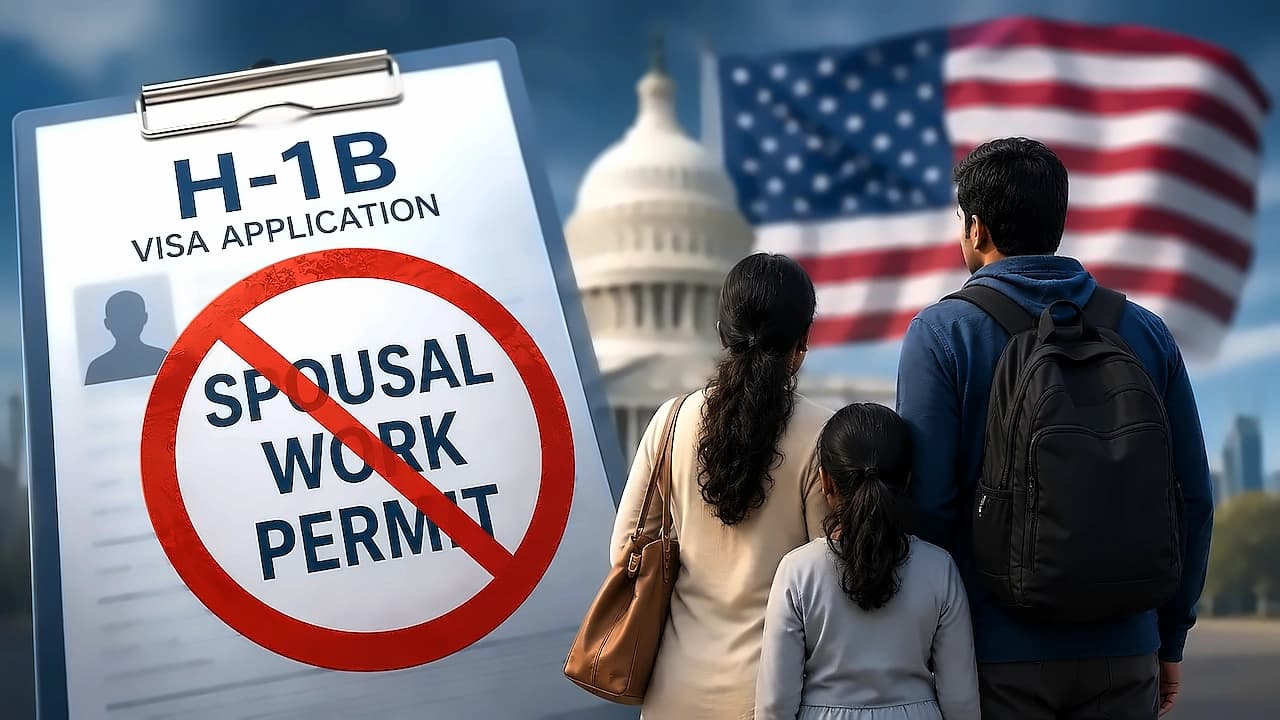
The potential reversal would undo a 2015 policy that gave eligible H-4 spouses of H-1B workers the ability to secure Employment Authorisation Documents (EADs) and work legally in the United States. As reported by Reginfo.gov, this 2015 policy represented a significant shift in immigration policy that allowed H-4 spouses to obtain work permits, providing them with legal employment opportunities in the United States. The current proposal would effectively eliminate this pathway for eligible H-4 spouses. The H-4 visa is a US visa issued to dependents of H-1B visa holders that allows them to travel to the US to accompany or reunite with the principal visa holder. Dependent family members refer to either spouses or unmarried children under the age of 21 of the H-1B holder. H-4 status generally lasts for the duration of the primary visa holder's status. Since 2015, the DHS has allowed certain H-4 spouses of H-1B workers seeking permanent residency in the US. An H-4 spouse can apply for an EAD if the H-1B spouse has an approved Form I-140 immigrant petition or has received an H-1B extension beyond the standard six-year limit under the American Competitiveness in the 21st Century Act (AC21). According to Murthy Law Firm, H-4 status must be separately extended for each family member by filing an application with USCIS, and it is not automatically extended when the spouse or parent receives an extension of H1B status.
This is not the first time DHS has sought to end the H-4 EAD programme. In 2017, during Donald Trump's first term, the department proposed rescinding employment authorisation for certain H-4 spouses of H-1B visa holders. The proposal was never finalised and was ultimately withdrawn in 2021. In 2026, the DHS is once again seeking to end the programme. The move comes as the Trump administration has renewed attempts to restrict employment via the H-1B visa, with the DHS recently proposing a new $103,265 fee for new hires and the White House clearing a proposal to eliminate the 60-day grace period for professionals on the H-1B visa to find new sponsorship after a job loss. While the proposal has a long way to go before being officially adopted, if the administration moves forward with the proposed rule, qualifying H-4 spouses could lose their ability to obtain or maintain employment authorisation under the existing H-4 EAD programme. The proposal is titled "Removing H-4 Dependent Spouses From the Classes of Noncitizens Eligible for Employment Authorization" and would reverse the changes made in the 2015 final rule, restoring DHS's long-standing policy of not extending eligibility to request employment authorisation to H-4 dependent spouses.
The potential financial impact of ending H-4 EADs depends significantly on whether households currently rely on the H-4 spouse's earnings. According to The Times of India, the work permit can serve as a source of income for H-1B families, and if the proposal eventually becomes a final rule that removes employment authorization, affected spouses could no longer continue working under an H-4 EAD. The significance of H-4 EADs cannot be understood without looking at the US employment-based green-card backlog. A recent analysis by the National Foundation for American Policy (NFAP) estimated that more than a million Indians, including dependants, were waiting in the first three employment-based green-card categories as of December 2025. The potential change would affect not only immigration status but also the ability of qualifying spouses to remain in the US workforce. Under AC21, H-1B nonimmigrants seeking employment-based lawful permanent residence may be eligible to work and remain in the United States beyond the six-year H-1B period of admission limitation, making the H-4 employment eligibility change particularly significant for families pursuing green cards.