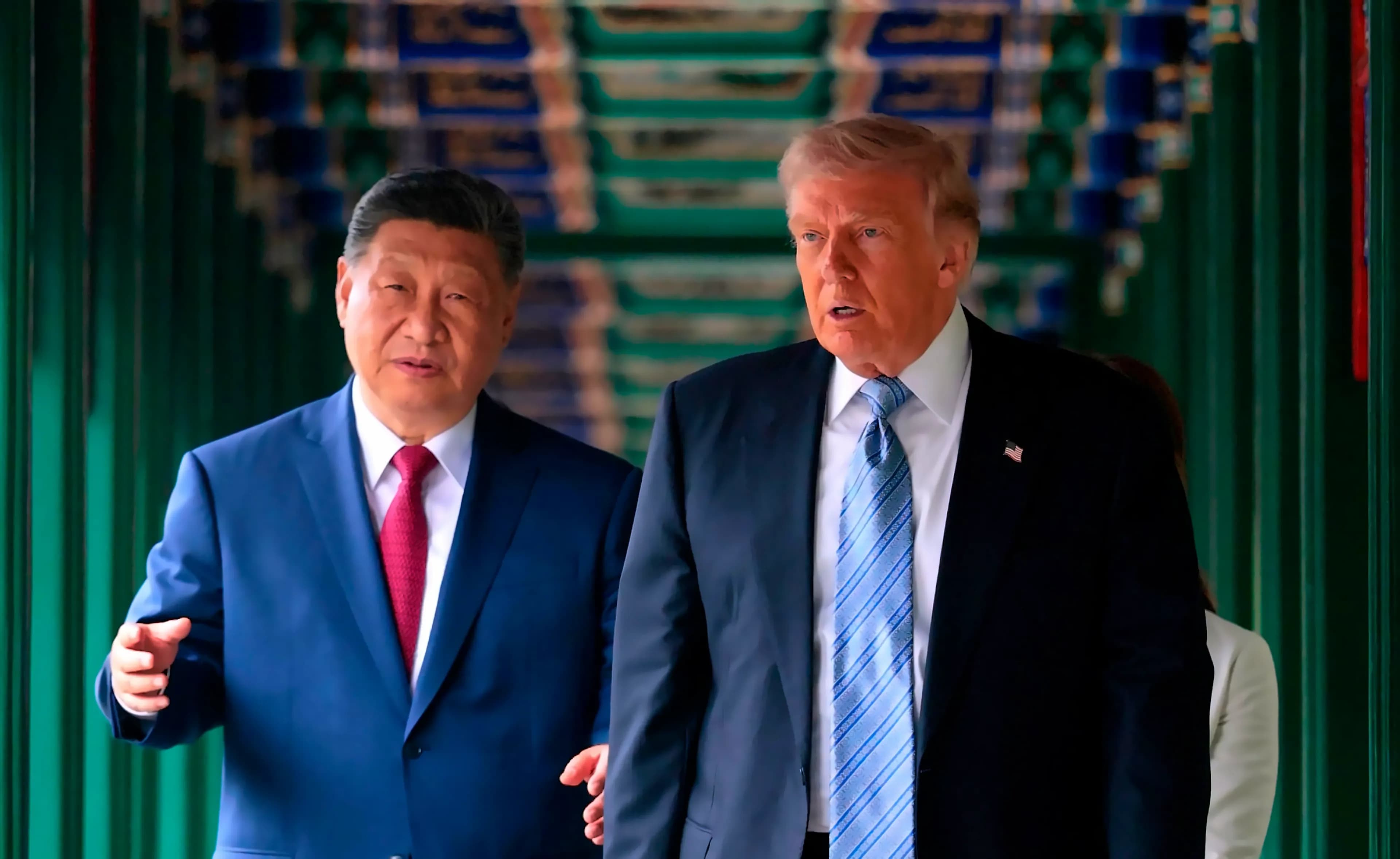
The United States and China are scheduled to meet in September to discuss artificial intelligence as the superpowers struggle to control the risks presented by their increasingly potent competing frontier models, according to reports from Reuters. The AI talks, a major outcome of the Trump-Xi summit in May, will probably occur before Chinese President Xi Jinping's scheduled September 24 visit to the United States, though the exact dates have not been finalised. Five people familiar with the matter have confirmed the September timeline, with sources asking not to be named as the information is not public. As economic, political and military rivals, China and the U.S. have grown increasingly anxious over each other's AI capabilities amid an accelerating global AI race. U.S. President Donald Trump stated publicly in early July that he expects to meet with Xi Jinping around September 24, coinciding with the United Nations General Assembly in New York. Despite recent discord in bilateral relations due to election interference allegations and a struggle for dominance in AI rulemaking, U.S. Secretary of State Marco Rubio has made clear that Xi Jinping's visit to the U.S. is still proceeding as originally planned without any changes.
Treasury Secretary Scott Bessent would reportedly lead the negotiations on the U.S. side, as confirmed by four sources to Reuters. The interesting choice of Treasury reflects how Washington is framing this diplomatic initiative, as the department runs sanctions, export-linked financial rules, and the bilateral economic file with Beijing. Preparations are still in the early stages, so the identities of other participants from the Chinese and American sides, as well as the discussion's agenda and venue, are still being considered. The September talks would constitute the first official U.S.-China dialogue on AI under President Donald Trump, marking a significant diplomatic milestone. The identities of other participants for the U.S. and China, as well as the agenda and location of the discussion, are still under deliberation as preparations are at an initial stage, with Chinese authorities continuing internal deliberations on AI issues over the next month before deciding which officials from which ministries will participate. The White House, U.S. State Department and U.S. Treasury did not immediately respond to a Reuters request for comment, while China's National Development and Reform Commission, cyberspace regulator, industry and foreign ministries, and the State Council did not immediately respond to faxed requests for comment.

Treasury Secretary Scott Bessent addressed intellectual property concerns in a recent interview on Fox Business Network, citing watermark violations in Chinese AI models. "We are finding watermarks of our U.S. large language models on many of the Chinese models, and that that's unacceptable," Bessent told the U.S. television network. "We're going to be looking at that in the coming days or weeks." The U.S. has already limited exports to China of some of the most advanced AI chips, but has held off on adding China's AI startup DeepSeek, memory chipmaker CXMT and more than 100 other companies flagged as national security risks to a trade blacklist in an effort to avoid escalating tensions with Beijing. Asked about possible trade actions, U.S. Trade Representative Jamieson Greer said a number of U.S. government agencies were looking at the issue, citing concerns over forced technology transfer and intellectual property issues as well as energy subsidies.
The AI talks emerge as the superpowers struggle to control the risks presented by their increasingly potent competing frontier models, with both nations grappling with implications of advanced AI development capabilities. Beijing and Washington are weighing how to regulate advanced AI models that could strengthen military capabilities, enable cyberattacks on critical infrastructure and disrupt labour markets. China's foreign ministry confirmed following Trump's visit that the two nations had agreed to establish intergovernmental AI talks, but Beijing has not commented publicly since. China's priority list for the discussions includes Mythos, how the U.S. will control the release of future advanced frontier models, and whether Washington will impose restrictions on Chinese open-weight models, according to analysts. The Trump administration is in talks with U.S. AI companies about creating voluntary safety standards for new AI model releases, though it has not yet announced any regulatory measures. Bessent has publicly given a narrow substantive hook: a protocol on 'best practices for AI to make sure non-state actors don't get a hold of these models,' as he put it in May, together with the line that the U.S. can afford these discussions "because we are in the lead." The talks are described as a significant outcome of the Trump-Xi summit in May, with the substantive hook being prevention of frontier model weights and capabilities from leaking to criminal or terrorist users, which is a relatively narrow, mutually convenient goal that is the easiest thing for both sides to agree to talk about without touching export controls, chip rules, or each other's domestic AI industries.
As preparations for the AI talks were underway, Trump last week suddenly accused the Chinese government of stealing 220 million voter records during the 2020 U.S. election, interfering in the American electoral process. Although these claims have long been refuted by U.S. intelligence agencies, markets are concerned that the move could jeopardize the trade truce reached last year. Furthermore, Trump has reactivated a plan to impose 90-day visa restrictions on Chinese journalists, the proposal was initially raised at the end of his first term and subsequently shelved by the Biden administration, adding further uncertainty to bilateral exchanges. However, before departing for Manila to attend the ASEAN Foreign Ministers' Meeting, Rubio stressed that all preparatory work is ongoing, with the Chinese team still traveling to the U.S. for coordination as usual. "When two powerful countries like the United States and China interact, there will always be points of friction," Rubio said. "But I believe that influential and important countries like ours have a responsibility to maintain dialogue and sustain the bilateral relationship." Notably, the United States has campaigned for specific safety measures at international events like the U.N. AI forums and the July 2026 World Artificial Intelligence Conference (WAIC) in Shanghai, while China has pushed for more affordable, open-source models and wider global access through programs like the World Artificial Intelligence Cooperation Organisation (WAICO)