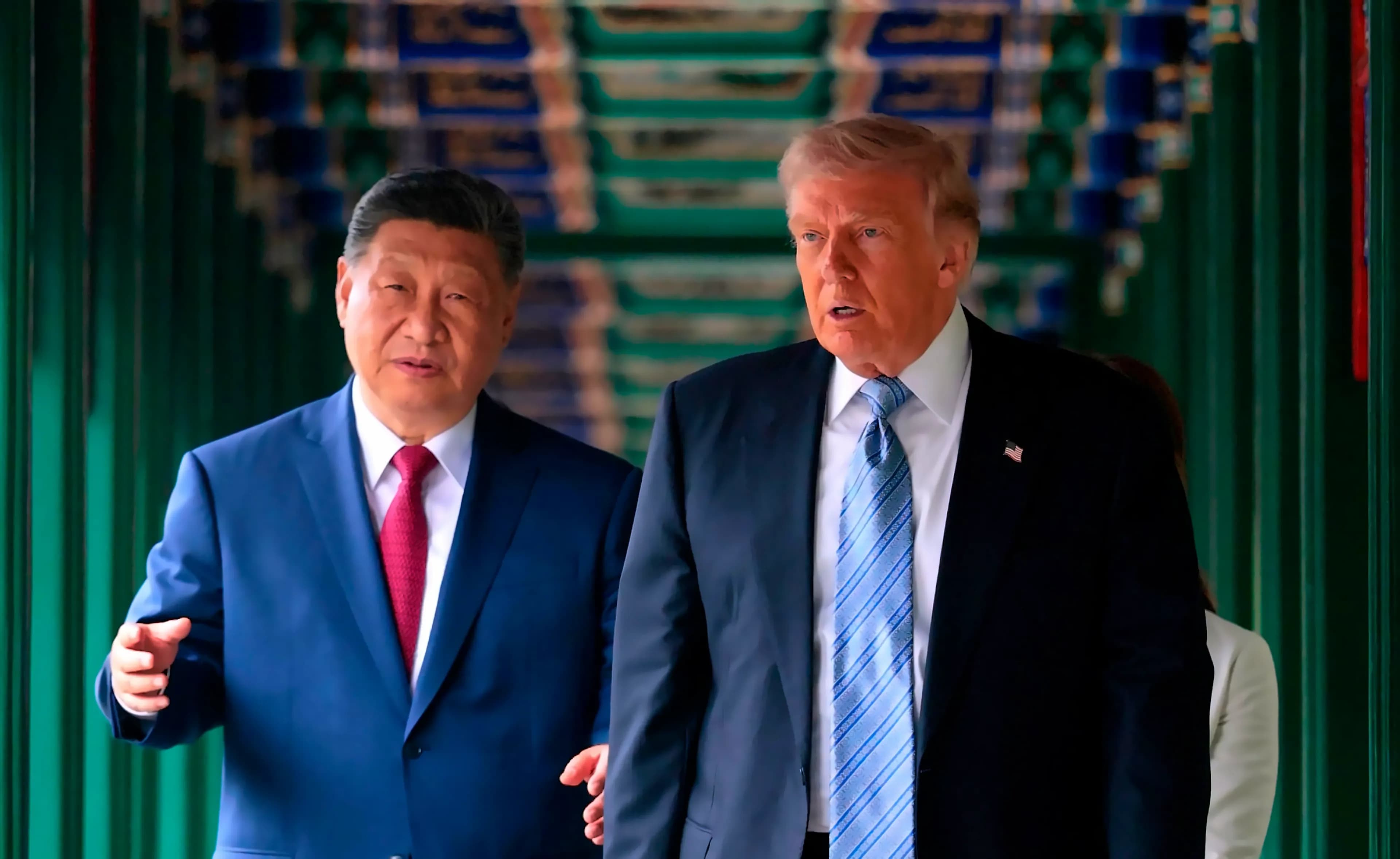
Chinese President Xi Jinping is officially scheduled to visit the United States from September 23 to 25, following an invitation from President Donald Trump. The confirmation came from China's Foreign Ministry spokesperson on Monday, addressing heavy doubts and speculation surrounding Xi's health and trip status. Washington released a detailed itinerary on Saturday outlining the three-day visit schedule. When Xi lands at Joint Base Andrews on Wednesday, he will receive a full state arrival ceremony on Thursday at the White House State Floor, followed by a troop review in the Rose Garden before private discussions. As reported by Associated Press, this marks a significant shift from Trump's typical White House meetings with foreign leaders, with the visit featuring a state dinner in the East Room where both leaders will deliver remarks. The visit will conclude with Xi and Peng Liyuan joining the Trumps for a private tea and tour of the National Archives during the US's 250th anniversary celebrations.
The Iran war launched in late February has created significant oil market volatility, but China's strategic energy reserves have helped prevent the most dire price projections from materializing. According to Associated Press, China's crude imports averaged just 8.1 million barrels per day in the second quarter, which is almost 4 million barrels per day, or 32% lower than in the first three months of the year. This dramatic reduction in imports has eased global demand and softened price effects for the United States, Europe and beyond. Brent crude currently hovers around $100, though it briefly peaked in late April at $126 before settling. Analysts at Bank of America forecast oil at $83 a barrel for the second half of the year, while violence escalation could push prices to $95 to $120 a barrel, with damage to major energy infrastructure potentially reaching $150 a barrel. Beijing spent years and billions of dollars amassing the world's largest oil stockpile, building it to about 1.4 billion barrels by the end of last year, according to the U.S. Energy Information Administration's estimates.
US officials indicated Washington and Beijing may be ready to ease some tariffs on non-strategic goods during the visit, according to senior US officials speaking to reporters. Such a move would affect a narrow band of goods that would be advantageous to both sides, marking a potential shift from Trump's previous confrontational approach. Treasury Secretary Scott Bessent will meet this weekend in New York with Vice Premier He Lifeng to discuss a range of economic issues, with artificial intelligence and China's stockpiles of rare earth minerals set to be a focus. The talks might continue at the working level into Monday, as reported by Associated Press. This development comes after Trump's initial tariff strategy through super-high tariffs and export restrictions backfired significantly, with China holding a relative monopoly on rare earths used in electronics that helped force a trade armistice.
The state visit will feature major business executives attending the state dinner, including Tesla and SpaceX's Elon Musk, Nvidia's Jensen Huang, Google's Sundar Pichai, OpenAI's Sam Altman, Amazon founder Jeff Bezos, Dell Technologies' Michael Dell, Citigroup's Jane Fraser, and Tim Cook who recently stepped down as Apple CEO. As reported by Associated Press, this business engagement reflects the very good trading relationship that Trump has described with Xi Jinping. The visit represents a dramatic transformation from Trump's initial campaign rhetoric when he called out China as a menace to the US economy, claiming it had gutted America's factories and eroded the middle class. However, Trump increasingly speaks in glowing terms about Chinese President Xi Jinping, describing him as a 'great gentleman' and stating they have a 'very good trading relationship.'
The upcoming meeting between the two leaders carries great significance for the global economy, set against a backdrop of complex trade restrictions, an accelerating artificial intelligence race, and fragile supply chains. According to Associated Press, as the world's two largest economic superpowers navigate a delicate 'constructive relationship of strategic stability' established during their previous meeting in Beijing, the outcomes of this summit will dictate the trajectory of global trade, technology standards, and energy markets for years to come. China has expanded its dominance in manufacturing and pushed into new technologies such as artificial intelligence and electric vehicles that create risks for economies of the US, Germany, Italy, France, South Korea and Japan. Evan Medeiros, a professor at Georgetown University, noted that the US might not be positioning itself to compete against China as it should be, with this idiosyncratic approach coming at precisely the time when competition needs to be amped up. It's unclear whether Thursday's visit will have a policy deliverable, with Associated Press reporting that it's possible the main deliverable will be the relationship itself rather than clear and measurable goals.