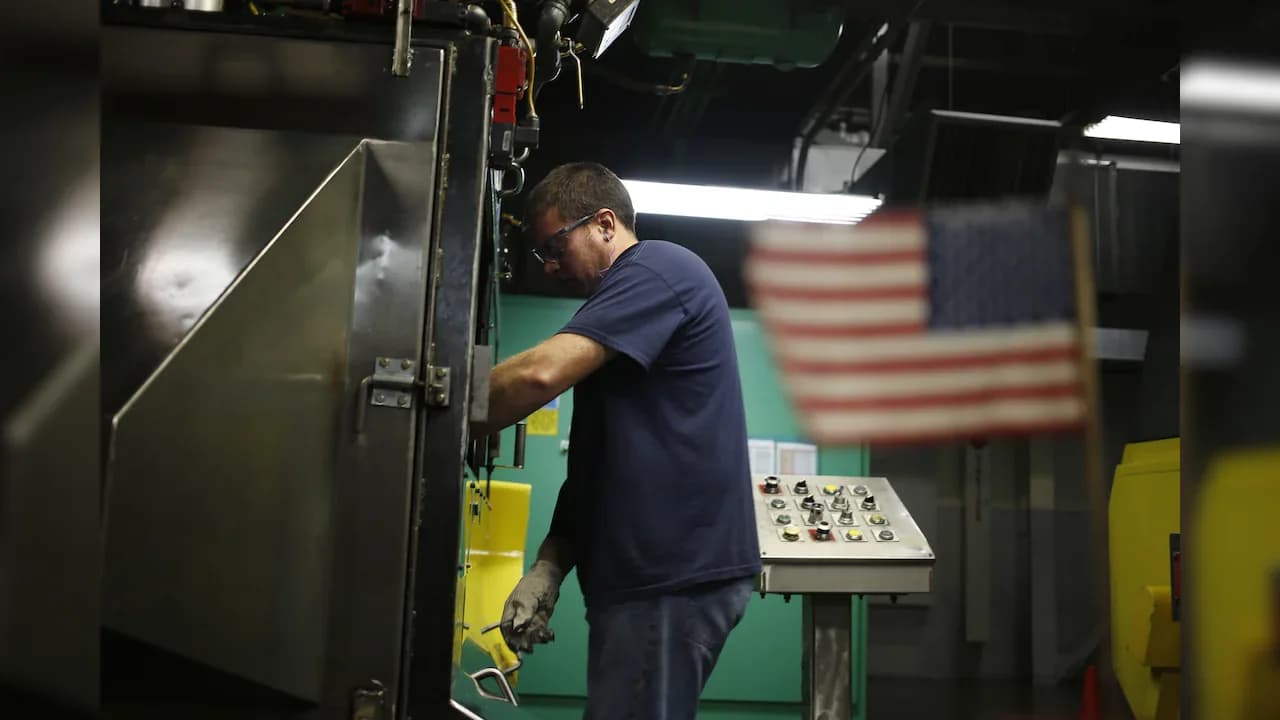
U.S. factory production posted its largest increase in 14 months in April, rising 0.6% after an upwardly revised 0.1% gain in March, according to the Federal Reserve. The manufacturing sector's 0.6% monthly gain significantly exceeded economists' forecasts of a 0.2% rebound, as reported by Reuters. Factory production advanced 1.3% on a year-over-year basis in April, demonstrating strong underlying momentum in the sector. The surge was primarily driven by motor vehicle and parts output jumping 3.7%, while high-technology industries increased 1.0% after rising 0.5% in March, with computers and peripheral equipment up 1.5% for the second consecutive month.
Businesses are rapidly adopting AI technology, investing billions of dollars and helping to prop up manufacturing, which accounts for 9.4% of the economy. AI spending contributed significantly to the economy's 2.0% annualized growth pace in the first quarter, as reported by Reuters. The technology sector benefited from semiconductors and related electronic components rising 1.0% while communications equipment increased 0.6%. Excluding high-technology industries and motor vehicles, manufacturing rose 0.3% in April after a similar gain in March, with durable goods production shooting up 1.2% last month. However, nondurable goods output eased 0.1%, with chemicals falling 0.9% and plastics and rubber products dropping 0.9%.
The U.S. labor market added 251,000 jobs since April 2025, though this growth has been heavily concentrated in a single sector - health care and social assistance. This broader employment growth contrasts sharply with the 0.2% decline in AI-exposed occupations between May 2024 and May 2025, as reported by Business Standard. The latest data shows U.S.-based employers announced 83,387 job cuts in April 2026, marking a 3-month high and a 38% increase from March, highlighting the ongoing challenges in AI-exposed sectors. Excluding the fast-growing category of medical secretaries and assistants tied to the healthcare boom, employment in the other 17 occupations fell 1.6% for the second year in a row.
The U.S.-Israeli conflict with Iran has disrupted shipping in the Strait of Hormuz, raising energy prices and straining global supply chains, causing shortages of a wide range of goods, including fertilizers, aluminum and consumer products. The New York Fed's Empire State Manufacturing Survey showed its measure of general business conditions increased nine points to 19.6 in May, the highest level in more than four years, with new orders and shipments rising considerably for the second straight month. However, the survey's measure of delivery time hit a four-year high while its gauge of supply availability remained negative, suggesting "delivery times were much longer and supply availability worsened," as reported by Reuters. Producer prices increased at their fastest pace in four years in April, with oil prices jumping on Friday after comments from President Trump and Iran's foreign minister dented hopes of a deal to end ship attacks and seizures around the Strait.

Overall industrial production advanced 0.7% after an upwardly revised 0.3% drop in March, with the industrial output previously reported to have declined 0.5%. Capacity utilization for the industrial sector climbed to 76.1% from 75.7% in March, though it remains 3.3 percentage points below its 1972–2025 average. The operating rate for the manufacturing sector increased 0.4 percentage point to 75.8%, which is 2.4 percentage points below its long-run average. Mining output dipped 0.1% last month after declining 1.6% in March, while energy production rebounded 1.0%, though oil and gas well drilling decreased for a second consecutive month. Utilities production increased 1.9%, with gains in both electric and natural gas, after falling 1.4% in March.