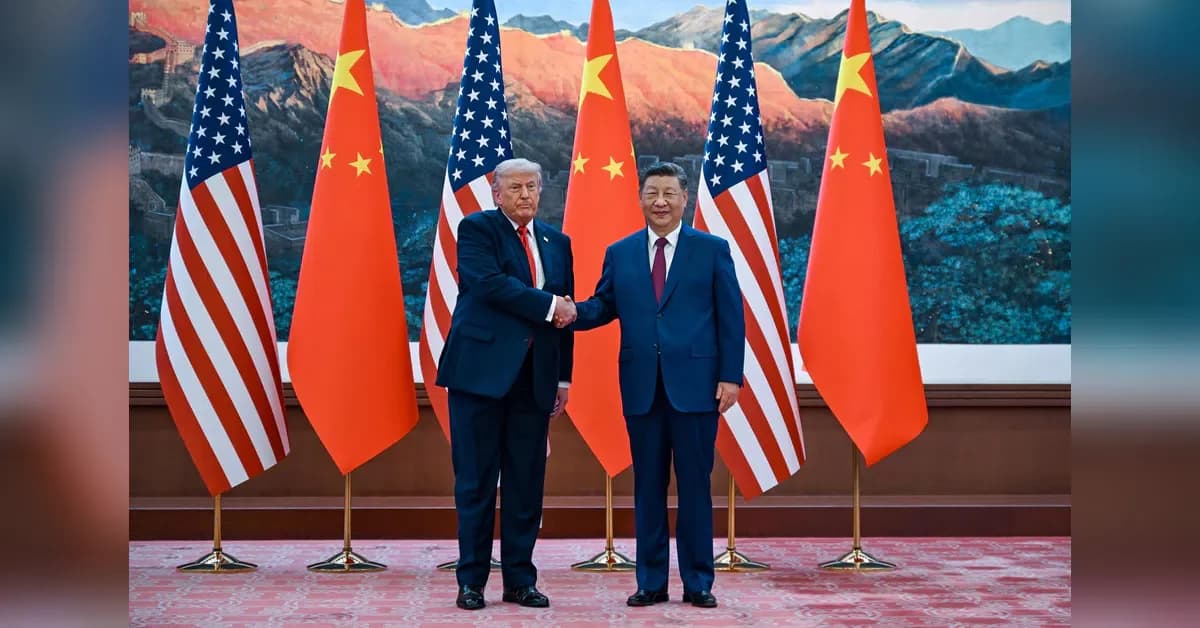
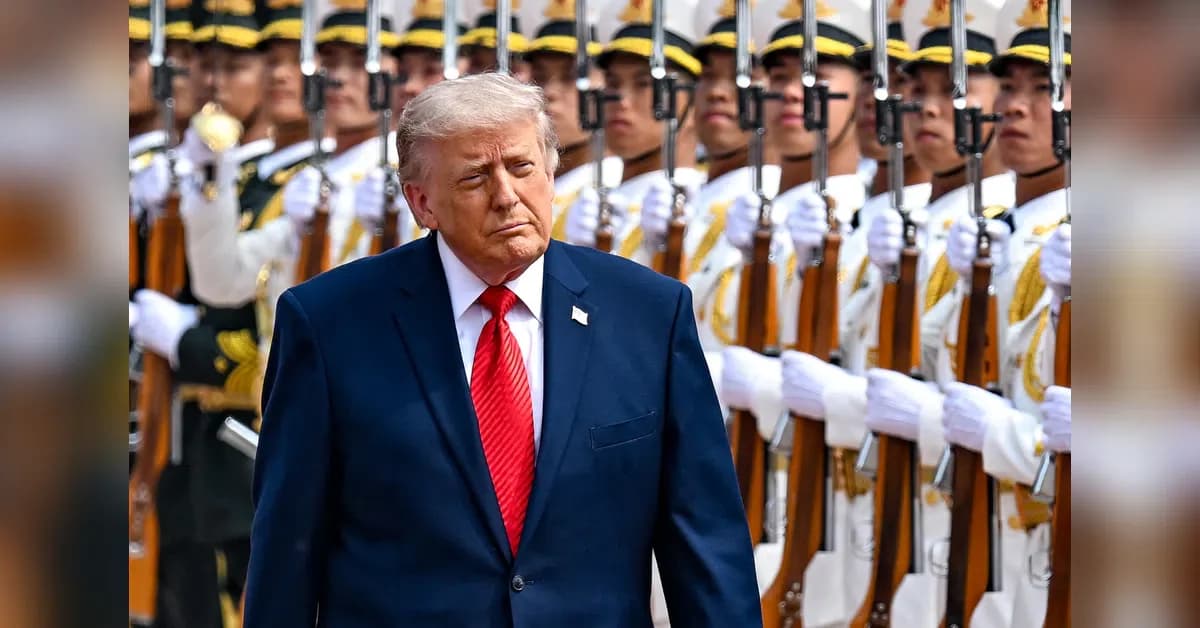
US President Donald Trump left Beijing on Friday ending his three-day visit, during which he held several rounds of talks with his Chinese counterpart Xi Jinping on a host of issues including the Iran war and trade. According to reports from Reuters, before Trump's departure, both leaders had a private meeting at Zhongnanhai, the well-guarded compound in Beijing where top leaders reside. This marked the first visit to China by a US president in nine years, with Trump himself being the last US president to visit China in 2017. The summit was filled with pageantry, from goose-stepping soldiers to tours of a secret garden featuring ancient trees and roses, but behind closed doors, Xi issued a stark warning to Trump that any mishandling of China's top concern, Taiwan, could spiral into conflict. Trump declined to comment on the matter, staying unusually restrained throughout the visit, with his off-the-cuff remarks mainly focused on feting Xi's warmth and stature. As reported by Reuters, Trump told Xi at their final meeting at the Zhongnanhai complex, a former imperial garden housing the offices of Chinese leaders, before their working lunch, "It's been an incredible visit. I think a lot of good has come of it."
Despite the diplomatic engagement, deep differences seem to persist between the two leaders on the issue of Taiwan. As reported by Reuters, during their Thursday talks, Xi warned Trump that mishandling the Taiwan issue could trigger 'clashes and even conflicts' between the two countries, according to Chinese state media. During a huddle with reporters on the way back to the US, Trump said Xi told him he opposed Taiwan's independence, stating "I heard him out. I didn't make a comment...I made no commitment either way," adding that he will decide on a pending arms sale to Taiwan after speaking to Taiwan's President Lai Ching-te. It was unclear if Trump was referring to Taiwan's president, with a direct conversation between a sitting US president and Taiwan's leader being unprecedented in the period since Washington shifted diplomatic recognition to Beijing from Taipei in 1979. U.S. policy on the issue of Taiwan is unchanged as of today, according to Secretary of State Marco Rubio, as reported by NBC News. Taiwan Foreign Minister Lin Chia-lung thanked the U.S. for expressing its support, with analysts noting that "Until now, China hasn't proposed an alternative - now they have - if the U.S. side agrees, that is progress," said Da Wei, director of the Center for International Security and Strategy at Tsinghua University in Beijing. Speaking aboard Air Force One as he left China, Trump revealed that he and Xi had discussed Taiwan and US arms sales to the island "in great detail," stating "I think the last thing we need right now is a war that's 9,500 miles away."
According to a readout of their meeting issued by the White House, Trump invited Xi and his wife to the White House on September 24, as both leaders agreed that the Strait of Hormuz must remain open to support the free flow of energy. During their farewell meeting on Friday, Xi said Trump's visit was a historic and landmark one and the two sides had set the 'new vision' of building a constructive relationship of 'strategic stability'. As reported by Reuters, Xi pushed the new term to describe the relationship as 'constructive strategic stability' – a sharp departure from the framing of 'strategic competition' used by former U.S. President Joe Biden which Beijing disliked. Xi's remarks that mishandling Taiwan could lead to conflict delivered a sharp warning during a summit that otherwise appeared friendly and relaxed. Xi will visit the U.S. in the fall at Trump's invitation, China's Foreign Minister Wang Yi said. Analysts said the new framing was a success for China as for the first time it was Beijing that defined the ties on terms that meant that any major rift or 'unconstructive' behaviour would violate the spirit of the relationship. US Trade Representative Jamieson Greer announced the administration expects China to agree to buy "double-digit billion" worth of agricultural products from the U.S. every year over the next three years as a result of Trump's trip, with China also "reupping" licenses for American beef exports after more than 400 US beef plants had expired over the past year.
A brief U.S. summary of Thursday's talks highlighted what the White House called the leaders' shared desire to reopen the Strait of Hormuz off Iran, and Xi's interest in American oil purchases to pare its dependence on the Middle East. However, just before the leaders met for tea on Friday, China's foreign ministry issued a blunt statement outlining its frustration with the war, stating "This conflict, which should never have happened, has no reason to continue," adding that China supported efforts to reach a peace deal in a war that had disrupted energy supplies and the global economy. At Zhongnanhai, Trump said the leaders had discussed Iran and felt 'very similar', though Xi did not comment. Trump told Fox News that Xi offered to help resolve the conflict and pledged not to provide Iran with military equipment, with Secretary of State Marco Rubio telling NBC News that the U.S. did not ask for China's help resolving the conflict. A readout released by the White House also said the two countries agreed that the Strait of Hormuz must remain open and that Iran can never have a nuclear weapon, with Xi "making clear China's opposition to the militarization of the Strait and any effort to charge a toll for its use." Trump also announced that his Chinese counterpart agreed to purchase 200 Boeing jets, with Boeing shares falling 4% when Trump made the announcement, significantly fewer than the roughly 500 that sources had told Reuters were under discussion. There were no Chinese commitments to do anything specific regarding Iran, as noted by Patricia Kim, a foreign policy fellow at the Brookings Institution. It was notable that there's no Chinese commitment to do anything specific with regards to Iran, Kim said.
Boeing shares fell 4% when Trump announced China would buy 200 Boeing jets, significantly fewer than the roughly 500 that sources had told Reuters were under discussion. Trump later added that the order could go up to 750 planes 'if they do a good job with the 200'. China and the U.S. agreed to establish a Board of Trade and Board of Investment to resolve concerns over market access for agricultural products and expand trade 'under a reciprocal tariff-reduction framework', Wang said according to his ministry statement. The expected move aims to reduce tariffs on non-sensitive goods that can be traded without crossing national security red lines, with both sides expected to identify $30 billion of goods. However, there were scant details of the deals and no signs of a breakthrough on selling Nvidia's advanced H200 AI chips to China, despite CEO Jensen Huang's dramatic addition to the trip. Trump also left without official resolution to the rare earths supply problem that has dogged ties since China imposed export controls on the vital minerals in April 2025. When asked if the two sides extended the truce beyond later this year, Trump said he and Xi 'did not discuss tariffs'. U.S. Trade Representative Jamieson Greer told Bloomberg TV on Friday that such an extension would be 'the most basic benchmark' for the success of the summit, with analysts noting that 'For the market, the summit can be strategically reassuring while underwhelming in substance,' according to Chim Lee, senior analyst at the Economist Intelligence Unit. Unlike on his previous trip in 2017, Trump did not discuss 'structural reforms,' 'global economic governance' or the 'international trading system' with Xi, according to the readout.